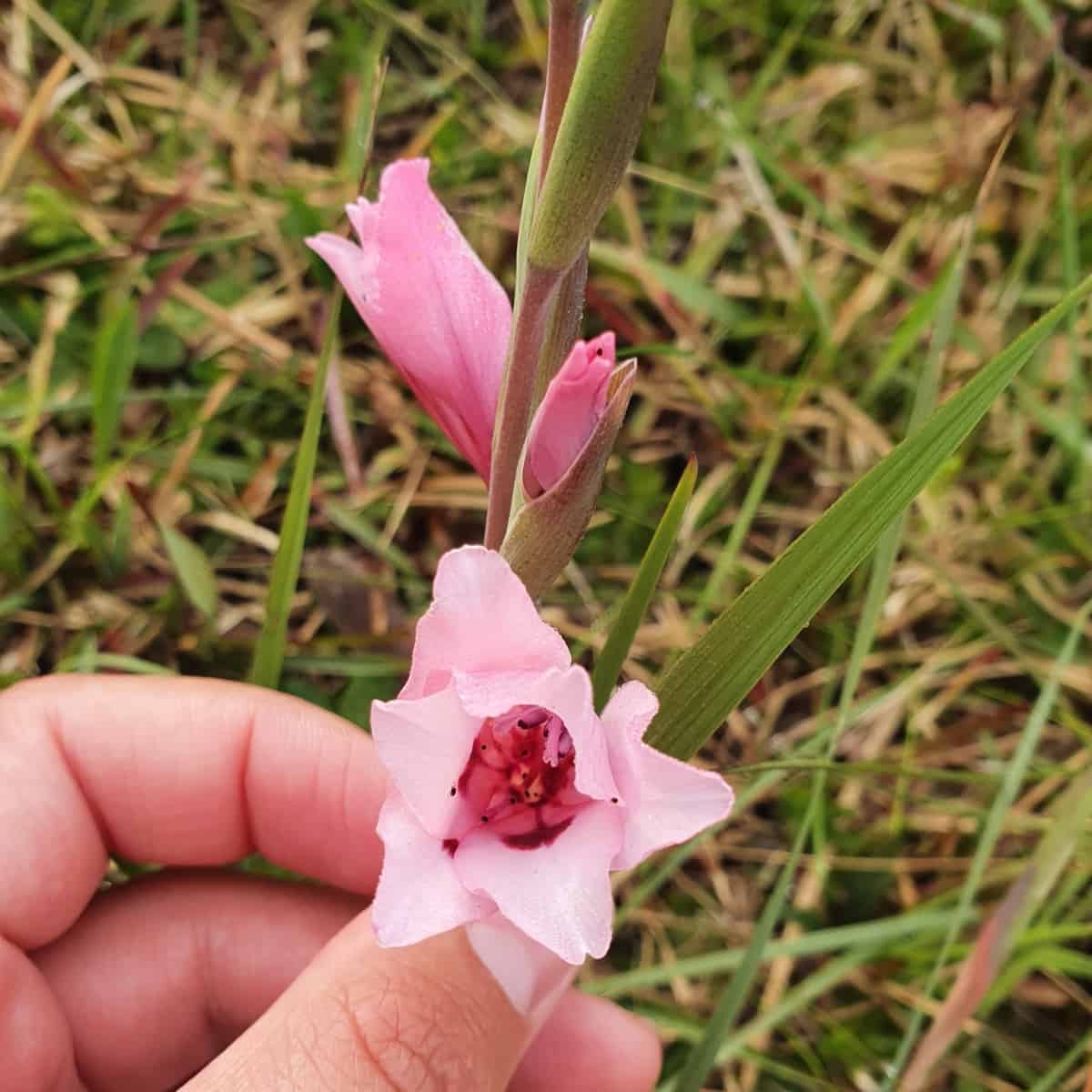



Along the southern tip of South Africa lies the Cape Floristic Region, an ecologically hyperdiverse area that supports over 9000 vascular plant species from 160 genera. One of those species is the magnificent Gladiolus carneus (Iridaceae), which grows in at least seven distinct forms in different parts of the region. A recent paper published in Annals of Botany found that these distinct forms represent true ecotypes, having discrete morphological forms that grow in distinct geographical niches. Khoury et al labelled these seven ecotypes as albidus, blandus, callistus, high-altitude, langeberg, macowanianus and prismatosiphon and found that their pollinators could distinguish between them.
Gladiolus carneus is a perennial plant native to the Cape Floristic Region that stores energy in an underground stem called a corm. According to Khoury et al, this species’ ecotypes are of interest because they grow across a broad geography “from Ceres, south into the Cape peninsula, and east along the Southern Cape coast and then inland into the Langeberg and Outeniqua Mountains” as well as over the “entire elevational gradient of the CFR, with populations occurring from sea level along the rocky Kleinmond coast, up to the high mountain peaks of the South-Western and Southern Cape, >1000 m above sea level”.
“To test whether G. carneus separates into distinct ecotypes based on morphology, we measured morphological traits in a total of 29 populations (eight albidus, one blandus, three callistus, three high-altitude, three langeberg, eight macowanianus and three prismatosiphon,” write Khoury et al. This broad sampling represented “the entirety of the geographical and morphological variation within the species complex.”
Floral traits such as flower number, floral tube length, petal size, flower width, colour, and inflorescence height were measured. Leaf traits such as the total leaf count, width and length of the longest leaf were also measured. These data were then assessed by cluster analysis to determine whether the floral and vegetative measurements would separate the proposed ecotypes into geographical clusters by morphology – and they could. Flowering time also differed between the ecotypes.
Additionally, the Gladiolus carneus populations were visited by a diverse range of pollinators, including solitary bees, carpenter bees, honey bees, long- and medium-tongued flies and lycaenid butterflies. And these pollinators showed specialisation, with each gladiola ecotype having a “single highly effective functional pollinator”, as observed by visitation records kept by Khoury et al. This specialisation coincided with divergent flower colour properties in the ecotypes.
“Using the G. carneus study system, we tested: (1) whether putative ecotypes are morphologically distinct from one another; (2) whether they occupy distinct abiotic, phenological and pollinator niches; and (3) whether differences in these ecological niches result in premating reproductive isolation,” write Khoury et al.
Both the timing of flowering and pollinator specialisation acted as “premating” barriers between the ecotypes. These barriers to reproduction, plus the ecogeographic isolation, were found to block gene flow between the ecotypes, resulting in reproductive isolation.
“The combined effects of ecogeographic, phenological and pollinator-mediated isolation has resulted in near complete premating isolation across the species complex,” write Khoury et al. “These results suggested that niche differentiation, and particularly abiotic factors, might be playing a role in driving incipient speciation within the species complex.”
Khoury et al suggest that these ecotypes might need to be treated as separate taxa, but this will depend on further studies of ‘genetic distinctness’ that measure gene flow between the populations, paired with phylogenomic studies on the ecotypes’ evolutionary relationships. Additionally, reciprocal translocations and garden studies should be done to test whether these ecotypes remain distinct if grown in the same habitat niche.
Regardless of whether the Gladiolus carneus ecotypes are truly separate species and deserve their own names, that which we call a gladiolus, by any other name would be as beautiful.
READ THE ARTICLE
Khoury, K.L., Edwards, S. and Newman, E.L. (2025) “Ecological niche differentiation mediates near complete premating reproductive isolation within the Gladiolus carneus (Iridaceae) species complex,” Annals of Botany, (mcaf172). Available at: https://doi.org/10.1093/aob/mcaf172
Cover image: Gladiolus carneus in South Africa by Corli du Toit Smith, CC-BY