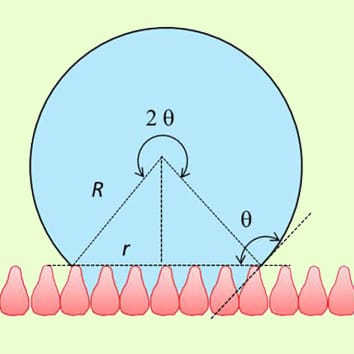


If the surface of a petal remains wet for an excessive amount of time the flower’s attractiveness to floral visitors may be impaired, and adhesion of pathogens may be promoted. Taneda et al. develop a thermodynamic model to predict surface wettability by considering the additive effects of the geometries of the epidermal cells and the structured cuticle. The model indicates that petal wettability depends on the height and interval between cuticular steps, and on a height-to-width ratio for epidermal cells if a thick hydrophobic cuticle layer covers the surface. If the surface is covered with thin cuticle layer, the petal is highly wettable irrespective of the roughness of the surface. These predictions are supported by the measurements of petal wettability made on flowers of seven herbaceous species.