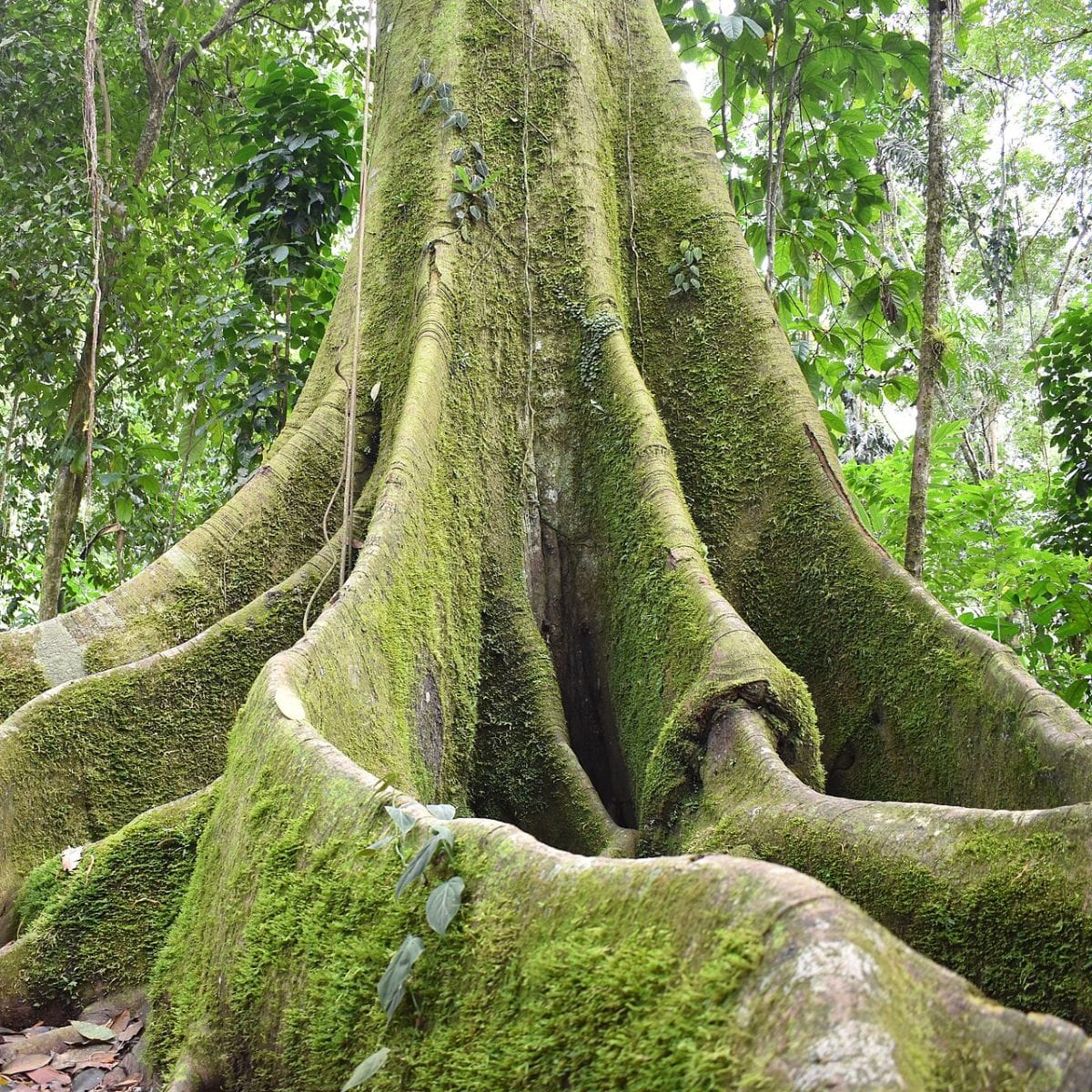


In the forests of Borneo, the spiritual world is tangible; for the Dayak Iban people, it is not a metaphor but a daily fact. Their forests are inhabited by “Antu,” a diversity of supernatural beings that exert their power over the living world. These spirits have a favorite abode: the imposing strangler figs.
For the Iban community located in West Kalimantan, this is a reality that defines their relationship with the forest. In a recent study published in Biotropica, researchers discovered that 94% of the community firmly believes that large figs host supernatural entities that are dangerous if disturbed. Causing damage to one of these trees is committing “menawa,” a profound disrespect. According to the locals, the consequences are dire, ranging from inexplicable illnesses to death.
Among these entities, the “antu grasi” or “hunter ghost” stands out, a spirit deeply rooted in their mythology and the only one they dare to visually depict in the sacred patterns of their woven mats. This entity is not only dangerous when its tree is damaged, it is said to hunt especially during “ujan panas” rain that occurs in hot, bright daylight, at which time villagers must protect themselves by placing a fresh leaf on their heads to avoid being hunted. When night falls, the fear changes shape towards the kalom. Described as humanoid pig-tailed macaque demons, these creatures are known for their unsettling red or yellow eyes and are said to terrorize farmers spending the night in their farmland shelters.
But why this tree? What is it about the strangler fig (Ficus spp.) that attracts such guardians? Botanically, its life cycle is as dramatic as the beliefs surrounding it. It is a keystone species in the rainforest, essential for the survival of countless frugivores.
Its life begins as a seed deposited high on a host tree. It germinates, sending aerial roots down in an act the Iban recognize and call “pinjam” (to borrow). These roots descend, embracing the host until they reach the ground. Then, the fig unleashes its power: its roots thicken, fusing to form a lattice-like trunk that slowly strangles and steals the light from its host. Finally, the fig stands victorious as an independent tree, often with a hollow trunk where its victim rotted away. It is precisely in this stage of dominance, when the fig is large and the host has died, that the Iban believe the spirits claim it as their home.
This is where the research by Ditro Wibisono Wardi Parikesit and his colleagues connects myth with reality. How can a farming community practicing swidden agriculture coexist with such dangerous neighbours in the middle of their farmland?
The research team documented this coexistence through 32 interviews with community members. They discovered that protection is not automatic; the Iban do not cut a tree if they suspect it is inhabited. To know this, they perform rituals to “ask” the invisible entities directly. One method involves embedding an axe in an aerial root and leaving it there for a week; if the axe has fallen to the ground upon return, it is interpreted as an unequivocal sign of spiritual presence, making the tree untouchable.
If it is confirmed that the tree is a spiritual abode, the community implements a land-use strategy called “pulau” (island). They deliberately create a circular protection zone of intact vegetation extending about 10 meters beyond the tree’s canopy, right in the middle of their own farmland.
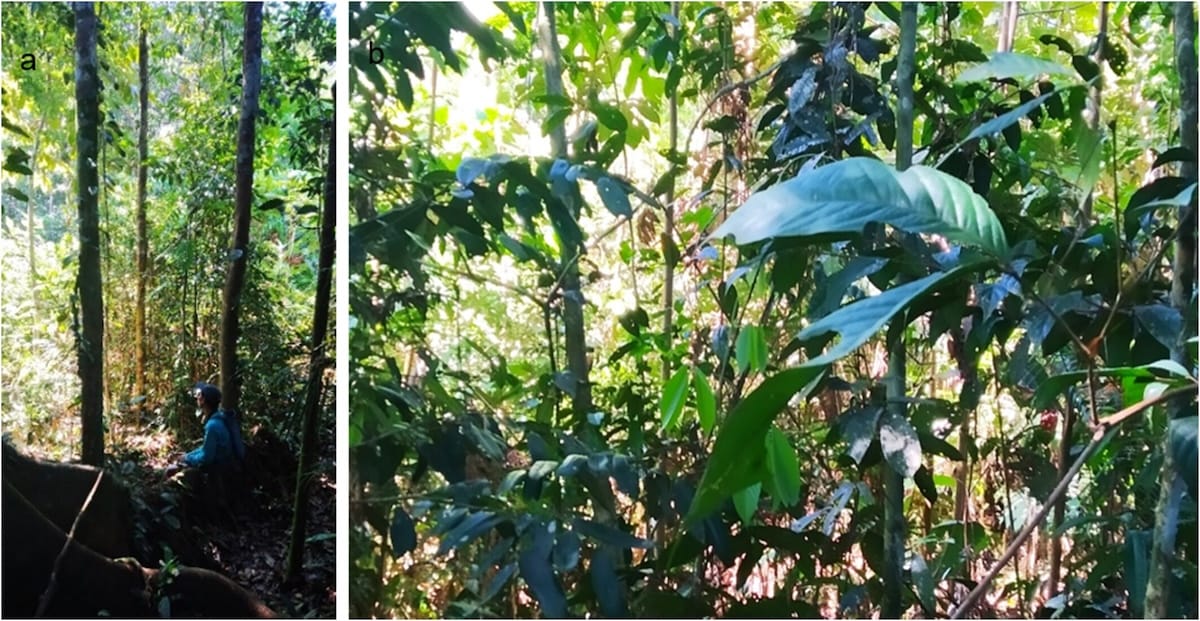
But does this practice have a real impact on conservation? To find out, the research team didn’t just ask; they measured. They established 16 kilometres of transects, 100 meters wide, and meticulously compared the figs in the old-growth forest (“rimba“) with those found in the agricultural mosaic (“damon“).
READ THE ARTICLE:
Parikesit, D. W. W., Hardiyanti, Kurniawan, F. H., & Sheil, D. (2025). Strangler Figs and Their Spirits: How Indigenous Beliefs and Practices Influence an Iban Landscape, West Kalimantan, Indonesia. Biotropica, 57(6), e70089.https://onlinelibrary.wiley.com/doi/10.1111/btp.70089?af=R
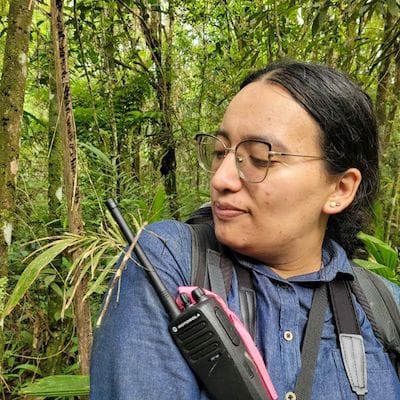
Erika A. Chaves-Diaz
Erika is a Colombian biologist and ecologist passionate about tropical forests, primates, and science communication. She holds a Master’s degree in Ecology and Wildlife Conservation from the Federal University of Minas Gerais (Brazil) and has been part of Ciencia Tropical since 2020—a science communication group that aims to connect people with biodiversity and raise environmental awareness. You can follow her and her team on Instagram at @cienciatropical.
Spanish and Portuguese translation by Erika Alejandra Chaves-Diaz.
Cover picture by Luciepotier (Wikimedia Commons)