

Today we celebrate International Day of Forests with some interesting tree hugging facts and a look at the most huggable trees of 2018!
Record-Breaking Tree Hugging
Last year, history was made on International Day of Forests, when 4,620 people took part in the largest tree hugging event in Thiruvananthapuram, India. The event, titled ‘My Tree, My Life’, aimed to raise awareness in the importance of trees and forests.
The news broadcaster, Asianet News Network Pvt. Ltd., achieved the record by collaborating with Jawaharlal Nehru Tropical Botanic Garden and Research Institute (JNTBGRI) and inviting the people to participate in the event.
In order to set the record, the tree huggers had to embrace their tree for a minimum of 60 seconds and embrace the tree with their arms spread fully.
The ‘My Tree, My Life’ event conquered the previous tree hugging record of 1,316 people! However, tree huggers never stand still (except when they are actually tree hugging) and another attempt in December 2017 will have set a new record of ten thousand huggers if it is ratified.
The historic origins of the ‘Tree Huggers’
Back in 1730, 294 men and 69 women from the Bishnois branch of Hinduism, used the physical act of hugging trees as a means of peaceful protest against foresters. The group were trying to prevent khejri trees from being cut down and used to build a palace. This act led to the protesters losing their lives to the cause, but their demonstration did not go unnoticed. Their efforts led to a royal decree that outlawed the felling of trees in Bishnoi villages and brought about the term “tree-hugger”.
The Bishnois movement is also famous for inspiring the Chipko (meaning “to cling”) movement in India, which began with a protest in the 1970s. In the state of Uttar Pradesh, a group of peasant women risked their lives by clinging to trees in the hope of preventing deforestation. This practice of non-violent protest became known as “tree satyagraha” and spread rapidly across India, resulting in the formation of the Chipko movement. The movement has since inspired a number of environmental and non-violent protests worldwide.
Tree Hugging is Cool
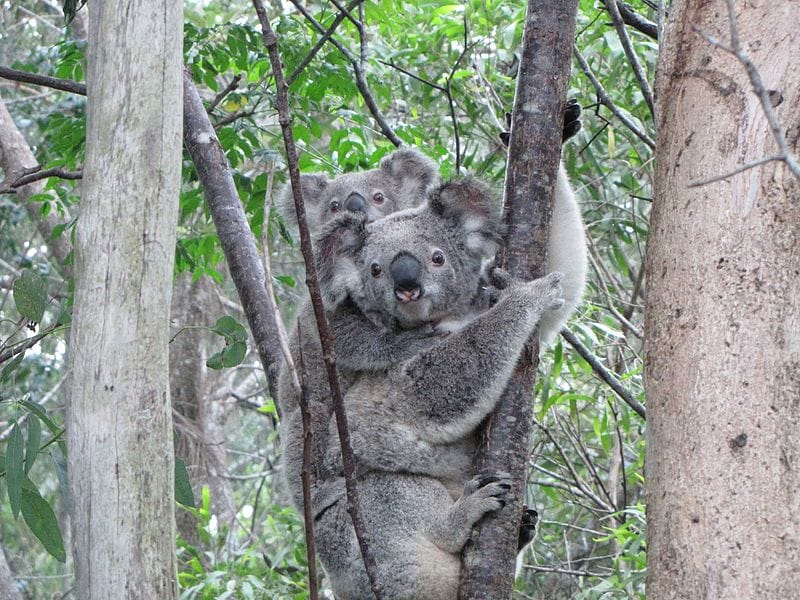
Many species of the animal kingdom are well-known for their tree-hugging nature, such as the Sloth, Giant Panda and Orangutan. A research study in 2014 found that one of the most iconic tree hugging animals, the koala, does so for more reasons than once thought.
Koalas hug trees to stay cool. Koalas get the majority of their water from their diet of eucalyptus leaves. This allows them to live high up in the trees, away from predation. Similar to dogs and kangaroos, koalas do not sweat. For them, hugging trees is a great way of keeping cool without losing water through panting.
Infrared cameras showed in hot weather, koalas tended to hug tree trunks that were cooler than the surrounding air. This might be because the trees are cooler due to heat exchange complexes, such as the heat exchange between the tree surface and its surrounding environment and the water flow within the trunk. In higher temperatures, koalas also spread their bodies to increase surface area for the transfer of heat and could cool themselves down by as much as 68%.

So, on the next sweltering hot summers day, be more koala and hug a tree!
Most Huggable Trees of 2018
If in 2018, you want to be more Koala, choose your tree wisely. Look out for these especially huggable trees but, keep in mind, not all plants are equally as huggable.
Your Tallest Friend
Redwoods are a type of conifer and grow to heights that make them the tallest trees in the world. They can tower at heights of over 300ft and live for over 2,000 years.
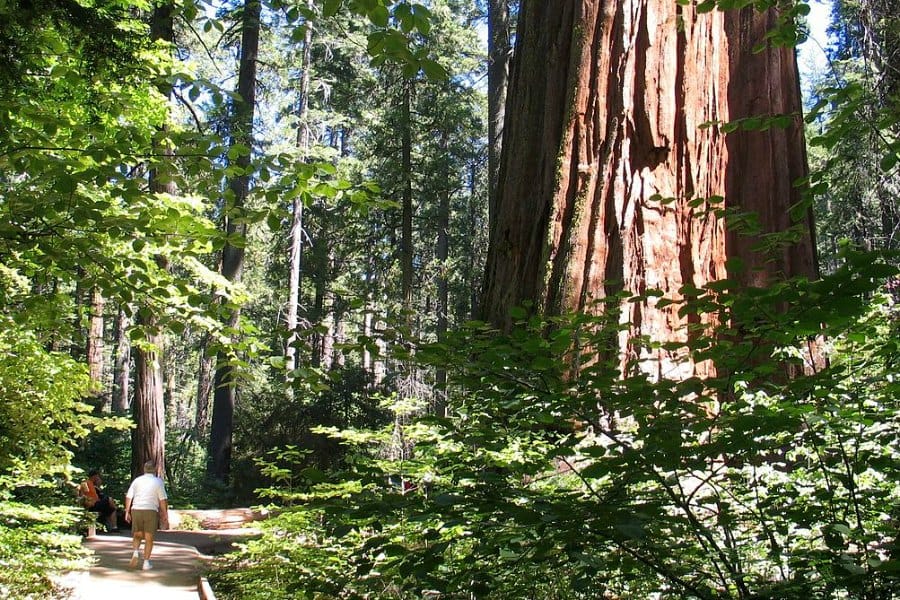
Redwoods are also known for their incredibly soft bark, perfect for all your hugging needs, and if you are someone who likes to distribute hugs based on evidence: California’s ancient redwood forests remove a vast amount of carbon dioxide in our atmosphere. A study carried out by researchers from Humboldt State and the University of Washington found that the Californian redwood forests capture and store more atmospheric carbon per acre than any other forests worldwide.
Show them the love and give them a hug!
Huggable Rating: 8/10
The Human Beech Tree
This human-shaped beech tree stands at 65 ft tall in the depths of the Balkan Mountains in Bulgaria. This woody companion has been compared to the heroic, vegetative beast from the Lord of the Rings, Treebeard. Although this tree cannot walk and talk like Treebeard, the shape of its massive branches make it look like it’s holding its arms open wide to invite hugs.
If you are a giant, you can go in for the full-sized hug. Otherwise, you will have to stick to hugging one of its human-like legs.
Huggable Rating: 7.5/10
Árbol del Tule and the African Baobabs
Looking to do a spot of tree hugging with your family and friends?
Currently, the tree with the greatest girth (circumference) in the world is a Montezuma cypress (Taxodium mucronatum), located in Oaxaca state, Mexico. The tree, known as Árbol del Tule (Tule tree), stands at a height of 35.4m and has a girth of 36.2m, at 1.5m above ground level.
That’s a lot of tree to go around! In fact, if you take the average arm span of an adult as 1.5m, you could be enjoying a woody embrace with 25 tree-loving friends!
Huggable Rating: 7/10
There are other perfect trees for your group hugging adventures, such as the African Baobabs, also known as the “Trees of Life”.
These trees can grow up to an enormous 50 m in circumference and they use their vast trunks to store water after the wet season. This allows baobabs to produce nutrient-rich fruits in the dry season.
Baobabs are also regarded in some communities as a symbol of life and positivity. Embrace this tree to embrace positivity!
Huggable Rating: 9/10
The Deadly Manchineel Tree
This is a tree you definitely want to keep off your hugging list. The manchineel tree, also known in Spain as the ‘manzanilla de la muerte’ meaning ‘little apple of death’, is one of the most dangerous trees in the world.
The tree is native to areas such as Central America and the Caribbean and belongs to the spurge family. To the naked eye, the manchineel tree could be mistaken for a typical apple tree with its small green-yellow fruits and leaves. However, this tree is hiding a deadly secret behind its mask of innocence.
The potentially inviting-looking fruit of the manchineel tree is extremely toxic and can even be fatal if ingested - not the sort of fruit you would want to mistake as a tasty snack. But there’s more!
You shouldn’t touch or even stand near a manchineel tree. The milky white sap, found in all parts of the tree, including the bark and leaves, is extraordinarily toxic. The sap contains phorbol and other skin irritants, which are so strong they can damage the paint on cars! Physical contact with manchineel tree sap can cause burn-like blisters on the skin and temporary blindness if it enters the eyes. This tree shouldn’t ever be used as protection from the rain because, even when diluted, the milky substance can have devastating, blistering effects.
Oh, and don’t breathe near this tree. Inhaling the air around a manchineel tree can be fatal.
Basically, avoid this extraordinarily deadly tree at any cost. For this reason, the manchineel tree does not even deserve a huggable rating, it’s just a no go! Unless you’re a black-spined iguana who can eat the fruit and live amongst the branches with no consequence.
Huggable Rating: Never
What’s that smell?
There are a number of trees that should be avoided due to their putrid smell, such as the maidenhair trees (Ginkgo biloba) native to China.
The smell produced by the fallen fruits of female maidenhair trees has been compared to that of rotting eggs and vomit, which is not exactly desirable when getting up close and personal with a tree.
Not only does this tree smell dreadful, it also creates an unpleasant sticky mess when the fruit drops to the ground. Hugging might be useful if you need to get out of a work meeting, but otherwise, to be avoided.
Huggable Rating: -5/10
Fancy doing a spot of tree-hugging yourself? Every day is a good day for a fond embrace with our inanimate friends, but when better than today? As it's International Day of Forests, we recommend celebrating the day by having a cuddle with your favourite and most huggable tree! The fewer spikes, the better.
If you reckon we’ve missed out a very huggable tree from our list, feel free to comment on our post to share your tree hugging expertise with the world.
Get out there and get hugging!