

Have you ever wanted to be an intrepid explorer wandering the world to identify species? Good news – the Royal Ontario Museum (ROM) of Canada officially invites you to join a crowdsourcing expedition from the comfort of your own home. Citizen scientists (and professional ones too) are needed to help digitize the ROM botanical collection and piece together our shared natural history.
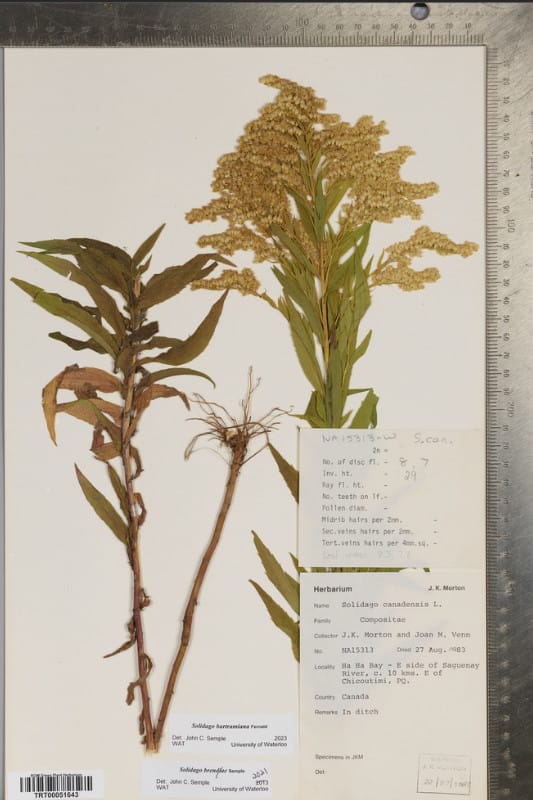
The initiative launched in February as “Notes From Nature - Natural History at ROM Revealed” with 500 plant specimens – a small fraction of the 370,000 botanical specimens kept in the collection. Each of these specimens is a snapshot in time, carefully preserved with a name, location, and history, but less than a third of the collection is easily searchable because all the notes are handwritten onto specimen labels. The ROM wants to digitize their collection so that it is accessible to all.
“Natural history collections are libraries of life. This is what we curate and keep here. It’s for all people, for the whole world, in perpetuity,” said Simona Margaritescu, a collections specialist at the ROM, when interviewed. “But, like any other museum, we have a lot of dark data. A lot of information has not been entered in any virtual type of format. We have ledgers, we have labels, but everything is analogue.”
This is now changing rapidly with the help of virtual volunteers, people like you, who work to transcribe data from photographs, one specimen at a time. Amazingly, the 500-specimen pilot project was done in just five days, delighting ROM curators.
“We're actually over the moon with it,” said Margaritescu, who is optimistic that with continued public help “in about five years, we should have almost all of the really important specimens digitized, in the database and searchable.”
To accomplish this goal, ROM curators continue to add new ‘expeditions’ for the public as each is completed.
Expeditions focus on a single plant genus or family. Virtual volunteers digitally transcribe a specific part of a botanical specimen’s label, as seen in a photograph, into an entry form on the Notes From Nature platform hosted by Zooniverse. For example, some people might only provide the scientific Latin name and maybe the collector data. Other people who are more interested in geography can choose an expedition to transcribe where and when a specimen was collected.
In this way, the label is provided to the public three times, with three different people transcribing the same kind of information. This built-in redundancy provides a buffer for error.
As each expedition is completed, Notes from Nature send the raw data and a consolidated spreadsheet to ROM curators, who check the information and upload it into ROM and public databases.
“All our collections are later uploaded in GBIF [Global Biodiversity Information Facility],” said Margaritescu. “So they become an open source. They become available to all scientists and all people all over the world, which is, I think, amazing.”
In this way, anyone can use the information to learn about natural history and can compare the ROM’s data to other accessible archives. This opening of the archives is a big, and very recent, shift in mentality for the world's museum and university collections.
Previously, explained Margaritescu, institutions thought that information was power and everybody guarded their secrets. They did not collaborate, or perhaps conditionally collaborated. Now, there is a global push to take a more open approach.
“I think we're understanding that all these things belong to everybody and the best way to make use of them is actually to make that information available to the world in any shape and format both for scientists and also for the public,” said Margaritescu.
By digitizing the ROM’s specimens, the public will gain access to a botanical collection that is extremely large, both geographically and taxonomically, with 700,000 specimens from every plant family, including vascular plants, bryophytes and even algae.
Like other herbaria, the oldest ROM specimens are from the 1850s/60s because that's when collections of this kind started. For historical reasons, the ROM collection is richer in North American species, particularly those found in Ontario, Canada, where the ROM is located. But thanks to specimen exchanges in the 1950s/60s, the collection also includes diverse species from Africa, Australia and Asia.
“Some of these collections were done by our own scientists, or people like students doing their PhDs and being affiliated with either University of Toronto or the ROM. Other specimens were obtained through exchange,” says Margaritescu.
Now, with new technology and partnerships, it is possible to truly democratize access to herbaria around the world by digitizing the collections.
“Digitization through crowdsourcing was on our mind for a long time,” says Margaritescu. “Deborah Metsger (Assistant Curator for Botany at the ROM), began mulling the idea of digitization about 15 years ago, but technology and know-how was not available at the time.”
Then a couple of years ago, Brad Hubley, a ROM collections specialist for insects and arachnids, took a course on digitization through We Dig Bio and heard about the Notes From Nature initiative. Hubley saw the opportunity and instigated a pilot project using virtual volunteers to transcribe label data from a small group of 700 ladybugs in the ROM collection. To the amazement of the ROM team, all 700 specimen labels were completely transcribed within two weeks.
For Margaritescu, this really emphasized how impactful public engagement can be.
“People are so enthusiastic. I see that even in the tours we give. They really want to know more about these things. And maybe they didn't have a chance to study them, or maybe when they should have studied them, they didn't think they were cool,” said Margaritescu.
And now, anyone interested can participate in a specimen expedition regardless of experience and expertise. If you have five minutes, 10 minutes, or even an hour – you can help unlock the secrets contained in the ROM's living library.
“I think it's a fantastic way to bring science to everybody in a very playful way,” says Margaritescu. “Rather than maybe play a game, you play this game, that is also useful at the end. It's not just for you, but for everybody.”
She encourages everyone to “plug in all your enthusiasm and try a few.”
Future crowdsourcing expeditions will include some of the 10,000 lichens in the ROM collection in addition to plants. The ROM is also asking for public help in digitizing their fungal and insect collections.
With the world at your fingertips, which expedition will you choose?
Simona Margaritescu, Collections Specialist at the Royal Ontario Museum, has the following tips for getting the best data possible during digitization:
1. Even if you have a high level of botanical education, please do not try to guess what's on the label. Just transcribe what’s written as closely as possible. If there are questions about a word or even a few letters, it's better to put a question mark which will flag it for the review team, rather than guess.
2. Please read the ‘How to’ instructions and follow the tutorial on how to transcribe various parts of the label. It’s tempting to jump right in, but there are some important instructions to follow to help the process go smoothly.
3. If you have questions, ask! There is a discussion forum exactly for that purpose and ROM team members monitor the discussion board and will answer.
4. If you're consistent in a certain expedition, then you'll become more and more familiar with the terms or with the handwriting and you'll become more confident in transcribing the label.
5. Transcribe the most up-to-date label in the photograph and write the details for any given field in full.
6. Have fun! And don't worry about making a mistake. There are two other people transcribing the same data and the ROM collection specialists will look it over too.
The cost of the program is supported by external grants and ROM funds. Specimen photographs were obtained by extensive volunteer work and benefactor-funded internships.
To learn more or participate visit: Notes From Nature - Natural History at ROM Revealed