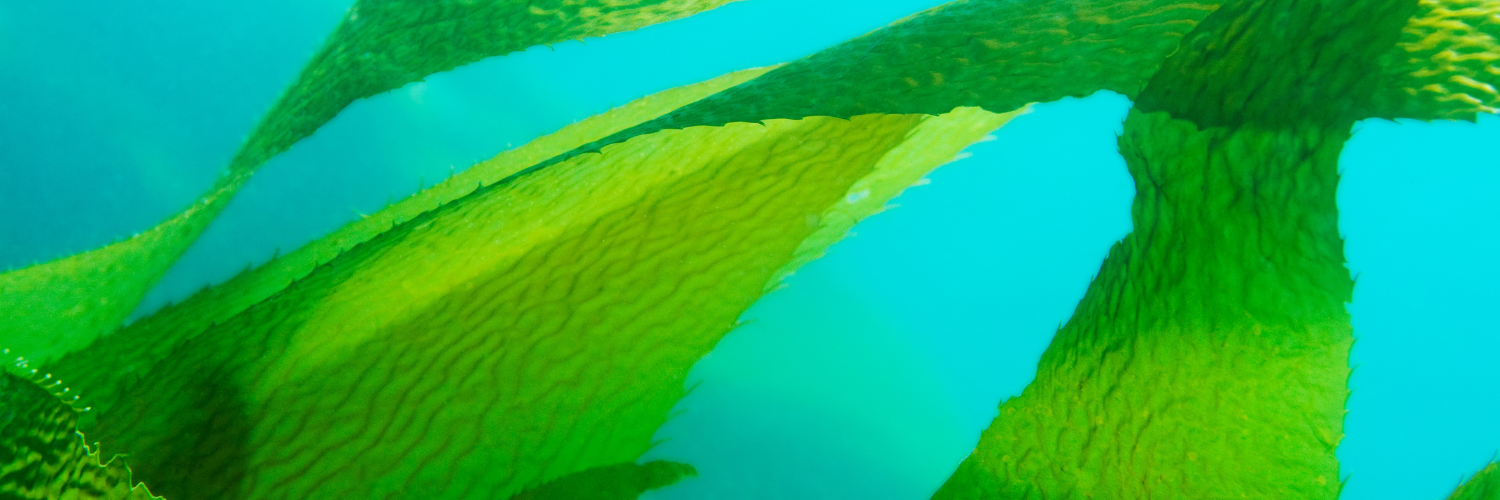


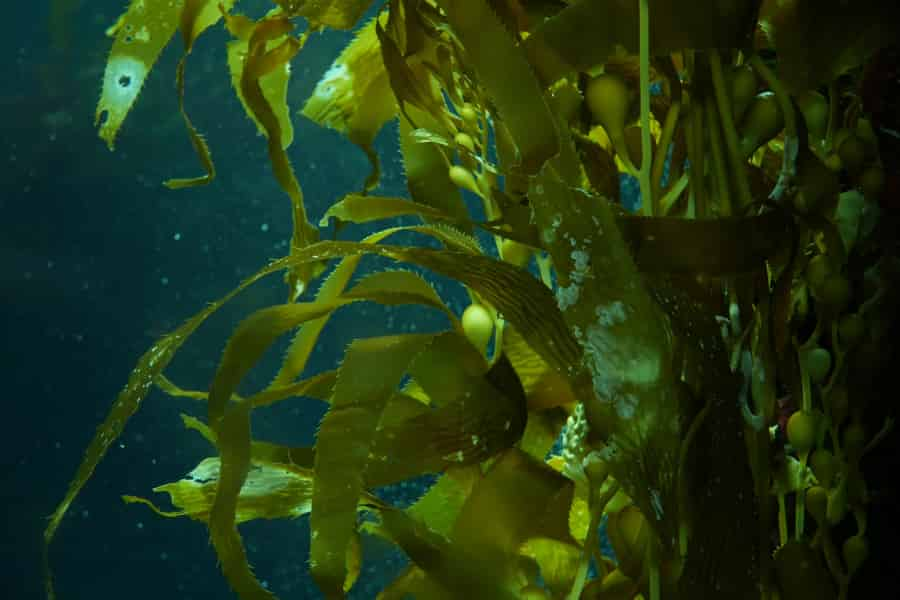
Waves play an important role in coastal ecology and can contribute to shoreline erosion. Giant kelp, such as Macrocystis pyrifera, strongly interact with surface gravity waves, which are the typical sea swells we think of in ocean waters. Scientists have wondered to what extent this common macroalgae can damp waves and therefore prevent coastal erosion.
To answer this question, Elsmore et al. went to Marguerite Reef off the coast of Palos Verdes, California. This coastal area is undergoing kelp forest restoration after severe overgrazing by the purple urchin Strongylocentrotus purpuratus and presents a unique opportunity to measure the effect of kelp forests on wave attenuation.
Wave height, wavelength and frequency all contribute to the energy and velocity of wave travel and these attributes can be affected by seafloor properties as well as by large living organisms such as Macrocystis pyrifera. In Marguerite Reef, Elsmore and colleagues were able to collect wave measurements in the absence and presence of kelp at the same ocean site, allowing them to separate out the effects of the kelp from the physical properties of the seafloor.
After removal of the urchins, Elsmore et al. measured kelp forest regrowth over time in eight evenly spaced areas of the reef. Kelp individuals were counted to estimate forest density with areas classified as having ‘No Kelp’, ‘Transition’ and ‘Kelp’. They then measured the total wave energy in each of these zones to determine whether the kelp contributes to a loss of wave energy as the wave approaches shore. Elsmore et al. found that Macrocystis pyrifera specifically decreases wave energy flux for longer period waves.
But can Macrocystis pyrifera be used to prevent or reverse coastal erosion in eco-restoration projects? Unfortunately, this macroalgae’s effect on waves is small relative to other species of kelp that have stiffer support structures. Therefore, Macrocystis pyrifera is unlikely to make a large impact on coastal erosion.
These findings reinforce and confirm previous work, conducted without the advantage of an explicit no-kelp–with-kelp experimental design, suggesting limited potential for wave attenuation by giant kelp. Benefits of M. pyrifera forests for shoreline protection therefore appear modest, other valuable features of such forests notwithstanding.
Elsmore et al. 2024
Those valuable features include acting as a marine foundation species that provides structural habitat for over 800 species, effects on seawater chemistry and the ability to slow ocean currents. Macrocystis pyrifera is the most widespread canopy-forming kelp in US coastal waters.
READ THE ARTICLE
Elsmore, K., Nickols, K. J., Miller, L. P., Ford, T., Denny, M. W., & Gaylord, B. (2024). Wave damping by giant kelp, Macrocystis pyrifera. Annals of Botany, 133(1), 29–40. https://doi.org/10.1093/aob/mcad094