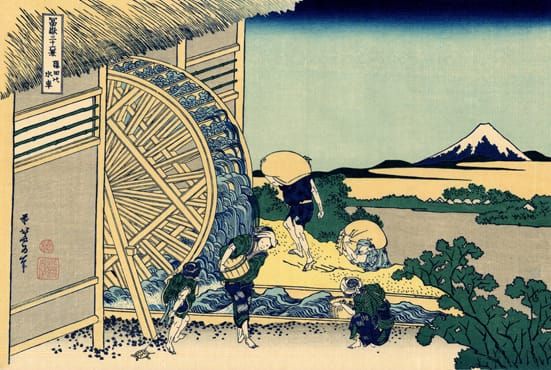

Image: Katsushika Hokusai, Watermill at Onden (1826–1833).
Rice, or strictly speaking the hulls, has been proposed as a substitute for perlite – itself a substitute for soil in plant cultivation (http://en.wikipedia.org/wiki/Perlite) – by Christophe Currey et al. (HortTechnology 20: 863–866, 2010). Quests for organic alternatives to perlite have often faltered because they compromise the effectiveness of PGRs (plant growth retardants) such as paclobutrazol and uniconazole. The PGRs are supplied during watering (‘drenching’) to ensure uniform plant growth, but some perlite-substitutes appear to decrease their effectiveness. Although this is not the first work to demonstrate use of rice hulls as a soil-substitute, it does establish that this material does not reduce PGR ‘drench efficiency’. This finding is also good news because it vindicates a use for a waste product, which is otherwise burnt (http://www.purdue.edu/newsroom/research/2010/101025LopezHulls.html). Teaching point (mainly for students): PGRs (in the sense used here) should not to be confused with PGRs (plant growth regulators, aka phytohormones – http://en.wikipedia.org/wiki/Plant_growth_regulators), and clearly demonstrates the need to define abbreviations carefully on first mention. It is also noteworthy that other sources that covered this story (e.g. http://www.physorg.com/news/2010-10-rice-hulls-sustainable-drainage-option.html) reported the PGRs as plant growth regulators.