


I was driving to a wedding on Saturday, when bananas came up as a topic on the Rhod Gilbert show. The question came up, would putting a banana in bag with an avocado help it ripen? It’s frustrating because it’s one of the few questions he asks that I know the answer to. Listeners were able to help with Huw in Bridgend supplying the information that bananas give off ethene or ethylene, and this causes the avocado to ripen.
Rhod then went on to ask if a banana can accelerate the life of an avocado, could it do that to anything? If you had twins and you put one in a room full of bananas, would she age faster than the twin outside the room? No, but the reason why not is interesting.
If you think bananas make other things ripen by a simple chemical reaction, then it’s reasonable to ask what the effect of filling a room with bananas is. What is surprising about ethylene is how little you need to ripen a fruit. Fruit can ripen when there is a concentration under one part in ten million.
That’s a freakishly low concentration, but it’s not ethylene that directly attacks the fruit. It’s a plant hormone, so it’s something cells use to signal to how they should grow or die. Cells all over a plant can produce it as a means of telling the other cells what’s going on. It’s still odd that a banana ripening could affect an avocado, but ethylene is a very simple chemical and it is used a lot by all kinds of plants.
The fact that ethylene from one plant can affect another means that detecting it is important, but with concentrations being so low, it’s also a challenge. A review in Annals of Botany in 2013 found there was no perfect solution.
Toward the end of the programme another listener sent a message that ethylene can also affect flowers, and the presenters were sceptical. In fact it’s surprising what ethylene is used for by plants. For example, when a shoot is blocked from growing, ethylene can inhibit the elongation of cells, instead causing them to grow wider and stems to thicken to give more push against an obstruction.
It plays a role in leaf abscission, effectively controlling the timing of when leaves fall off. It also effects germination and root formation, among other things. Given the sheer number of things ethylene can do, in some ways it’s a bit of a surprise bananas don’t age people. At least they don’t with ethylene.
There is another feature of bananas. They’re radioactive. Quite a lot of fruit and vegetables are because they have potassium, some of which is naturally radioactive, but bananas come to mind because of the Banana Equivalent Dose.
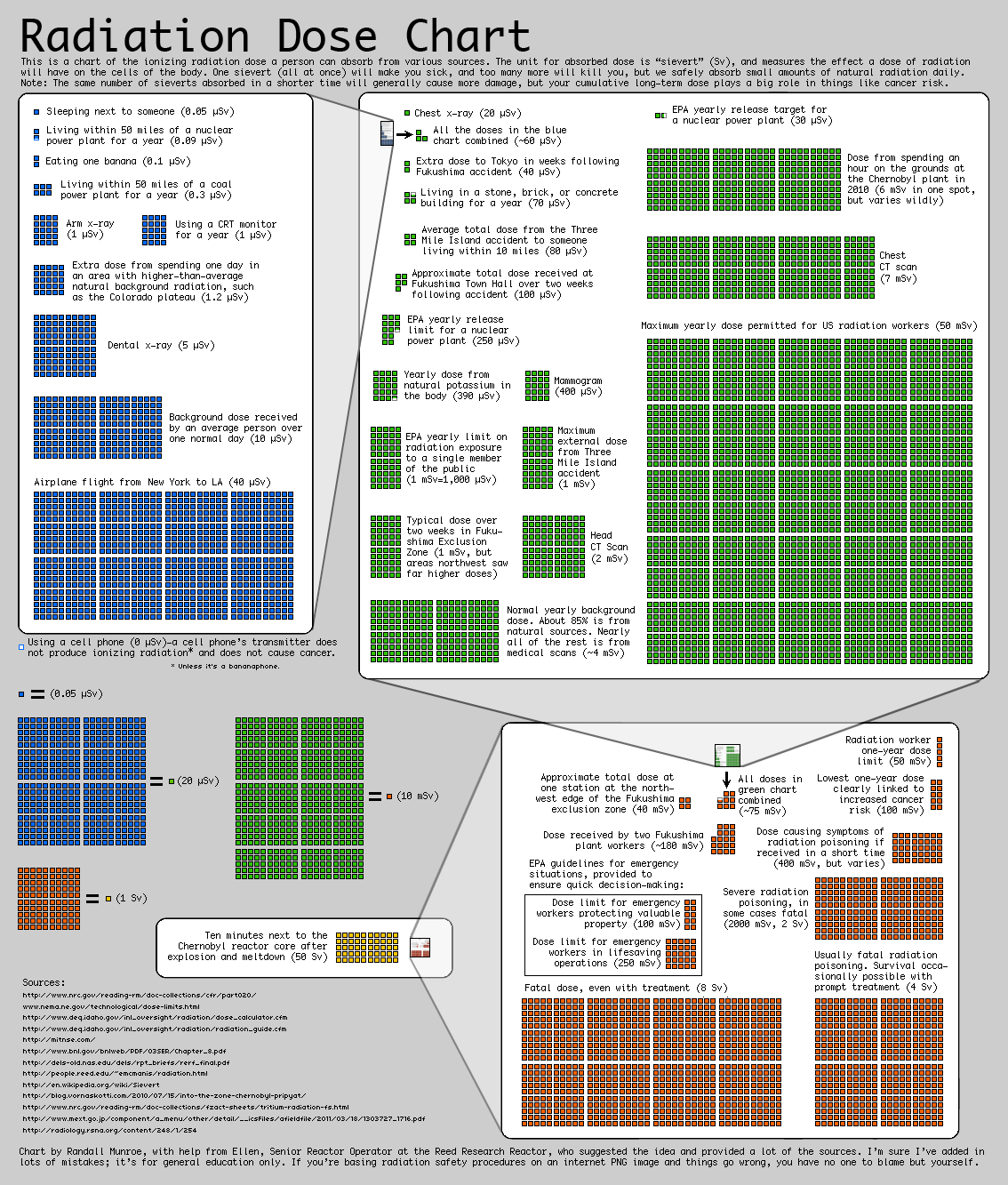
The Banana Equivalent Dose is a way of thinking about the effects of low-level radiation. Eating a banana gives you a dose of 0.1 μSv. In reality it doesn’t work to take this too seriously because the effects of long-term exposure are different to acute exposure. A dose of 4 Sv is usually fatal so if someone were to put (4 000 000 / 0.1 =) 40 million bananas into you instantly then you have a would be a fatal dose, though it’s likely you’d have died from other problems before that.