


EDIT:This post was written at the symposium as it happened. It has now been edited to correct some errors made while working rapidly, fix links, and add tweets from other people at the symposium.
We opened with Alexandre Antonelli, the new science director at Kew, talking about his work with Cinchona. The story of Cinchona starts with Loxa, in Ecuador where the ‘fever tree’, a tree with cinnamon coloured bark. First recorded in 1861, Europeans started collecting seeds, but it turns out there are many species of Cinchona. This matters as not all trees are equal. Antonelli has been working with Nina Rønsted and others and found that the yield of quinine in Cinchona bark varies with phylogeny. The team works to correlate environment and genotype with quinine production.
Antonelli has found that the native peoples have found the Cinchona with the best metabolites for fighting malaria. It underlines the importance of indigenous knowledge. Allied to modern genomics you can find what it is that makes Cinchona so effective at fighting malaria.
Historic collections from @KewScience complement new wild collections from across South America in the quest to find the species with the highest concentration of quinine! #PPP19pic.twitter.com/F2W0AsBP6c
An interesting question that came up is that malaria didn’t come to the New World till European colonisation. So what were native people using the Cinchona tree for? It’s hard to say. Antonelli pointed out that native peoples saw it as a ‘fever tree’ and that it could have been used for other fevers, but it’s not known which one. Again, this is an argument for preserving indigenous knowledge.
Dawn Sanders followed on from her paper in PPP. It’s a call for an interdisciplinary approach to understanding plants. For her, Time is an issue. To what extent to humans share plant time? Do these temporal differences have an effect on our relationship?
She moved on to the question of where ‘we’ end and ‘it’, nature begins. It connects to a reference she made earlier to Aloi’s article on Milan Palm controversy of 2017. One night in February, Starbucks Coffee, in collaboration with Italian architect Marco Bay, installed a grove of palm and banana trees opposite Milan’s cathedral. Some people hated it, with the palms and bananas denounced as unItalian.
‘Art as a way of thinking’ is something Sanders explored. I’m probably the worst person in the room to respond to this. I’m intellectually aware of an Arts/Science divide, but don’t live it, so it’s all a bit foreign to me. Or maybe I’m just not aware I live it, so I’m blind to it. A challenging quote from forthcoming work Sanders has is: Perhaps, more than anything, the artists created spaces in which to linger with questions of identity concerning characteristics of ‘plantness’. My reaction is that ‘plantness’ seems a very human term. We don’t have a similar block-level categorisation of ‘animals’. Some people don’t even recognise fish or insects as animals.
Language is very important in Sanders’s work. She referred to a podcast, where people asked questions like: “Can I have plants in my bedroom?” A key element here is the undercurrent, I’d like to have a relationship with plants.
She closed with a very good question: Where are the plants in the sociology of climate change? If your reaction is sociology is a human, not plant realm, then the special issue of PPP that Sanders guest-edited is well worth a look. For example, are plants just background for human action? Weilenmann and Hillman look at selfies from the point of view of action rather than product. What are people doing when they use ‘the wild’ as a background to a selfie? While the genre refers to the self, the act of taking the image is a matter of placing yourself in context with a locality. It’s rare that selfies contain a blank background.
Another example of plants as cultural expression is covered by Sachdev. She looks at the use of plants imagery in street art and artefacts in urban India. The religious background of India, in particular the symbolism of some plants in Hinduism, uses plants to give meanings to art and artefacts.
In her paper, Dawn Sanders concludes: “In an era characterised by anthropogenic change the terms by which we define a lack of human attention to plants have, I believe, become secondary. In sharper focus are the diverse inquiry processes by which we might better comprehend, as researchers, these “botanical horizons” between human and plant/plant and human.” and highlights the need for an interdisciplinary approach. If you’re comfortable with the certainties of one discipline, then inter-disciplinary work can be difficult.
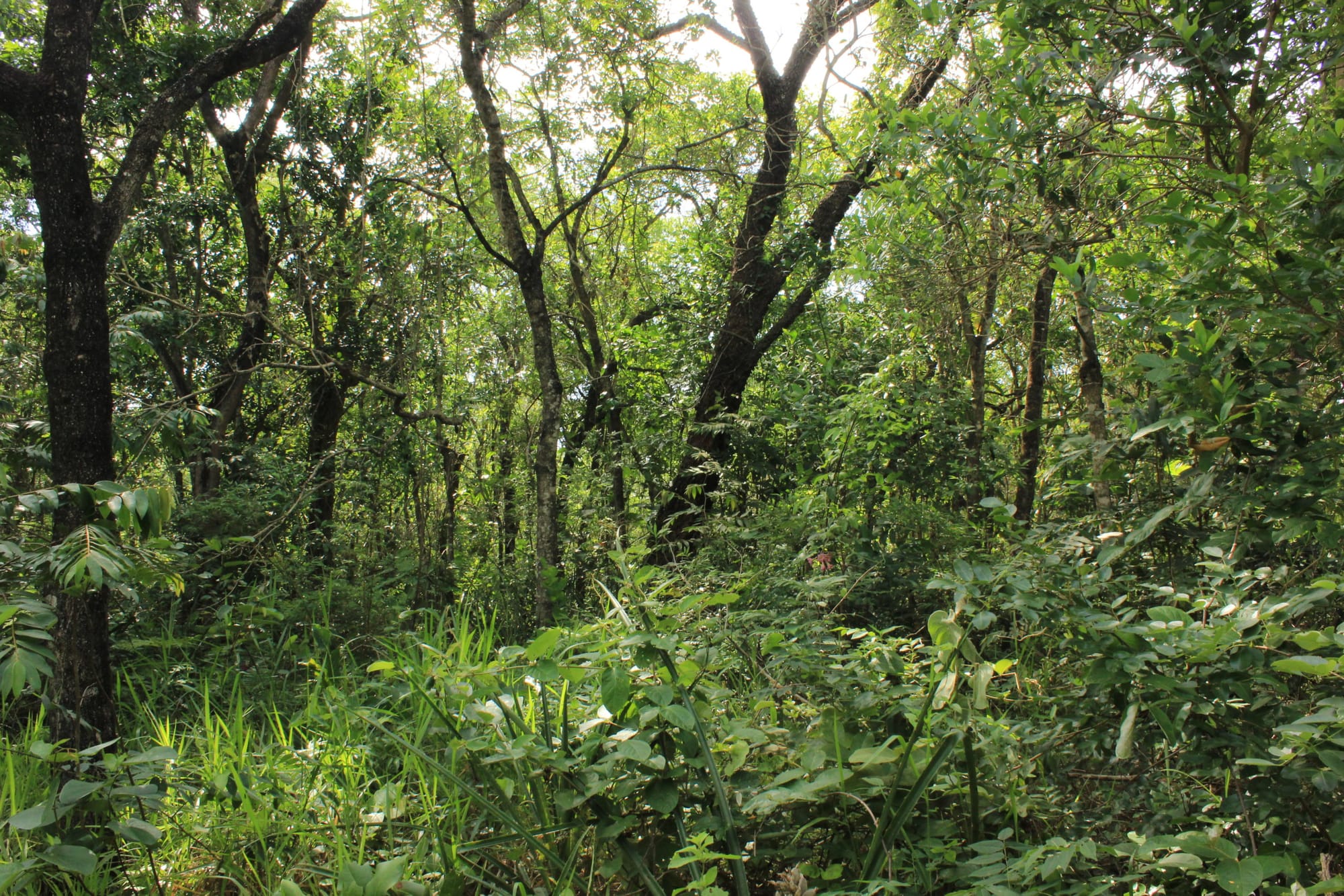
Crystal McMichael returned us to Amazon. In the Amazon there are about 4 billion trees in 16000 tree species, but 227 species account for half of all individual trees in the Amazon. This is hyperdominance.
What causes hyperdominance? Recently the argument is that pre-Columbian societies may have structured the forest, contributing to hyperdominance.
McMichael wanted to examine this, including whether human influence was across Amazonia, or in some places or not others. With teams of students she went coring soils looking for charcoal and phytoliths. This is necessary as past beliefs about human interference in the Amazon may be due to oversampling of sites where archaeological remains have been found. So that relatively small areas are thought to stand for the forest as a whole.
Fire and phytoliths – two subjects close to my heart! Using charcoal and phytolith records to determine the role of humans in tree diversity in Amazonia. Cool research by @crystalmcmic#PPP19
In the wettest parts the Amazon, she could only find seven pieces of charcoal due to human activity. The other record is through phytoliths? She showed a slide of work in progress building on earlier work with palm phytoliths. In the new work, there’s not a lot of grass phytoliths, which indicates the forest has not been opened. Nor are there signs of any cultivars in soil samples.
Comparing fire records, McMichael was able to show the effects of fire in other plots. Is this human activity? Could some bits of forest just be unlucky? You’re able to tell the temperature of a fire by examining the charcoal. This can tell you what kind of fire it was, crown fire being high temperature or slash and burn being comparatively low.
McMichael emphasises The importance of space and time in plant people interactions in Amazonia.#ppp19. also heads up to would be doctoral and post doc students she is hiring
McMichael used the fire evidence to rule out direct human influence, but not indirect human influence. Hunting, she notes, affects how plant seeds get distributed. So this needs more work. If it’s the kind of thing that appeals to you, McMichael will be hiring people in the near future.
Stephanie Smith talked about nitrogen. Nitrogen is good for plants. It’s a limiting factor in many places, and so adding synthetic nitrogen is helpful. However, excessive application makes nitrogen a pollutant. Excess nitrogen is broken down by microbes, leading to ammonia, methane and NO2 emissions, all greenhouse gases. It also increases agricultural air pollution. Far from being fresh air, it seems rural air has its own pollution problems causing fatalities.
Smith introduced the Cambridge‐India Network for Translational Research in Nitrogen (CINTRIN) seeks to reduce nitrogen fertilizer overapplication (and the resulting environmental pollution) in Indian agriculture.
#PPP19 @BrachySteph on a real @CINTRIN_UKIndia success story through the development of a simple visual tool. In trials this has reduced urea usage with no loss of yield.. ✅ pic.twitter.com/SWDD37LswN
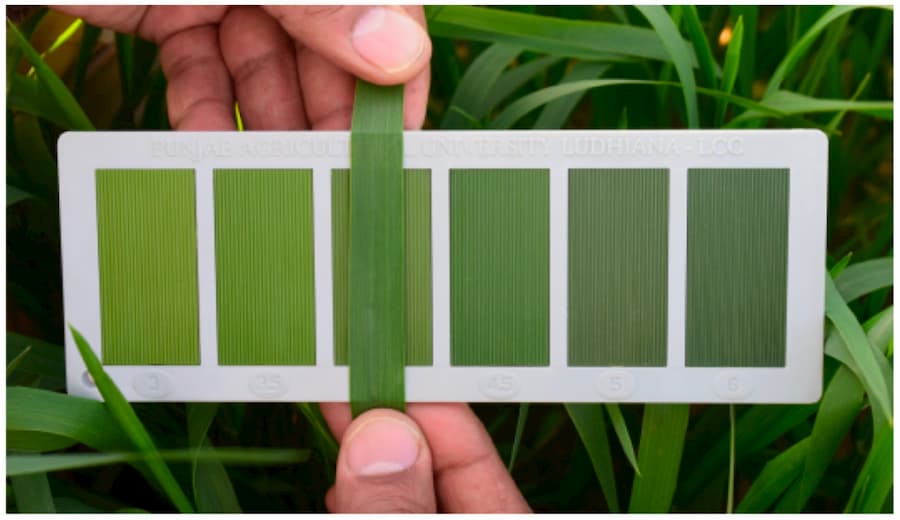
Another route is education. They’ve produced a simple colour chart for examining leaves. It’s 100 rupees, about £1 (at time of writing 11:39 in the morning).
Leaf Color Assessment. Source Swarbreck et al. 2019.
The chart has produced a 50% reduction in cost and reduction in pests as they’re not over-fertilising.
Smith’s advice for success is to talk to local stakeholders to find out what they really want. Also, talk to other disciplines. Importantly remember that communication is two way. Smith argues that the West can learn from India too.
The Anthropocene is here, Jessica Turner-Skoff started off her talk on urban trees with no compromises. Turner-Skoff and Cavender set out to produce something that you could give to policy makers, setting out the benefits of urban trees. One of the positive things they found was that of the UN goals for sustainable development, trees could help meet 15 of 17.
I highly recommend checking out the paper. I could mention that she said trees can cool cities by up to 9 degrees centigrade, but by the time I do that we’ve moved on. Trees do a lot. And once I’d typed that we moved on to trees in 86 Canadian cities removed 16500t of air pollution. There’s a correlation between tree loss and crime. Normally this would be a criticism, but I did the reading:
“Trees promote health and social well‐being by removing air pollution, reducing stress, encouraging physical activity, and promoting social ties and community. Children with views of trees are more likely to succeed in school. Trees promote a strong economy and can provide numerous resources to the people that need them. While cities are getting hotter, trees can reduce urban temperatures. They provide habitat and food for animals. Finally, trees are valuable green infrastructure to manage stormwater. Money spent on urban forestry has a high return on investment”
Some of the benefits cover water management, health, energy bills and (a reduction in) crime.
It is staggering how much trees can benefit you in urban locations.
“It’s easy to identify deprived areas in a city, by examining the tree canopy, because trees are not considered a basic right.” Sorry if I mangled that quote but it gets the spirit. Combined with an aerial photo, it’s so obvious it’s staggering.
“If we want to have the benefits of urban trees in the future, we must think of our urban forests as an investment. Like any investment, if trees are not cared for, they depreciate in value and can become a liability. Through planting and care, however, urban forests can have compounding benefits, trickling through every layer of society, leading to a better world.“
It was a very positive, if rapid talk. It closed with positive actions for improving urban life. It goes well with a companion paper from Cavender and Donnelly:
Urban Forest Stressors.
“A focus on below‐ground aspects, such as root development and soil composition, is a critical component for success. Horticultural and scientific knowledge combined with extensive public reach make botanical gardens and arboreta important potential partners in achieving urban forest objectives, but a greater call to action is needed.”
Practical solutions to implement now: “Priorities should focus on protecting existing trees, improving the selection and diversity of species, and improving planning, standards, and care for trees. Success in carrying out these priorities requires a more socially inclusive approach and is reliant on different interest groups.”
Pulling the session together, the talks hit the same topic from different angles. I think that this was a session on the Anthropocene as Turner-Skoff said, but referring back to Sanders’s talk you could flip it the other way round. Just as plants live in a human environment you can also say that humans are also living in a plant environment, a bit like McMichael found. Antonelli and Smith both raised the importance of society being more than a homogenous term. Western-industrial societies can learn from other societies.
Our view of science is often Platonic. Scientific truths exist in an ideal and incorruptible form. I like that. It’s tidy. But scientific practice, like any interaction, is in a human social context. If you’re as anti-social as I am, that’s a challenge.
¿Puede la investigación sobre razas locales brindarnos una mejor comprensión sobre las posibles características que permitirían aumentar la tolerancia a salinidad en cultivos?
Los efectos del cambio climático, la frecuencia de incendios y la defaunación, actuando en conjunto, afectan negativamente la estructura y función de la sabana brasileña.