

Pollinators are widely regarded to drive the evolution of attractive floral traits, like flower colour and scent. Subtle variations in flower shape and size, however, are also likely to experience selection by pollinators, albeit through a different mechanism. This mechanism, mechanical fit, involves a tight match between the size and shape of flowers and their pollinators. Tailoring flowers to match their pollinators may be expected, because it can optimise pollen transfer by increasing the contact time between a flower’s reproductive organs and the pollinator.

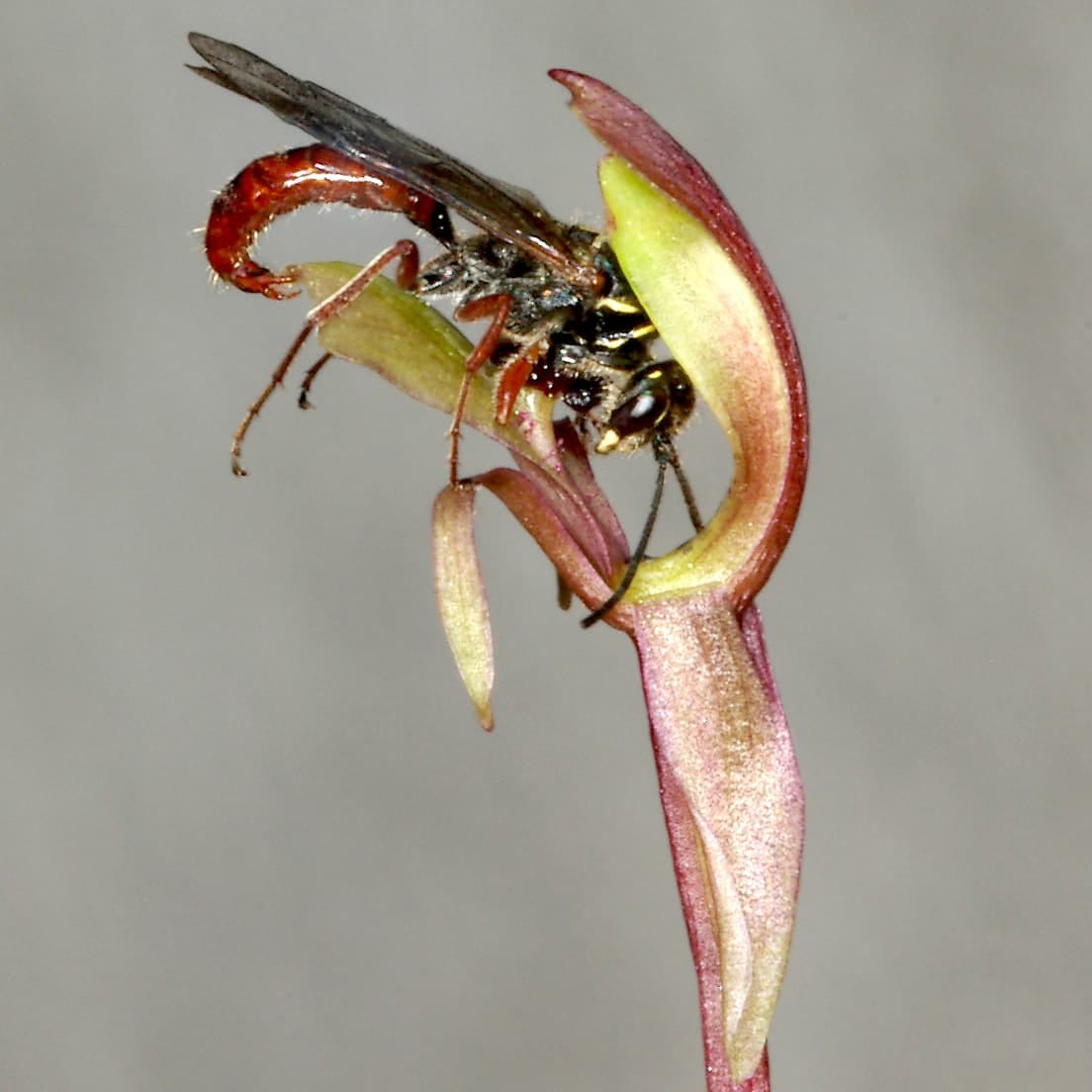
In a new paper Marinus de Jager and Rod Peakall investigate mechanical fit and show that the labellum of a sexually deceptive orchid experiences strong stabilizing selection from its pollinators. Pollinators usually land on the labella of orchids when foraging for nectar, but in the sexually deceptive orchid Chiloglottis trapeziformis, they do something else as well: they try to mate with it (Figure 1). This interspecies mishap occurs because C. trapeziformis accurately mimics the females of their male wasp pollinator by copying the female sex pheromones. As if such deception isn’t misleading enough, the orchids also produce these sex pheromones in amounts ten-fold that of actual females.