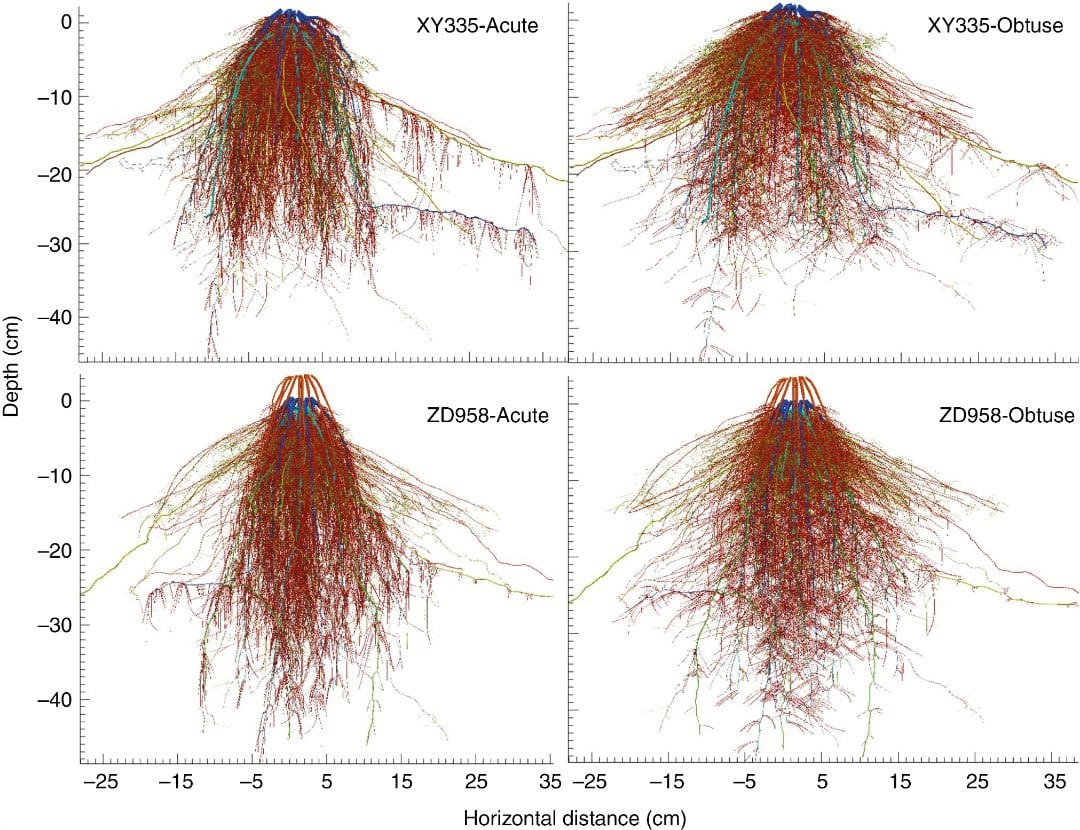


Virtual assessment based on root system architecture (RSA) modelling has great value in the optimisation of core-sampling strategies. Based on the measurement dataset of two maize cultivars having contrasting axile root angles, Wu et al. construct contrasting three-dimensional RSA models of individual maize plants in which the different lateral rooting angles are represented.

The reconstructed three-dimensional root system architecture models for individual maize plants at the grain-filling stage of two cultivars, ZD958 and XY335, with contrasting axile root angles
The reconstructed three-dimensional root system architecture models for individual maize plants at the grain-filling stage of two cultivars, ZD958 and XY335, with contrasting axile root angles. The spatial architecture of axile roots was reconstructed using digitized data for the axile roots. The lateral root architecture was reconstructed by matching the scanned data of lateral roots of ZD958 onto the axile roots of both cultivars. Acute and obtuse lateral root angles were set in the reconstruction in which lateral roots with acute angles having a strong preference for the vertical direction and that with obtuse angles having a strong preference for the horizontal direction. Red, yellow and green segments are first-, secondary- and tertiary-order lateral roots, respectively.

The accuracies of various core-sampling strategies for estimating root length density (RLD), including a new two-core sampling strategy based on an area-weighting algorithm, are assessed using these models. The new two-core sampling strategy shows considerable promise as a cost-efficient way of obtaining good-quality RLD estimates for maize.

This paper is part of the Annals of Botany Special Issue on Functional-Structural Plant Growth Modelling. It will be free access until June 2018, then available only to subscribers until April 2019 when it will be free access again.