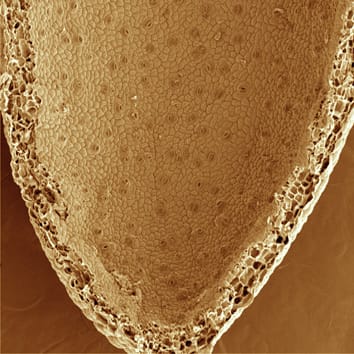


The Orchidaceae have a history of recurring convergent evolution in floral function as nectar production has evolved repeatedly from an ancestral nectarless state. Hobbhahn et al. study the South African orchid genus Disa and find that independent nectary evolution has involved both repeated recapitulation of secretory epidermis, which is present in the sister genus Brownleea, and innovation of stomatal nectaries. These contrasting nectary types and positional diversity within types imply weak genetic, developmental or physiological constraints in ancestral, nectarless Disa. With its morphologically diverse solutions to the problem of nectar production, Disa is a good example illustrating the contribution of functional convergence to phenotypic diversification, which probably also underlies the extensive diversity of nectary types and positions in the orchid family.