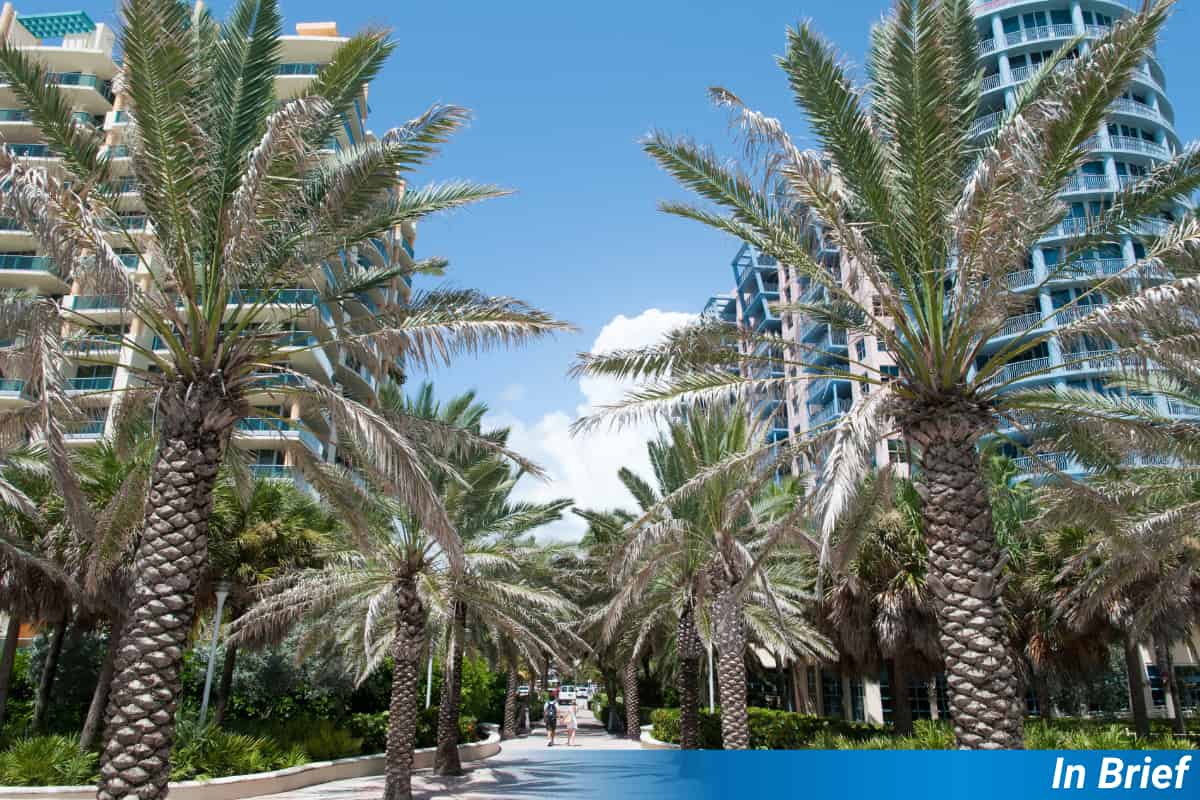



Street life is set to change in Miami in the coming years, according to a new study by Kullberg and colleagues. The report, published in Urban Forestry & Urban Greening, reveals a concerning future for the city’s street trees. By analysing the thermal safety margins of 235 tree species, the researchers found that up to 41% of Miami’s current street trees may struggle with rising temperatures by the end of the century.
The scientists found that one visible shift in Miami’s urban forest is that it’s likely to become more exotic, as it is the native species that will suffer most in rising temperatures. It is possible that up to half of the native tree species will be beyond their thermal safety margin. However, some trees, including natives, do show resilience to multiple climate stressors beyond just heat.
Kullberg and colleagues compiled a list of 288 Miami street tree species from official sources for their study. They then calculated thermal safety margins using global occurrence records and climate data. With this data, they were able to consider current and future climate scenarios to assess tree vulnerability.
The researchers note that Miami is particularly vulnerable to climate change as it’s the only major city in the continental United States with a tropical monsoon climate. Its future likely holds many more days above 100 °F. Trees play a crucial role in mitigating urban heat and providing other ecosystem services, so having data informed by climate change will help protect the city in the future.
Urban heat is currently a major global issue, which has increased by over 200 % since 1983 and affects billions of people… A climate-adaptive strategy wherein maintaining and increasing canopy cover of shade trees is informed by the climate resiliency of the trees should be employed by cities like Miami.
Kullberg, A.T., Aragón, L., Bernal-Escobar, M., Fortier, R., Lautenschlager, L., Ballantyne, J., Feeley, K.J., 2024. Rising temperatures will make Miami’s street life even more exotic. Urban Forestry & Urban Greening 101, 128502. https://doi.org/10.1016/j.ufug.2024.128502 ($)