


Climate can vary across large areas of land, but it also can vary within much smaller areas such as farms. A new study by Sisk and colleagues examined whether these microclimates — the climate of a very small or restricted area — affect pollination by both wild and managed bees and resulting wild blueberry yields.
Back in 2019 we blogged on the increasing interest in Thermal Ecology. This research dovetails with other recent research into effects of heat on pollinators, particularly bees. Last year, Carlos Herrera published that bees have a wide range of thermal diversity, so differing microclimates could help boost local pollinator diversity.
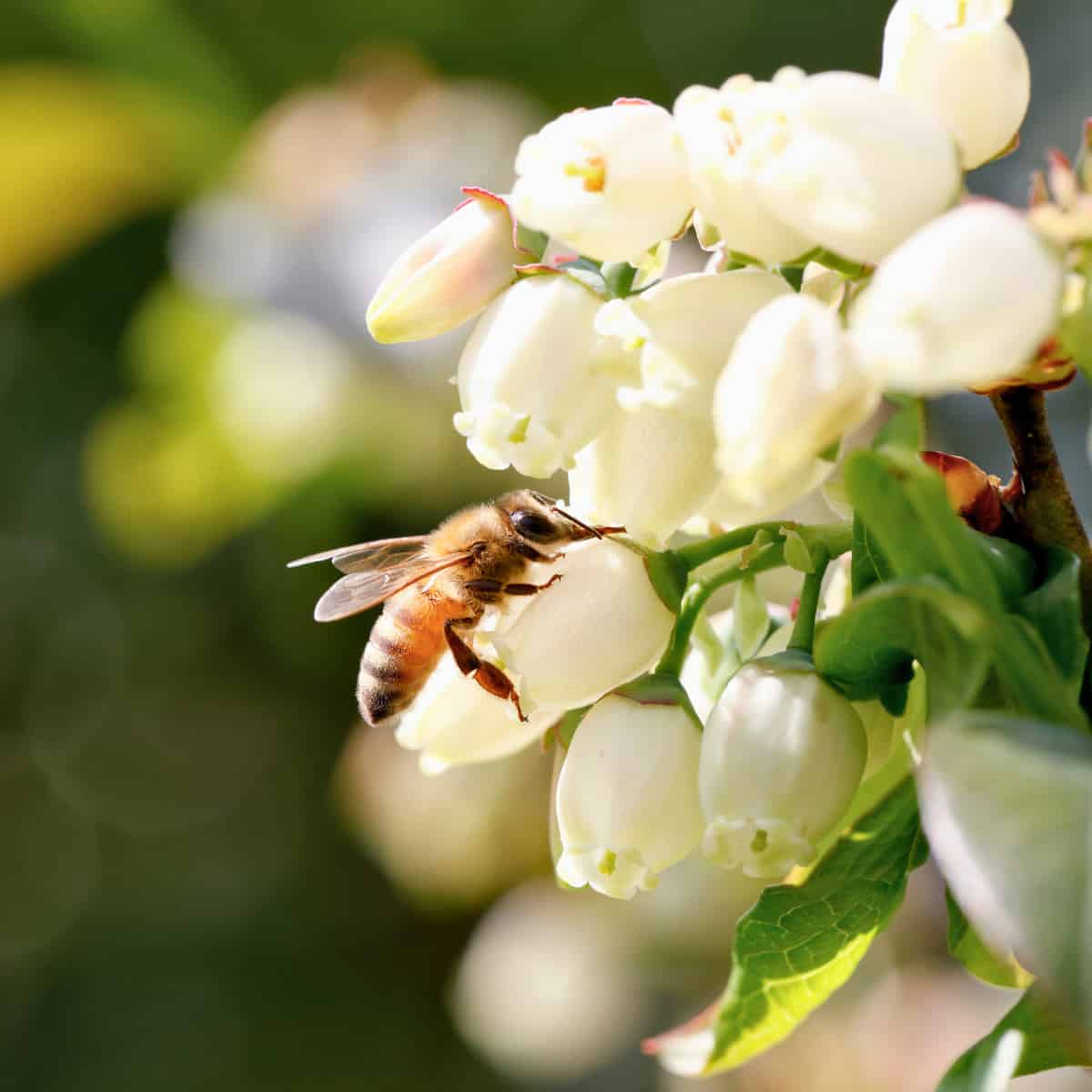
Sisk and colleagues discovered that both wild bees and honey bees found the most densely blooming areas of the fields and concentrated their foraging in these areas. Wild bees also tended to forage on plots that were warmer than average. The researchers found that across the site, variations in the landscape resulted in microclimates with differences of as much as 10 degrees Celsius and 29% relative humidity.
The researchers also found that even though managed honey bees were abundant at the site, there was no evidence of fewer wild bees near the honey bee hive locations or in the fields that had the highest honey bee foraging.
Karbassioon and colleagues have found that bumblebees and honeybees have different tolerances for weather and temperature, so this might explain the co-existence in space. It also emphasises the importance of thermal diversity. Sisk and colleagues observed similar patterns of coexistence. Both managed honey bees and wild bees had overlapping foraging areas and habits, with both favoring warmer microclimates, although wild bees foraged earlier in the day and during a wider range of conditions.
Heather Grab, assistant professor Penn State and head of the research group on the paper, said the findings could be used to help inform precision agriculture approaches to help conservation efforts.
“For example, precision agricultural management approaches often suggest removing low performing sites from production, perhaps to the benefit of increasing areas for biodiversity conservation,” she said. “Remote sensing techniques could measure flower density patterns across the field and identify low blooming regions, which may be a promising method for selecting candidate areas to convert to conservation habitats.”
While prior studies have shown that factors like habitat cover in the surrounding landscape and weather patterns can be important for predicting pollinator activity, diversity and health, Grab said a large amount of variability still remains to be explained.
“Much of that variation could be explained by fine spatial and temporal variation in temperature and humidity across the day and across different microclimates within a given area, which is what we sought to explore in this study,” she said.
A problem is that the study covered a specific period with a specific background climate, with climate changing, things will get more complicated. “Because warmer areas of the field also had more flowers and higher yields, changes to the climate that increase microclimate variability may contribute to increased yield variability within fields,” Grab said.
Microclimatic conditions in human-modified areas may not always correlate well with broader regional climate patterns, suggesting that scaling up these findings will require careful consideration of local landscape contexts.
READ THE ARTICLE
Sisk, G., Ostroski, A., Dillard, T., Hall, B., Goslee, S.C., Grozinger, C.M., Khanna, V. and Grab, H. (2025) “Unraveling microclimate effects on pollinator foraging and crop yield in lowbush blueberry,” Agriculture, Ecosystems & Environment, 392(109734), p. 109734. Available at: https://doi.org/10.1016/j.agee.2025.109734
Original press release: https://www.eurekalert.org/news-releases/1089050