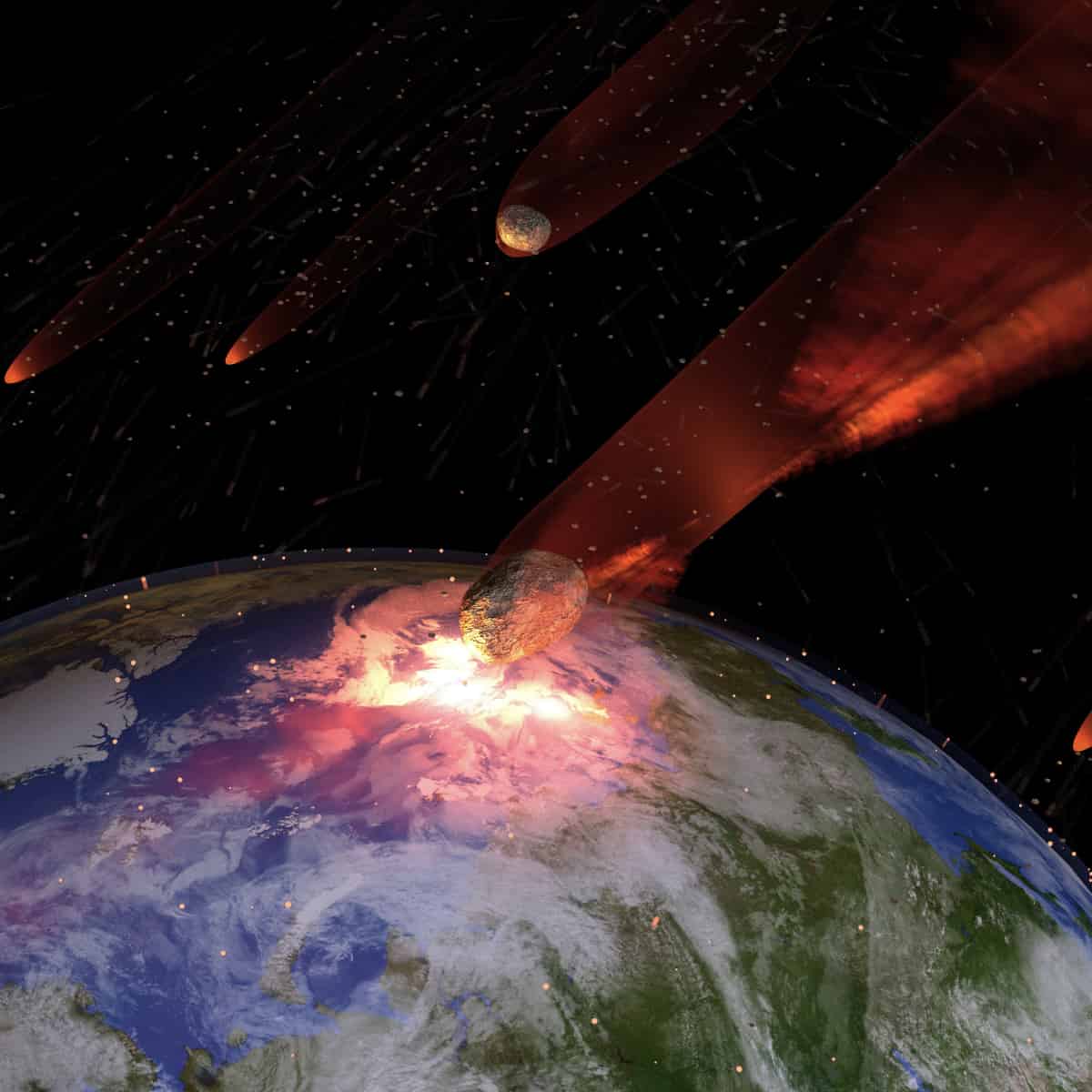



Colin Barras reports on a recent paper by Peng et al that finds a healthy ecosystem barely 75,000 years after the end-Permian extinction, 250 million years ago, thought to be the deadliest mass extinction ever. Barras finds the deadliness of mass extinctions might depend on who you talk to.
For example, an extinction we’re all familiar with, the end of the Cretaceous, that was a mass extinction, yes? Barras asked Spencer Lucas “I think that there’s a lot of hyperbole involved in this. It’s a big deal that the non-avian dinosaurs go extinct at the end of the Cretaceous. That said, I don’t think it’s really a mass extinction.”
It’s a bold statement and, naturally, not everyone agrees. Barras also talks to tetrapod experts Mike Benton, who is convinced of mass extinctions, and Paul Wignall who provides the quote: “I think it would be fair to say that Lucas’s viewpoint is not mainstream.”
A lot of the discussion is about how well the fossil record can capture extinctions across a wide sample of genera. Are fossils missing because the animals that make them are extinct? Are they missing, because not everywhere is conducive to providing fossils? Barras notes Sandra Schachat’s comments that the insect record isn’t as complete as we’d like. Maybe insects suffered from an extinction, or maybe they took evolutionary advantage of changing times around the same period. Then he turns to the plant record, and how biologists think about plants. And how sometimes they don’t.
Barras talks to Cascales-Miñana and Cleal who, back in 2013, suggested there were just two mass extinctions for plants, at the end of the Carboniferous period, when it became the Permian, and during the Permian. Barras reports Cleal has an explanation for plant resilience. “Imagine shooting all the elephants in the world: 10 years later, there are still no elephants,” he says. “Now imagine cutting down all the oak trees in the world: 10 years later, there are the beginnings of new oak forests because the acorns germinated.”
There’s been more research since then. Nowak et al have argued that the end of the Permian wasn’t a mass extinction event for plants either. As a result Barras asks: “Should we label an event a “mass extinction” if it only affects a limited set of organisms and has little impact on other major groups?”
It’s a pity (but understandable) that this is behind the New Scientist and Apple News + paywalls. It’s an engaging article that captures the spirit of scientific debate without portraying one side as stubborn stick-in-the-muds. If you can get access to this it’s well worth your time.
It also raises a worry. If plants haven’t had a mass extinctions in the past, then current biodiversity loss in unprecedented. If that’s the case we need reconsider about how we think about both past resilience and present vulnerability.
A slightly abridged version is cross-posted to Bluesky & Mastodon.