


In a recent paper published in Methods in Ecology and Evolution, Yves Klinger and his colleagues presented an innovative methodology named iPhenology. This approach uses publicly available photographic data from citizen scientists (CS) to track large-scale phenological events in plants. Phenology, the study of cyclic and seasonal natural phenomena in relation to climate and plant and animal life, is a largely understudied area of plant functional ecology. Understanding the timing of pivotal reproductive stages, such as bud burst, flowering, and seed production under differing climates, is crucial for predicting how plants’ geographical ranges may shift under a changing climate.
The iPhenology workflow consists of data acquisition, cleaning, phenological classification, and modelling of spatiotemporal patterns of phenology. The study exemplified the use of iPhenology by tracking the flowering and fruiting stages of an invasive European plant, Lupinus polyphyllus, the large-leaved lupin, whose home range runs from the west coast of North America between southern Alaska and California and as far inland as Utah and Wyoming.
The authors emphasize the vast untapped potential of citizen scientists’ photo observations, an underutilised source of data that has surged with the rise of smartphone apps for species identification, such as iNaturalist and Pl@ntNet. These apps have been downloaded over 12 million times, populating databases like the Global Biodiversity Information Facility (GBIF) with an unprecedented quantity of observations.
One of the advantages of using photos from smartphones is the data embedded with the photo. This usually includes an accurate date stamp and GPS location, placing the photo at a point in time and space that botanists can use.
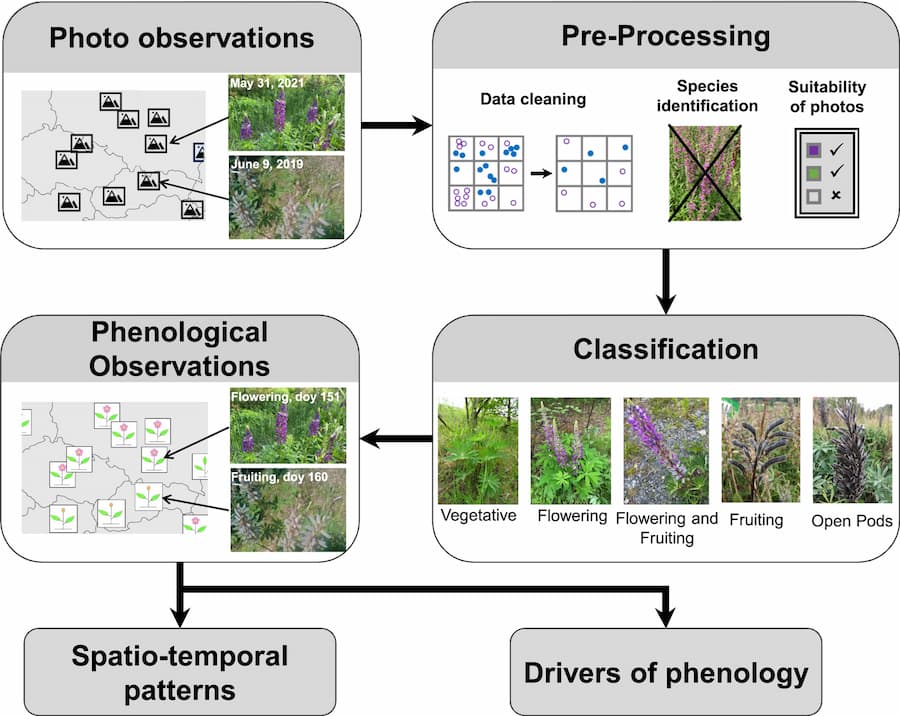
Phenological studies are crucial for predicting how species will respond to climate change, but they’ve been limited by the sheer logistics of obtaining simultaneous observations across large geographical ranges. iPhenology, therefore, is a game-changer, allowing researchers to track phenological events like never before.
However, the team found that the quantity and quality of data can vary between species and phenological stages. There were also potential biases due to the opportunistic nature of citizen scientist observations, often skewed towards more accessible and urbanised areas. Despite these limitations, the authors affirm that publicly available public photo observations are suitable for tracking key phenological events, significantly advancing our understanding of plant phenology. In their article, Klinger and colleagues write:
iPhenology, the observation of phenological events using publicly available CS photo observations, is highly promising approach to advance phenological research for many widespread species. Among the many potential fields of application are comparing expert-based phenology data with CS data, modelling climatic drivers of phenology using CS observations or determining the right timing for the management of invasive alien species based on their phenology. In future, phenological classification of CS photos using deep learning may allow automated real-time assessments of phenological events for a vast number of species.
Klinger et al. 2023
READ THE ARTICLE
Klinger, Y.P., Eckstein, R.L. and Kleinebecker, T. (2023) “iPhenology: Using open‐access citizen science photos to track phenology at continental scale,” Methods in Ecology and Evolution. Available at: https://doi.org/10.1111/2041-210x.14114.