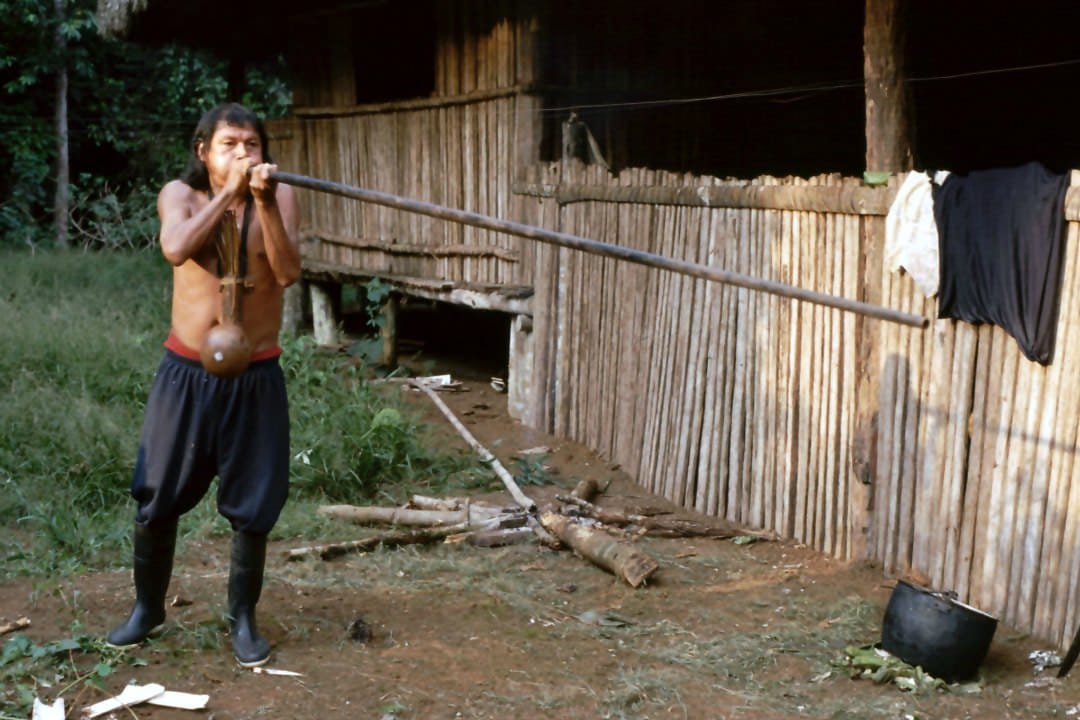


Not much I suspect. And it’s probably not that important that any of us do in the so-called developed world where we don’t need to hunt for meat using blowgun and poison-tipped darts. And it’s probably not as important nowadays for those living in areas where in days gone by that was a traditional method of hunting, e.g. in Amazonia or the forests of south-east Asia, because lifestyles for many have moved on. But, such traditional knowledge is important – whether it’s still practised or not – because it is representative of the understanding that exists between people and the natural environment, particularly pertaining to the plant component.

The potential for loss of that knowledge, which belongs to all humanity, was brought home to me by work of Elaine Schneider et al.. They examined traditional knowledge about palms (Arecaceae) by the Chachi indigenous group in northwestern Ecuador. More importantly, they compared present day knowledge with that recorded 30 years before. Whilst 4 understorey palm species reported as useful previously were not recorded in 2015, pleasingly, most of the palm uses noted in 1985 were also registered in the recent study. However, and significantly, ‘knowledge about blowguns, blowgun darts, and marimba keys*, seems to have vanished’. Whilst that knowledge still exists in the 1989 scientific paper, it is effectively lost from the collective knowledge of the people who could identify the plants that go with those uses.
If this example of loss of traditional knowledge is globally representative, we risk losing important information that may harbour cures for the ills that plague human societies, or novel materials that could help create a more environmentally-sensitive, sustainable future. We don’t know what’s out there, and may never know if traditional knowledge is lost. We therefore need to keep in touch with our ‘roots’ – in both senses of the word! – if we are to make the best use of all that nature has provided**.
However it’s not just about recording and documenting the knowledge, we also need to preserve and conserve the plants – and animals, fungi, bacteria, algae, etc. – that provide those wonderful natural resources. So, ethnobotany isn’t just about blowguns, but it is about words, and it’s also about actions. One Planet: One Chance to get it right.
* The marimba is a traditional percussion musical instrument (a sort of xylophone) of the region, with its origins ultimately in Africa [9; 10], and has a distinctive sound.
** A timely example of the often unpredictable value of traditional plant knowledge is provided by Shameem Sultana Syeda et al. who demonstrate the potential of ouabain as a male contraceptive. Famously, ouabain is an arrow poison that is sourced from plants of the Strophanthus genus (Apocyanaceae) and was traditionally used by humans in hunting [16]. Rather than perpetuate its life-ending property, Western medicine has exploited this drug as a useful treatment for various heart conditions to enhance and prolong life in humans. Now, the compound’s ability to interfere with Na+/K+ ATPaseactivity has been effectively used to render male mice sterile, prompting this to be a step towards the creation of a maleequivalent of the female oral contraceptive, ‘the pill’ for humans. From arrow-poison to procreation-inhibitor, the latter use probably couldn’t have been predicted when this traditional knowledge of ouabain’s effects was first noted, but such a use is now possible because that knowledge was passed on and shared. This is a dramatic example of what can be achieved with a little imagination, and underlines the need to ensure that the totality of human traditional and indigenous knowledge is fully recorded, and intelligently exploited.
[Ed. – for more studies on ethnobotanical potential of South America, and palms specifically, we’ve sourced these items for you: Joanna Sosnowska and Henrik Balslev, Manuel Macía et al., and Rodrigo Cámara-Leret et al..]