


Scientists trying to preserve California grasslands and heathlands are repeatedly coming up against a persistent invader, Oncosiphon pilulifer, commonly known as Stinknet. Previous research by Loralee Larios has shown that fire isn’t a great way to control it, so how about herbicide? The research by Rodriguez and colleagues shows that while herbicide can kill Stinknet, you have to hit it in the right season to reduce its chances of making a comeback.
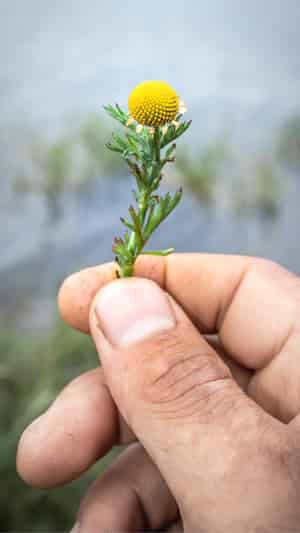
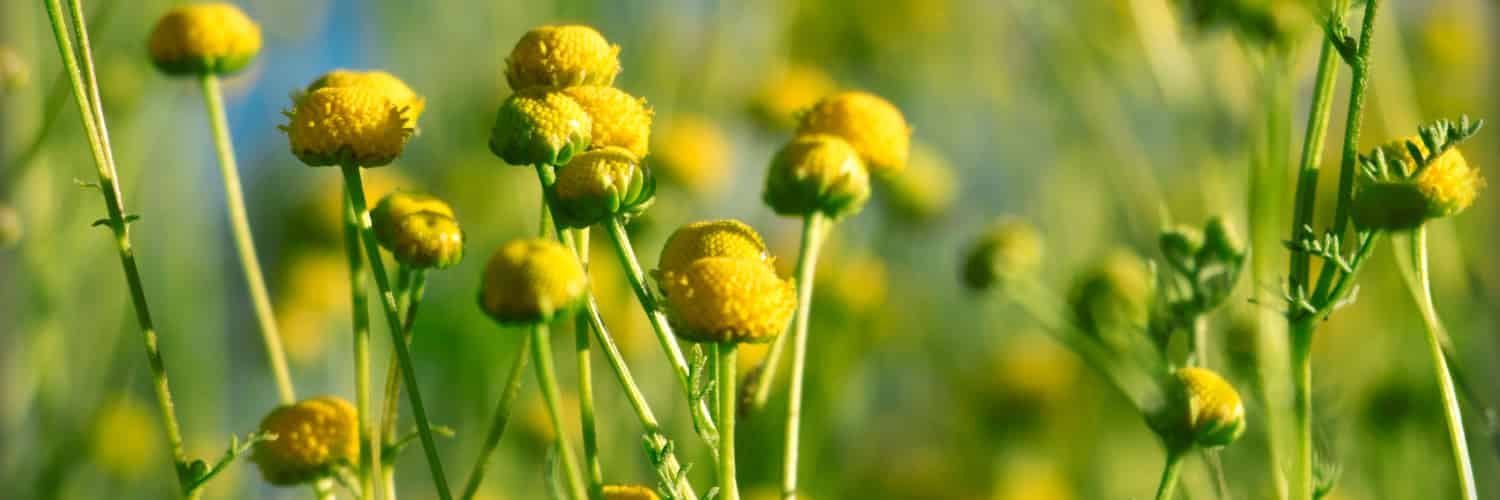
Readers may remember this plant from last year, a relative of the daisy with distinctive yellow orb flower heads that give it another name, globe chamomile. It’s a native of South Africa, but a pest elsewhere, particularly in Western Australia and the USA.
This time around Larios’s team measured the effectiveness of herbicides on killing Stinknet. The researchers conducted their field experiment across three invaded grassland sites in Riverside County, California. At each site, they established two blocks, each containing 16 experimental plots measuring 2 x 5 metres. The plots were arranged in a 4 x 4 grid and spaced 1.5 meters apart.
The experiment used a split-plot design to test the effects of seasonal herbicide management (early vs. late season) and the number of annual herbicide applications (1 vs. 2 years). The main plot effect was the number of herbicide applications, while the subplot effect was the seasonal timing of application. For each seasonal strategy (early and late), three different herbicides were used to estimate the overall effect. Early-season herbicides were applied in November directly to the soil surface, while late-season herbicides were applied in March or April when Stinknet was starting to bud but before significant flowering.
To assess the impact of treatments, researchers established a 1-square-metre subplot within each larger plot for vegetation surveys. They recorded plant cover by species, total litter, and bare ground cover. Soil samples were also collected to analyze the seedbank through a 7-month seedling emergence trial in a greenhouse.
This comprehensive experimental design allowed the researchers to evaluate the effects of herbicide timing and frequency on both Stinknet and the broader plant community, including native species and other non-native plants.
Rodriguez and colleagues found the key to any success was timing. Early-season herbicide was most successful at removing Stinknet. Late-season herbicides removed plant cover, but the problem was already in the soil at this point with Stinknet building up a seed bank from which the next generation of plants could grow.
Unfortunately, removing the invasive plant leaves patches of bare earth – which are perfect for an invasive species to move into. The team tried multiple treatments of herbicide to remove all the Stinknet, but they didn’t see any obvious success. Rodriguez and colleagues write: “Reinvasion from surrounding untreated areas may be driving the muted response of multiple treatments (Pearson et al. 2016), and small seeded highly fecund species like stinknet may be able to capitalize on post treatment areas if their seed-bank is not sufficiently depleted within the treatment area (Schwab et al. 2023)”
One of the silver linings of the eradication of the plants above ground is that the native plant seed bank was not so damaged as the Stinknet seed bank by herbicides. Rodriguez and colleagues write: “Native seedbank responses were more nuanced and likely captured multiple dynamics such as robust evolutionary strategies, invader impacts, and treatment impacts. Unlike many of the invasive species that have transient seedbanks in our study system, many California native species have evolved long-lived seedbanking strategies to deal with high precipitation variability, which may act as a buffer to mediate short term management impacts (Gremer & Sala 2013; Larson & Suding 2022). Here we found support for this dynamic as the soil seedbank density of native species was not depleted by any of the management treatments.”
However, this more robust seed bank is not enough by itself to help the native plants re-establish. The botanists argue that any herbicide strategy has to be part of a wider plan, probably including seeding and transplanting into cleared areas in order to survive.
READ THE ARTICLE
Rodriguez, C.S., McDonald, C.J., Bean, T.M. and Larios, L. (2024) “Efficacy of invasive plant control depends on timing of herbicide application and invader soil seedbank density,” Restoration Ecology. Available at: https://doi.org/10.1111/rec.14237.