


Yingsheng Liu & colleagues have spent six months tracking an invasive plant, Amaranthus retroflexus, and how soil contamination with copper and lead may be giving it an advantage over the native plant Amaranthus tricolor. The pollution may affect how the plants recycle nutrients from leaves.
When leaves fall from a plant, all the expensive nutrients like nitrogen and potassium are lost, at least for a while. When leaves decompose they return those nutrients to the soil and the plant, or a descendant, can pick up those nutrients again. So decomposition is important for survival. Amaranthus retroflexus, and Amaranthus tricolor, are annuals, so having the parent decompose efficiently will help any seeds in the area grow more effectively. These are likely to be the seeds of the parent. If something interferes with your decomposition, your offspring may have a problem.
The botanists used litter bags to simulate different invasion stages from light invasion to full takeover. They found that heavy metals (Cu/Pb) slow down native plant decomposition but don’t affect invasive plant breakdown. This differential response gives invaders a competitive advantage. The difference in response means that polluted areas become invasion hotspots. Not only are the invasive plants getting nutrients faster, but they’re getting them just as the plants need help to cope with the stress from the pollution. And this is where the real world causes problems.
The authors say that pollution is spreading due to: “the rapid economic development and robust anthropogenic disturbance, including metal industries, mining, fossil fuel burning, automobile exhaust, wastewater irrigation, and land application of sewage sludge.”
“Of particular note is the prevalence of the co-contamination of copper (Cu) and lead (Pb) in Eastern China due to the release of substances containing these two heavy metals into the environment during extraction, transportation, manufacturing, and use”
The results suggest that invasions could be slowed by targeting some areas for protection from pollution, in particular preventing heavy metal pollution near roadsides, farms, and wastelands could reduce invasion success by maintaining native plant advantages. Without this kind of pollution control, Liu and colleagues warn of a “Matthew effect”, a process where small advantages accumulate, so the strong get stronger and the weak get weaker. If Amaranthus tricolor is to survive it has to be unhindered by pollution so it can die well.
Liu, Y., Du, Y., Li, C., Li, Y., Wang, C., Liu, J., Zhang, H. and Du, D. (2025) “Mono- and Co-contamination of Cu and Pb may facilitate plant invasion by slowing the decomposition of native plant litter,” Biological invasions, 27(8). Available at: https://doi.org/px4k ($).
Read free via ReadCube: https://rdcu.be/eya0P
Cross-posted to Bluesky & Mastodon.
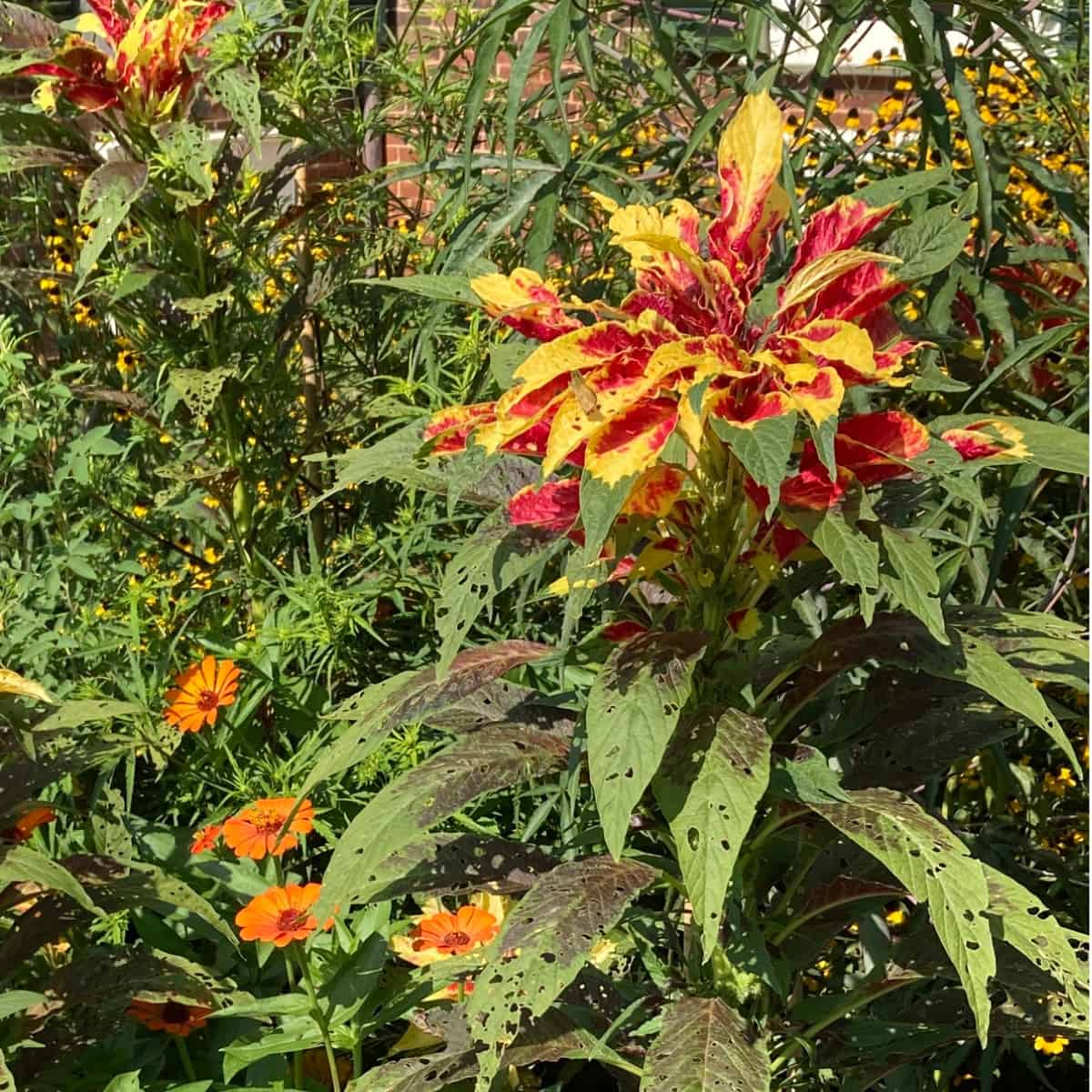
Cover image: Amaranthus tricolor in the USA by cgmi11rer / iNaturalist. CC BY-NC.