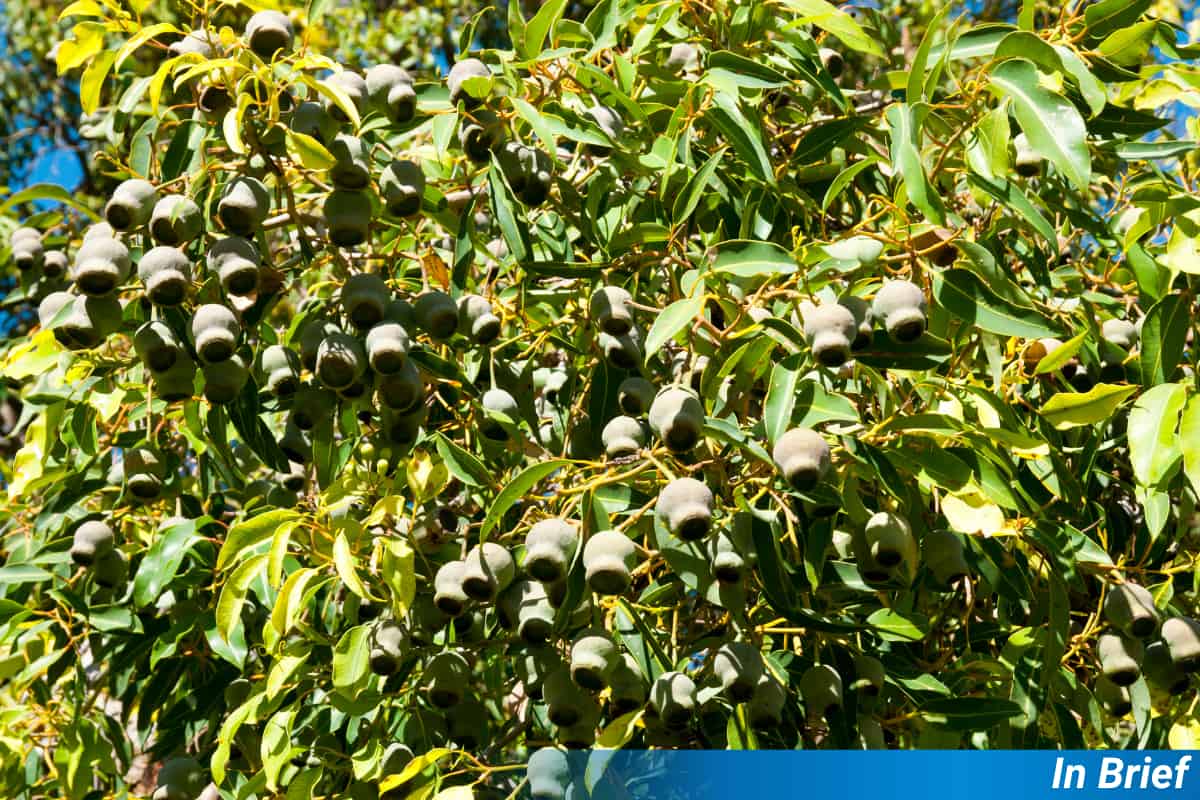



Are certain species ‘keystones’ for an environment, without which the populations of many other species would collapse? Pendergast & Willers examined the Marri tree (Corymbia calophylla) in western Australia. They examined 16 locales, to see how bees use them. They found that Marri trees bloom when most other plants have finished flowering, making them essential for bee survival. This is a pretty clear indication that any conservation of the bee species has to include a plan for conserving the trees.
It’s hard to overstate how important the trees are to the bees. Pendergast & Willers found 81 different species of native bees visiting Marri flowers. In most places studied, about 90% of all bees observed were feeding on Marri trees. In a press release Dr Kit Prendergast added: “Furthermore, this tree not only provides food sources for native bees, but also nesting resources, with species observed nesting in small holes and among the roots, and its copious iconic red sap is used by Megachilidae bees to seal off their nests.”
Pendergast & Willers first studied 16 different sites including nature reserves, urban bushland, and forest areas. They then included data from 8 more urban sites studied during earlier research. At each location, they spent 2-3 hours catching bees visiting the trees, using special nets, and identified them under microscopes.
Australia has over 1,600 known species of native bees, with at least 500 more yet to be discovered. Most bee conservation work in the Northern Hemisphere focuses on planting flower strips, but in Australia, flowering trees are more important. Native bees and their plant relationships in Australia have evolved over thousands of years in isolation.
The study also revealed Marri trees are often the main, or only, plant species visited by these bees year-round, making them indispensable in the local ecosystem, which underlines the importance of conserving this species, not just for bees, but for the health of the broader landscape. “The findings point to an urgent need to protect Marri trees from threats such as logging, mining, fire events, disease, agriculture and urban and industrial development, because without this tree, many native bee species would struggle to survive,” Dr Prendergast said.
Prendergast, K.S. & Willers, N. 2024. Corymbia calophylla (Marri) (K. D. Hill & L. A. S. Johnson) (Myrtaceae) is a major resource for native bees in the southwest western Australian biodiversity hotspot. Pacific Conservation Biology. https://doi.org/10.1071/PC24054 (OA)