
The euphyllophytes comprise the major lineage of plants that includes most of the vascular plants alive today. Angiosperms, cycads, gingko, conifers, gnetophytes, horsetails and ferns are all living descendants of a single ancestor that dates to the Early Devonian more than 400 million years ago.
But, while all of these living species have leaves and roots, to date, rooting structures have been conspicuously absent from the Early Devonian fossil records of euphyllophytes.
"The euphyllophyte clade presents an intriguing situation," write Doran and Tomescu. "Despite a growing number of species reported from Lower Devonian deposits, there is a striking lack of good evidence for euphyllophyte rooting structures until the Middle Devonian and for unequivocal roots until the Late Devonian."
And so, when did roots begin for the euphyllophytes?
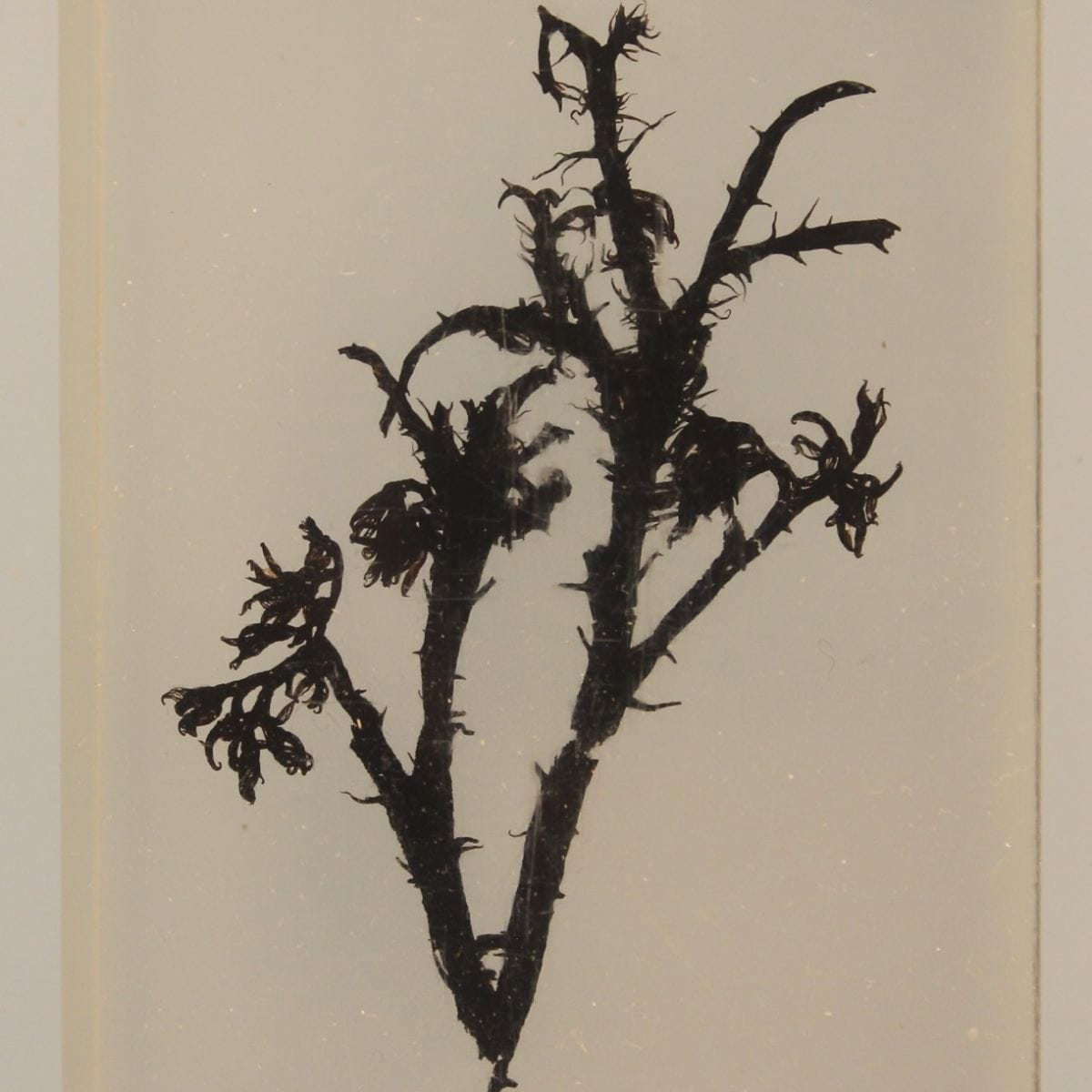
To find out, Doran and Tomescu set out to fill the fossil gap and find evidence of rooting structures in a large, extinct euphyllophyte genus: Psilophyton. This diverse genus is well-studied and has been used to address evolutionary questions such as early vegetative anatomy, sporangium and spore development, water conduction, wound response and herbivore defence. The researchers searched for fossils in the Val d’Amour Formation in New Brunswick, Canada.
"The genus Psilophyton groups at least 14 species ranging in age from Lower to early Middle Devonian (Pragian to early Eifelian) that include some of the oldest known euphyllophytes, central to our understanding of the early evolution of the clade," they write.
Of the 14 recognized species, Psilophyton crenulatum is the oldest and best characterized morphologically – and importantly it is known to have "spinescent emergences on its axes", according to Doran and Tomescu.
In other species, these spiny protrusions have been hypothesized, or even demonstrated, to perform a myriad of functions, including involvement in photosynthesis, transpiration, plant support and excretion. But their function had never been addressed in P. crenulatum before Doran and Tomescu's recent paper.
They found evidence that these emergences are early rooting structures.
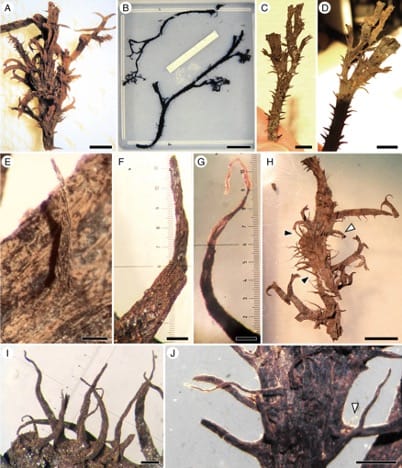
P. crenulatum was extracted from rock by chemically dissolving rock specimens. A total of 2090 emergences were microscopically examined and measured for morphology and distribution in relation to the axis of the plant.
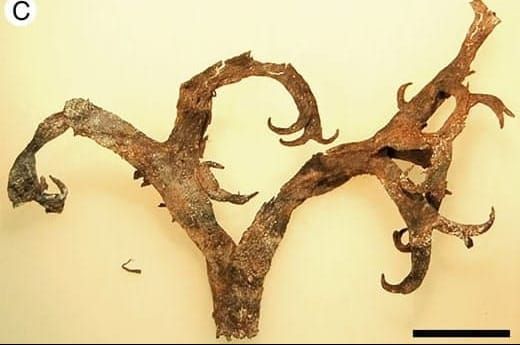
Doran and Tomescu found that P. crenulatum fossils included two different types of spiny emergences – simple (unbranched) and complex (branched) – and that their distribution was vertically polarized, with emergences appearing most frequently on the lower side of the plant axes that ran horizontally along the ground, consistent with what's known of root placement.
"The hypothesis that the emergences of Psilophyton crenulatum had a rooting function is supported by evidence coming from their morphology and distribution on axes and is consistent with the absence of any other types of rooting structures associated with the P. crenulatum mats," write Doran and Tomescu.
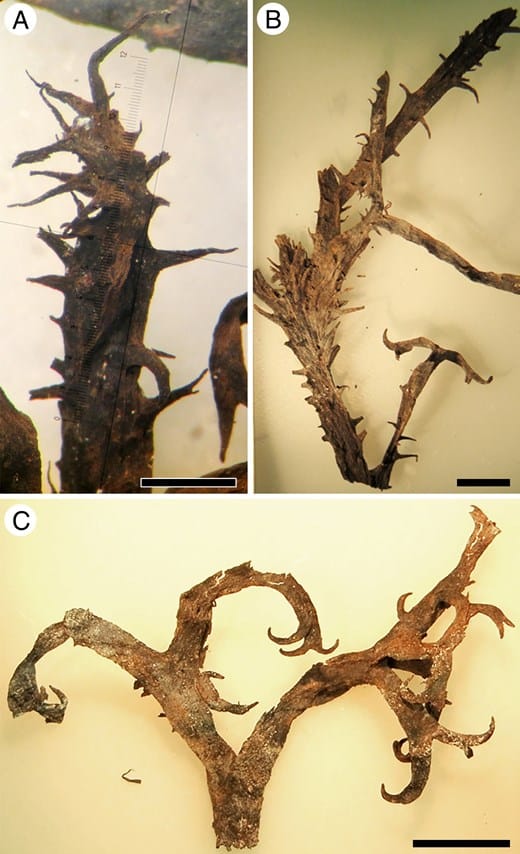
The researchers note that rooting functions would not exclude other possible functions for the emergences, particularly those located on the aerial portions of the plant.
But, because the emergences are strongly polarized in their distribution, with the lower sides of axes having two to four times as many emergences as the upper sides, their placement is most aligned with rooting structures, which are gravitropic (that is, they develop in response to the pull of gravity), and their functions. Additionally, the irregular branching patterns of the complex emergences lends support to the theory because it fits the known "morphology of organs that grow through the heterogeneous material that is the substrate of plants", explain Doran and Tomescu. Finally, the researchers add that the emergences' morphology is consistent with an "absorptive" function due to the types of cells present (parenchyma).
"The combined weight of all the evidence discussed above supports the hypothesis that the emergences of P. crenulatum had a rooting function," write Doran and Tomescu.
And so the P. crenulatum emergences represent not only the oldest euphyllophyte rooting structure currently known, but they also provide the oldest evidence of gravity-responsive growth in the euphyllophyte clade – bringing us one step closer to the root of roots.
READ THE ARTICLE:
Doran, J., and Tomescu, A. (2025) On the origin of euphyllophyte roots: hypotheses from an Early Devonian Psilophyton. Annals of Botany, 137(6), pp. 1689-1708. Available at: https://doi.org/10.1093/aob/mcaf121.
Cover Image: Psilophyton crenulatum emergences as seen in Figure 9C of Doran and Tomescu 2026 (CC BY)