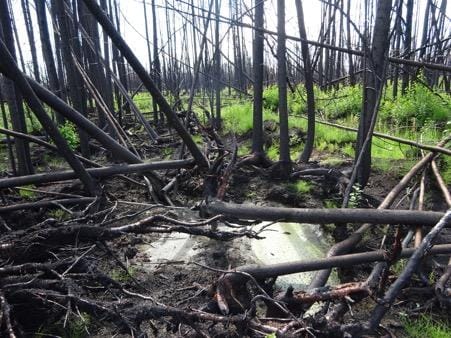


The scrawny black spruce trees that push up through the peat bogs of Canada’s boreal forest are valuable indicators of fire risk, say researchers who studied a burned-over area just outside Fort McMurray, Alberta, where a devastating wildfire struck in 2016.
The science behind their findings is complex, but the conclusion is simple: in a peat bog, bigger trees mean greater risk of high-severity fire.
“There’s a strong correlation between the size of the trees in the areas that were burned and how severe the burn was,” says Sophie Wilkinson, the lead author of a new paper that makes the connection. “Where there’s an area of known peat land and it has these big trees, that should act as a red flag for more awareness of greater fire risk.”

Black spruce grow better where peat is already dry. As they grow, larger trees shade out the surface layer of moist sphagnum moss that protects against devastating peat fires, explains Wilkinson, a PhD candidate in Geography and Earth Sciences. Bigger trees also pull more moisture out of the ground, multiplying the threat posed by dried peat fuel.
Where the spruce are small, there is more moisture in the ground and more sunlight gets to the sphagnum moss that acts like a fire blanket across much of the landscape.
In a peat land, the difference between the largest and smallest trees is not great. The researchers found that the threat comes from trees just 5 metres tall. Their more benign counterparts reach just 2 metres.
The findings are published in Environmental Research Letters. The research compared sections of peat bog adjacent to Hwy. 63 in northern Alberta, a divided road that was the main evacuation route out of Fort McMurray during the fire.
"It was very difficult to put out a section of the fire where the smouldering was very intense," says James Michael Waddington, Wilkinson's PhD supervisor and a co-author of the paper.
Peat bogs are vital carbon stores, and when they burn, not only do they release massive amounts of carbon and smoke, they can also smoulder underground, where they are difficult to extinguish, sometimes surviving for months before re-emerging in a new location.
The researchers in Fort McMurray studied the behaviour of the fire through sections of peatland between the northbound and southbound sections of the highway that had been drained to varying degrees.
They found the worst damage in the most heavily drained sites, where the peat had in many places burned right down to the mineral soil, and where the trees had been largest. Firefighters also reported that the most heavily drained areas along the highway had been the most challenging to extinguish.
The solution, at least for the short term, appears to be to remove large trees and encourage the beneficial sphagnum moss to grow back. This is the focus of a new study called Boreal Water Futures, led by Waddington.
A longer-term challenge, Wilkinson says, will be to find ways to re-wet water and mitigate the risk of smouldering fire, even as climate change threatens to make existing problems worse.
Source: Eurekalert