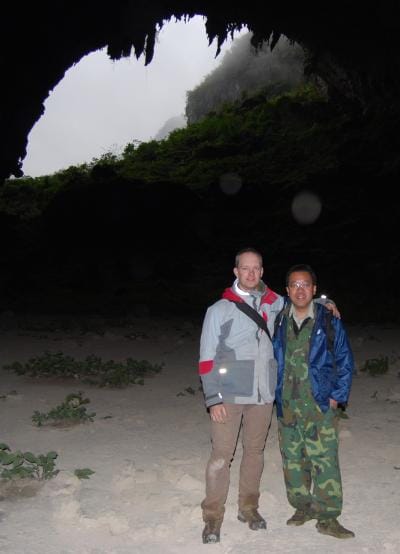



Three new species of nettle have been discovered in China. By itself this is interesting, but not that big news. What makes the story interesting is that one of the species lives in caves. In a press release buried over the Christmas period, Alex Monro said: “When my Chinese colleague Wei Yi-Gang from the Guangxi Institute of Botany first mentioned cave-dwelling plants to me, I thought that he was mis-translating a Chinese word into English. When we stepped into our first cave, Yangzi cave, I was spell-bound. It had an eerie moonscape look to it and all I could see were clumps of plants in the nettle family growing in very dark condition.”
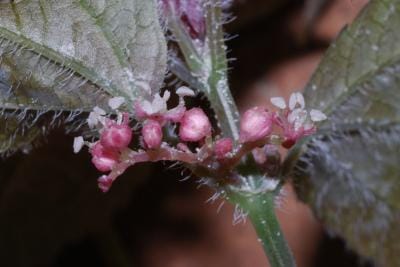
This isn’t a plant that grows in the complete dark, but it is in very low light. Sometimes as little as 0.04% of full sunlight. Along with this nettle Pilea cavernicola, they’ve published details of two more species in the open access journal PhytoKeys, so you can read about this for yourself.
The press release also notes: “South West China, Myanmar and Northern Vietnam contain one of the oldest exposed outcrops of limestone in the world. Within this area are thousands of caves and gorges. It is only recently that botanists have sought to explore the caves for plants.” It underlines the potential for adventure in botany. I already knew that it could take you from the arctic to the tropics and from mountain tops to beneath the seas, but inside caves is new to me.
I saw this come up on the Phytophactor’s blog and thought “That’s strange. I’m sure I’ve seen that somewhere before.” I’d written this, but scheduled it not posted it. It means I can link to the Phytophactor’s thoughts on the subject.
Monro A., Wei Y.G. & Chen C.J. (2012). Three new species of Pilea (Urticaceae) from limestone karst in China,
PhytoKeys, 1951-66. DOI: 10.3897/phytokeys.19.3968