


By Clare Ziegler, Rosemary Dyson, and Iain Johnston
Carbon dioxide is changing the world, and levels are continually rising. Human activities are pumping CO2 into the atmosphere. This is affecting the climate and plant growth around the world. There’s an urgent need to know the effect of elevated CO2 on the world’s ecosystems, in order to make accurate scientific, environmental, and economic predictions of future climate change.
Plants play a central role in the planet’s CO2 budget. Photosynthesis takes in CO2 from the atmosphere, and plant respiration releases it back. If more is taken in than is released, plants can act as a carbon sink and reduce atmospheric levels of CO2. But how much of a sink can plants provide? And how will a changing climate influence this? Changing CO2 levels affect how plants grow. Different plants may respond differently to changing CO2. Other processes in an ecosystem may take up or release carbon. Because of these complications, researchers find it challenging to measure how much carbon is taken up by real ecosystems, like UK forests. In particular, we don’t know how future increases of CO2 will affect forest ecosystems.
At the Birmingham Institute for Forest Research (BIFoR), we are interested in answering these questions. But how can we study how ecosystems will respond to future CO2 levels? We are using a cool experimental setup called FACE. This stands for Free-Air Carbon Enrichment. In a lab, you might grow a single plant in a cabinet with elevated CO2 – FACE scales this up to the ecosystem level. Our experiment takes place in a 100-year-old oak forest in Staffordshire. We’ve installed some industrial-scale plumbing in the forest that pumps CO2 into focussed regions about 30m across. These regions experience an atmosphere with CO2 levels elevated by 150ppm – the levels predicted for 2050. This allows for the influence of elevated carbon to be observed on plants growing in their natural environment. We’ve got lots of cool research projects looking at many different aspects of the ecosystem.
Latest view from the BIFoR phenocam
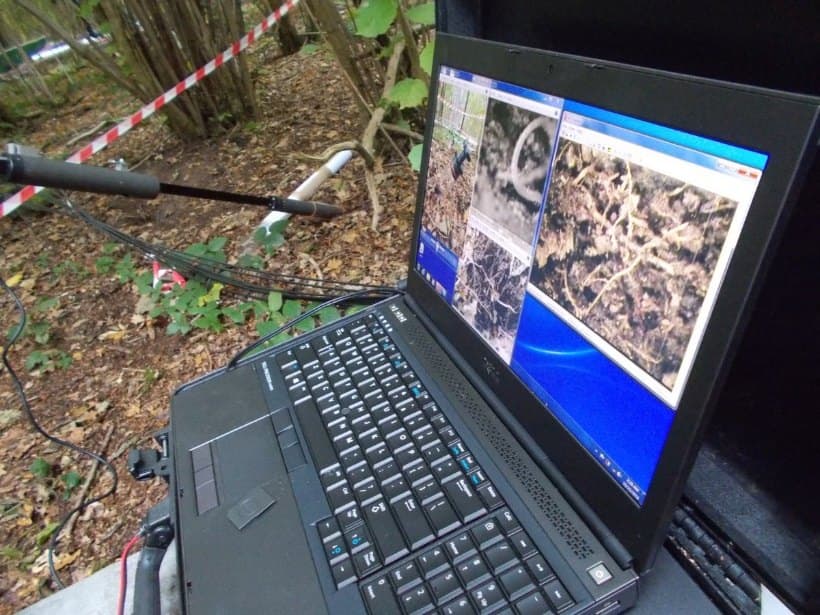
Clare Ziegler is a PhD candidate at BIFoR, looking at the effect of elevated CO2 (eCO2) on the root systems below the forest floor. Roots are a key plant organ, provide support and nutrients. They bring carbon below ground as they grow. This carbon is transferred to the soil as they die back. Their growth, architecture, turnover, and development need to be understood in order to understand carbon in an ecosystem. However, they are very difficult to monitor non-destructively – how do you observe a root system without doing any digging? One solution to this is to use minirhizotrons, which are clear plastic tubes sunk into the ground. Roots growing up against the tube can then be imaged over time using specialised camera equipment to collect important data on what is happening belowground.
These images are collected once a month from all 24 tubes on site, half of which experience eCO2 and half of which remain in natural conditions as a control. We analyse these images using specialised software to quantify the growth and dynamics of root systems using factors such as branch length, number of branches and branch width. These data will then be subjected to mathematical analysis to explore differences between eCO2 and control roots. We will use this data to draw conclusions about the effect of elevated carbon dioxide on plant roots. We’ll also be able to unpick how plant root behaviour affects atmospheric carbon. This work will form an important component of the wider scientific and environmental research taking place within the forest and worldwide.
We recently presented work at a Pint of Science outreach event in Birmingham, and wanted to have a visual representation of the project and what we are looking at. Clare took a series of images covering the entire inside of one of the tubes, which is embedded in the forest ground near a young oak tree and several sub-canopy plants including brambles, ferns and bluebells. She stitched the images together to form a mega-image covering a 360 degree view up and down the whole tube, comprising a diagonal column of about 50cm of belowground space. The image was lightly doctored in GIMP, just to smooth some of the edges created where images were joined together and make the image look a little prettier (the root system remained unchanged). Uploading this photo to Kuula, a panorama-hosting site, created a visual representation of the inside of the tube, which can be easily viewed on any computer or mobile phone. Take a look here – see if you can spot roots belonging to different plants fighting it out for belowground nutrients!
On top (literally) of this underground work, we do lots of other research using maths to explore how plants grow and function. Our research has explored how plants respond to other environmental cues (like temperature), how plants “roll dice” so that seeds germinate at different times, and how efficient photosynthesis evolved over millions of years.
Clare, Rosemary, and Iain work applying mathematical models and statistics to questions in plant sciences at the University of Birmingham. Clare is a PhD student with the Birmingham Institute for Forest Research (BIFoR), Rosemary is a Senior Lecturer in Applied Mathematics, and Iain is a Birmingham Fellow in Biosciences.