


Have you ever wondered how flowers manage to catch the attention of pollinators? Do you think it’s just a random encounter? The truth is that flowers don’t just “sit around” waiting for luck. Many plants use vivid colours, sweet nectar, and irresistible scents to attract ideal visitors. In return, these visitors help transport precious pollen from one flower to another, allowing plants to reproduce. It’s a beautiful, behind-the-scenes exchange that helps sustain entire ecosystems.
Among the many plant families that rely on pollinators, bromeliads stand out. Primarily found in the tropical Americas, these plants display a wide variety of shapes, colours, and pollination strategies. Many bromeliad species can’t reproduce on their own. So, they need the help of specific animal visitors to move their pollen and ensure the next generation.
One especially curious group is the genus Cryptanthus, found only in some areas of Brazil. These small, ground-dwelling plants are thought to offer fragrance rather than nectar as their primary reward. Some even seem to specialise in attracting male orchid bees, organisms that collect floral scents to impress their mates, like tiny perfumers of the forest. And yet, for most Cryptanthus species, we still know surprisingly little about how they reproduce.
With this in mind, Vitória Dias and her colleagues set out to discover how Cryptanthus bahianus attracts pollinators and ensures its reproduction. They examined the flower’s traits, such as flower morphology and nectar and scent production, and visitor behaviour in a natural population in northeastern Brazil.

Surprisingly, unlike other species in the genus that offer perfume as a reward, Cryptanthus bahianus relies on nectar as its main reward. The authors believe this species may represent an earlier evolutionary stage before some species began using fragrance instead of nectar to attract pollinators. In that sense, this species acts as a living window into how plants shift their strategies over time to attract pollinators.
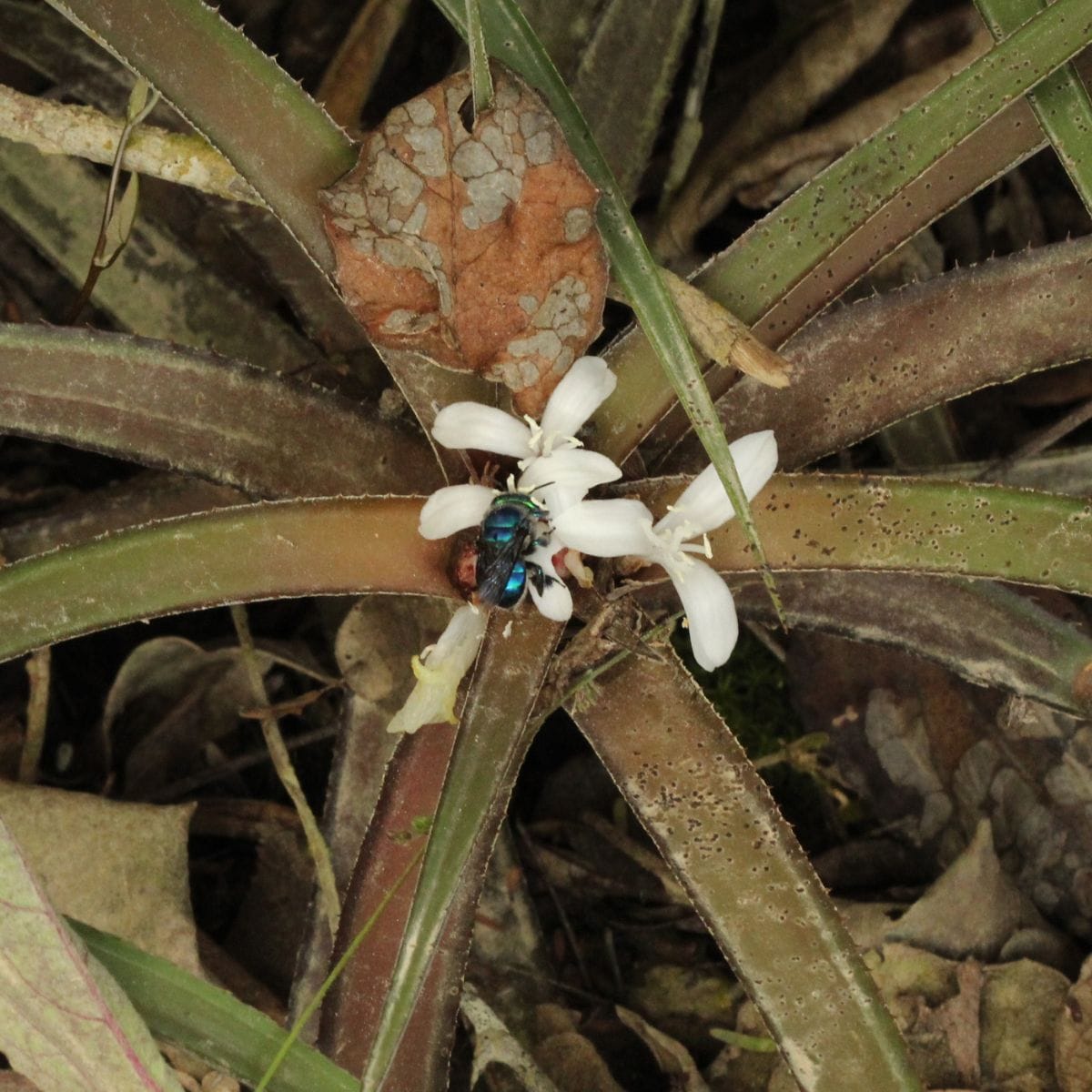
They also found that Cryptanthus bahianus produces two types of white flowers on the same plant: one with both stamens and pistils —the flower structures that produce pollen and ovules, respectively—- and one that lacks pistils. These tubular flowers open shortly after sunrise and remain open for about 12 hours. Interestingly, both flower types bloom simultaneously each day, which may be a strategy to increase the chances of being visited by pollinators.
To pollinators like bees, these flowers are not just attractive by scent, they are also visually striking. Under ultraviolet light, they stand out clearly against the dark green leaves of plants, making them highly visible. And sure enough, two bee species, Trigona spinipes and Apis mellifera, were responsible for about 70% of flower visits. These bees collected both nectar and pollen while coming into contact with the reproductive structures of the flowers, suggesting they play a key role in pollination.
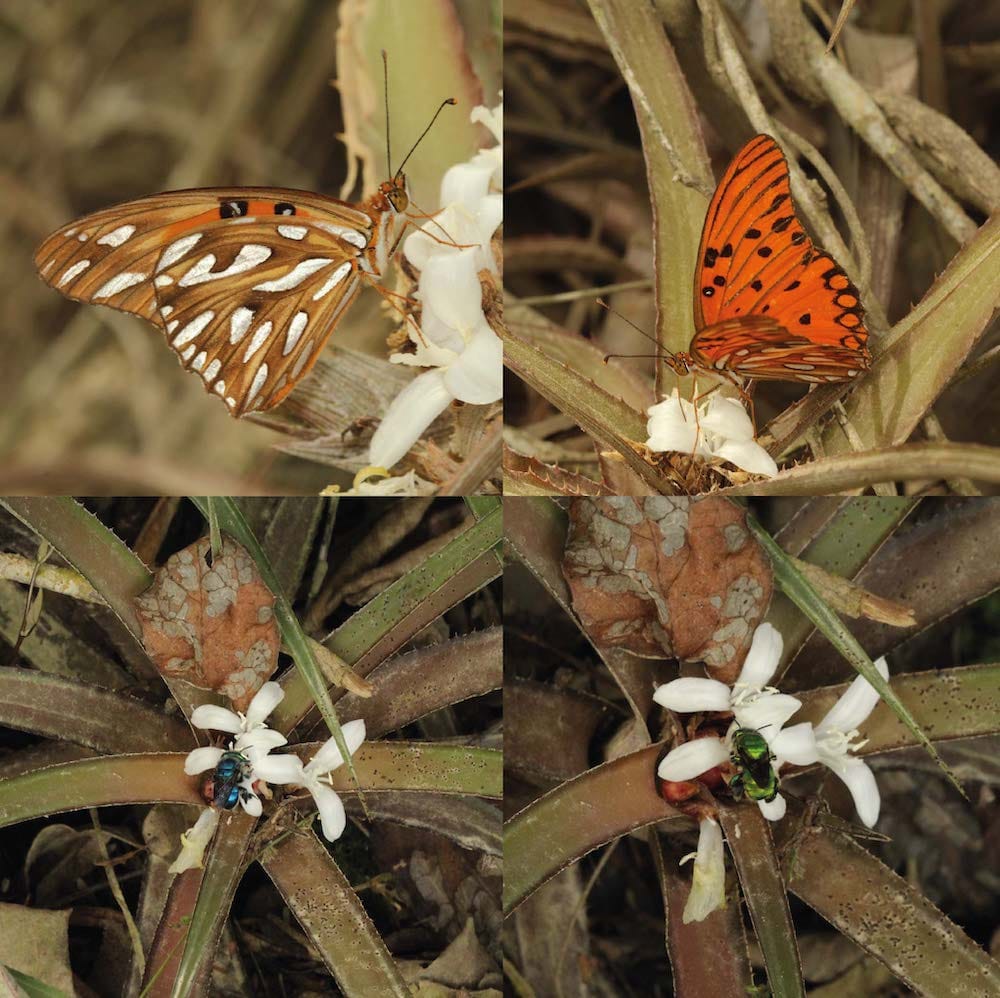
The plant also emits a distinct floral scent made up of various chemical compounds. While this likely contributes to attracting insects, these flowers scent lacks key compounds like copalol, which are known to attract male orchid bees that collect fragrances. Moreover, the visiting males did not show the typical scraping behaviour used to gather perfumes, suggesting that the scent is not the primary reward.
Finally, the study confirmed that Cryptanthus bahianus cannot reproduce independently, requiring pollen from another plant to produce fruit, implying it depends on visiting pollinators to transport pollen between plants. Still, it has a backup strategy: clonal reproduction. The plant can also produce genetically identical offspring through budding at its base.
These findings highlight how flower structure, visual signals, scent, and timing work in harmony to attract the right pollinators. And most intriguingly, they suggest that the genus Cryptanthus does not follow a single evolutionary path, but rather explores a variety of strategies. This raises a fascinating question: how do flowers switch from one kind of reward to another? The answer, it seems, may lie in the evolutionary flexibility of fragrance and the finely tuned senses of bees.
READ THE ARTICLE:
Dias, V. F., Albuquerque‐Lima, S., Navarro, D. M., Milet‐Pinheiro, P., & Machado, I. C. (2025). Nectar or perfume as reward? Investigating the pollination and chemical ecology of the bromeliad Cryptanthus bahianus. Plant Biology. https://doi.org/10.1111/plb.70031

Victor H. D. Silva
Victor H. D. Silva is a biologist passionate about the processes that shape interactions between plants and pollinators. He is currently focused on understanding how urbanisation influences plant-pollinator interactions and how to make urban green areas more pollinator-friendly. For more information, follow him on ResearchGate as Victor H. D. Silva.
Portuguese translation by Victor H. D. Silva.