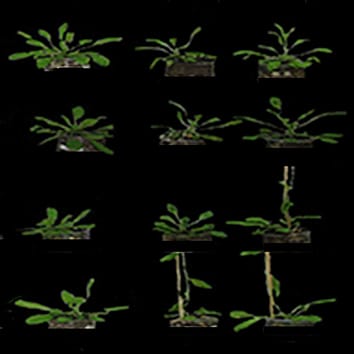



Plants must compete for space, light and other resources with the same and with other species. The shade-avoidance syndrome (SAS) is a strategy of major adaptive significance to plants. The SAS is highly widespread in most species growing in open habitats and depends on the ability of the plant to perceive the presence of neighbours to anticipate competition for scarce resources such as light in crowded stands. A plant canopy reduces the ratio of red to far-red light (R/FR) by the efficient absorption of red light by photosynthetic pigments and the relative increase of FR photons. Plants perceive this light quality change through the phytochrome system and respond very rapidly, enhancing SAS, including via vegetative structure elongation, hyponastic response and acceleration of flowering.
A recent paper in Annals of Botany examines the SAS genetic architecture of hypocotyl elongation to an end-of-day FR signal (EOD) – a light treatment that simulates shade conditions in nature – in Arabidopsis thaliana. The authors found that the ERECTA gene is implicated in the SAS in a background-dependent manner. ERECTA polymorphic effects in EOD responses were detected for other SAS traits, suggesting that its role in shaded environments is relevant for some populations in different phases of plant development.
The receptor-like kinase ERECTA contributes to the shade-avoidance syndrome in a background-dependent manner. (2013) Annals of Botany 111 (5): 811-819. doi: 10.1093/aob/mct038
Abstract
Plants growing at high densities perceive a decrease in the red to far-red (R/FR) ratio of incoming light. These changes in light quality trigger a suite of responses collectively known as the shade-avoidance syndrome (SAS) including hypocotyl and stem elongation, inhibition of branching and acceleration of flowering. Quantitative trait loci (QTLs) were mapped for hypocotyl length to end-of-day far-red (EOD), a simulated shade-avoidance response, in recombinant inbred line (RIL) populations of Arabidopsis thaliana seedlings, derived from Landsberg erecta (Ler) and three accessions (Columbia, Col; Nossen, No-0; and Cape Verde Islands, Cvi-0).
Five loci were identified as being responsible for the EOD response, with a positive contribution of Ler alleles on the phenotype independently of the RIL population. Quantitative complementation analysis and transgenic lines showed that PHYB is the candidate gene for EODRATIO5 in the Ler × Cvi-0 RIL population, but not for two co-localized QTLs, EODRATIO1 and EODRATIO2 mapped in the Ler × No-0 and Ler × Col RIL populations, respectively. The ERECTA gene was also implicated in the SAS in a background-dependent manner. For hypocotyl length EOD response, a positive contribution of erecta alleles was found in Col and Van-0, but not in Ler, Cvi-0, Hir-1 or Ws. Furthermore, pleiotropic effects of ERECTA in the EOD response were also detected for petiole and lamina elongation, hyponastic growth, and flowering time.
The results show that the analysis of multiple mapping populations leads to a better understanding of the SAS genetic architecture. Moreover, the background- and trait-dependent contribution of ERECTA in the SAS suggest that its function in shaded natural environments may be relevant for some populations in different phases of plant development. It is proposed that ERECTA is involved in canalization processes buffering the genetic variation of the SAS against environmental light fluctuations.