


Scientists worry that plants’ responses to climate change will be chaotic. New research by Karen Rice and colleagues at the University of Minnesota, shows that a warming planet will be a less predictable planet. Their research simulated possible future climates by raising temperature and changing watering for five species. They found that plants could advance or delay in blooming as the weather patterns shift.
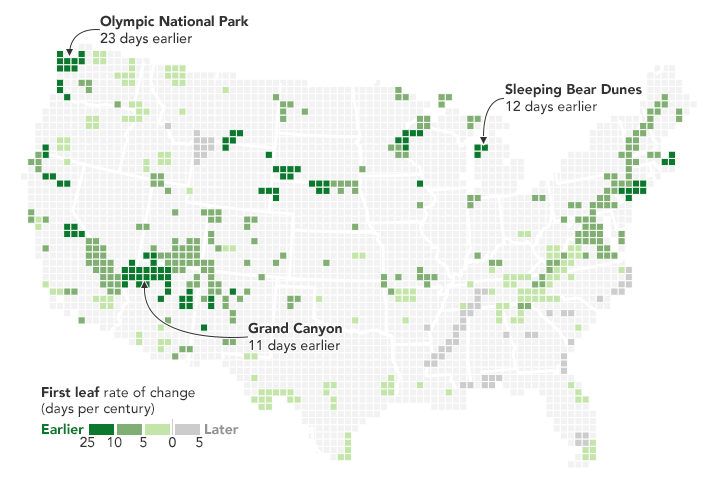
The research is the latest in the field of phenology, the study of the timing of natural responses to the seasons. Things like, the first bud of a plant, or the emergence of insects after the winter. Phenology is a useful topic to study if you want a peek into what the future might be like due to climate change. By watching for events like the first leaf or first bloom, you can see if the seasons are advancing, or lingering.
Rather than waiting for climate to change and seeing what the resulting mess is, Karen Rice and colleagues decided to peek into the future. The University of Minnesota has a project in the north of the state, Boreal Forest Warming at an Ecotone in Danger (B4WarmED). The plots in Cloquet, just outside of Duluth, and Ely, just outside Canada, have plots that can be artificially warmed. Infrared lamps can heat plants from above and resistance cables, buried in the soil, warm from below.
To compare how plants might cope with warming, the team heated some plots by +1.6 °C and +3.1 °C. They took care to leave control samples that remained unheated to give a meaningful comparison, so they could see what the results told them.
However, the future will not only be warmer. It could well be drier. This is because warmer temperatures will increase evaporation of water from the soil. In addition, transpiration - the flow of water from the roots to the leaves of a plant - will also increase removing more water from the soil. On top of this, water patterns will shift, so in some places there will be longer dry periods. Any simulation of the future has to take into account this change in water availability as well as the temperature. So, in addition to adding heat, the team also used temporary tarpaulins to reduce watering on some plots.
They then observed how Fragaria virginiana (Virginia strawberry), Lathyrus venosus (Veiny pea), Hieracium ssp.(Orange hawkweed), Solidago ssp. (Goldenrod), and Eurybia macrophylla (Bigleaf aster) grew.
“Flowering phenology responses to warming and rainfall manipulation were species specific in magnitude and direction. These differing responses altered the synchrony between species, leading to both convergence and divergence in timing of flowering between co-occurring species. Such responses to future climate conditions may lead to altered ecological relationships in forest communities,” write Rice and colleagues in their article.
If the plants were merely warmed, then four of the five genera flowered earlier, in particular the autumn-flowering plants they studied. However, add the changes to rainfall, and things changed. Eurybia macrophylla flowered earlier, but Solidago spp. Later.
“Eurybia macrophylla was unique in its response of advancing flowering in the warmest, driest treatment conditions,” write the authors. “This response may be related to this species’ ability to cope with hot, dry environments. For instance, it is one of the first species to rebound after a fire. It is an aggressively rooted species, perhaps allowing it to derive more moisture from deeper into the soil or over a wider area.”
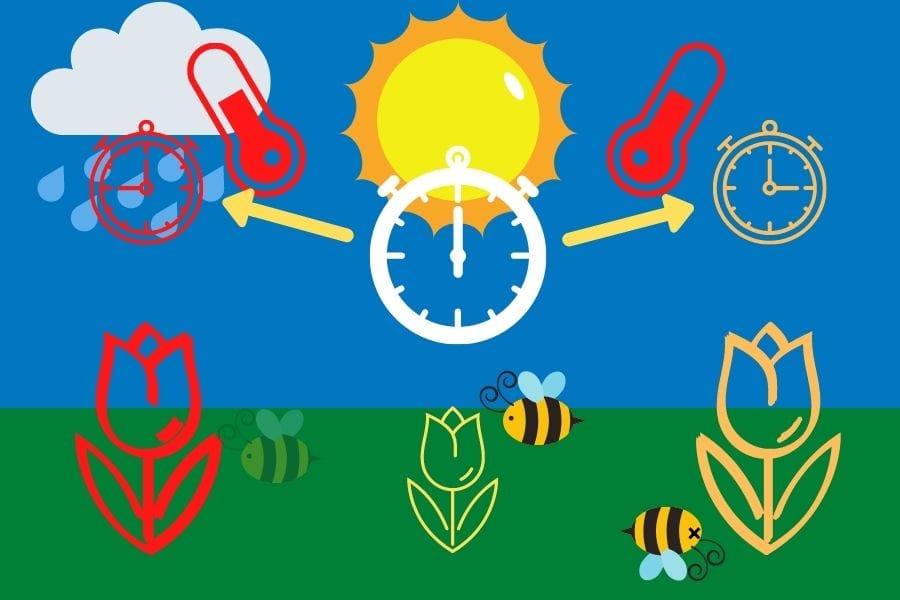
Altering the availability of flowers will impact any pollinators that rely on these plants. In the worst cases some plants may react to warming so differently to their pollinator partners that they miss the insects entirely - threatening their reproduction. In the case of plants that can partner with many species, earlier or later flowering could also lead to advantages in pollination, fruiting and germination, changing the balance of the ecology. The variation in response is a problem as Rice and colleagues highlight.
“Our observations highlight the importance of examining a range of co-occurring species and observing responses in the wide range of climate conditions predicted to change,” they write. “For instance, we observed different responses depending on the time of year during which the species bloomed. Furthermore, examining the responses of autumn blooming species in warming alone did not fully capture the response of these species. Examining the flowering response in the context of warming combined with altered rainfall provided a fuller picture of responses expected in a changing climate. More studies that combine warming with reduced rainfall are needed to enhance our understanding of the phenological shifts which may take place in temperate and boreal forests of North America, pinpointing sensitive species and elucidating potential changes in ecological relationships.”