
Examples abound of ancient life forms trapped in suspended inanimation within amber (fossilised tree resin) and which give us clues about ancient – maybe even extinct – biota and their ecology (e.g. ‘The past is bright, the past is … amber’). A revelation concerning amber-encased plant material suggests that current sexual reproduction in angiosperms may have remained little changed in over 100 million years.
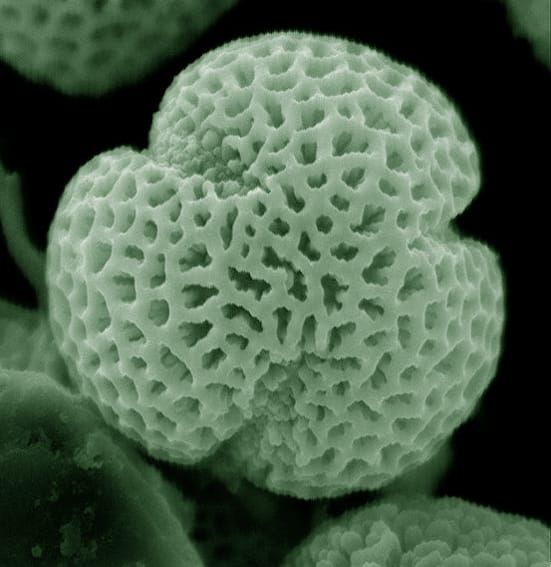
This insight comes from a new, albeit extinct, species named Micropetasos burmensis and work by George Poinar et al. with amber deposits from the mid-Cretaceous in Burma (Republic of the Union of Myanmar). Although given a binomial (with a formal description in English, as now permitted) and clearly a flowering plant, the team ‘prefer to leave the question of its exact familial relationships open at this time’. However, arguably the most interesting aspect of this discovery is the sight of pollen tubes growing out of two grains of pollen and penetrating the flower’s stigma (the receptive part of the female reproductive system). This precedes fertilisation of the egg, which would have begun the process of seed formation, had this act of plant coitus not been interrupted.
Curiously, this is not mentioned explicitly in the journal article, but was only discerned in the press release promoting it). Was that statement too outrageous or speculative for inclusion in the journal article? Surely not; legitimate commentary such as this ought to be encouraged, and only serves to make the discovery even more interesting. Come on, lads, don’t hide your light under a bush(-el)…
[OK, you can relax, I’ve saved you the trouble of finding that story about 165-million-year-old fossil insects caught during copulation. Text – and pictures – at the Smithsonian’s website. – Ed.]