


In an era of large-scale biodiversity change and reductions in basic knowledge of natural history, it is important that practical courses in subjects like field botany continue to be taught effectively. Academics and conservationists are concerned about an apparent decline in the interest in and knowledge of plants among their colleagues and the general public. Potentially contributing to, or compounding the problem, is the reduction in opportunities to study natural history in higher education programmes. And then came the COVID-19 pandemic…
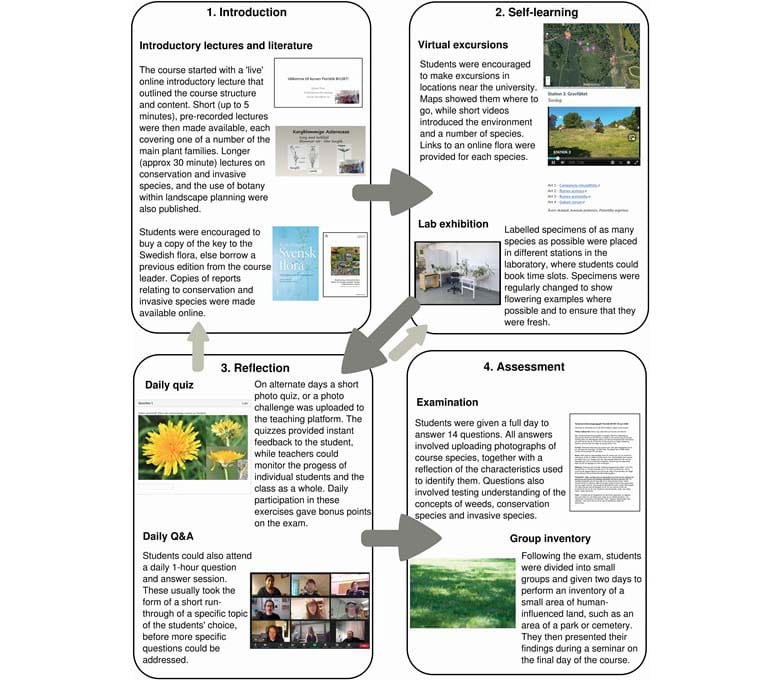
Forced by the COVID-19 pandemic to teach plant identification with no direct contact with students, Alistair Auffret and colleagues from the Swedish University of Agricultural Sciences used a range of methods and tools to promote self-learning and reflection in students, and to facilitate rapid feedback by teachers. In their new paper published in AoBP, Auffret et al. present an overview of their course that allowed students to achieve the skills and knowledge essential to field botany without actually setting foot in the field with them. In 2020, using a range of methods and tools to introduce students to the subject, promote self-learning and reflection and give rapid and regular feedback, the authors were able to produce a course that allowed students to achieve the intended learning outcomes and that obtained similarly positive student evaluations to previous years. The course and its outcomes were further improved in 2021.
Short example video from a virtual excursion. Video credit: Auffret et al.
The course included introductory lectures and readings, virtual excursions, bookable lab visits, daily quizzes, question and answer sessions, and finally an examination and group inventory exercise. Adopting such a diverse array of teaching methods proved to be highly successful for Auffret et al., with them stating, “being forced to rethink how plant identification can be taught at short notice was a huge challenge, but we believe that it will improve teaching and learning in years to come.” Although they still think that nothing will truly replace the experience of face-to-face teaching, they feel it is possible that hybrid courses including a combination of distance learning and concentrated field-based teaching, for example as a residential activity, could be a way to reach more students in the future.
READ THE RESEARCH
Auffret, A.G., Ekholm, A., Hämäläinen, A., Jonsell, M., Lehto, C., Nordkvist, M., Öckinger, E., Torstensson, P., Viketoft, M. and Thor, G. (2021) “Can field botany be effectively taught as a distance course? Experiences and reflections from the COVID-19 pandemic,” AoB PLANTS. https://doi.org/10.1093/aobpla/plab079