

If you visit the Namib desert after rainfall, you’ll see the sand spring to life – but not everywhere. In some places, patches known as fairy circles appear. Inside the circle, grass will be dead or dying, yet around the outside of the circle, grass will be lush and green. Why? Stephan Getzin and colleagues studied the circles to see if termites caused these dead zones or if something else was happening. Their results have been published in Perspectives in Plant Ecology, Evolution and Systematics.
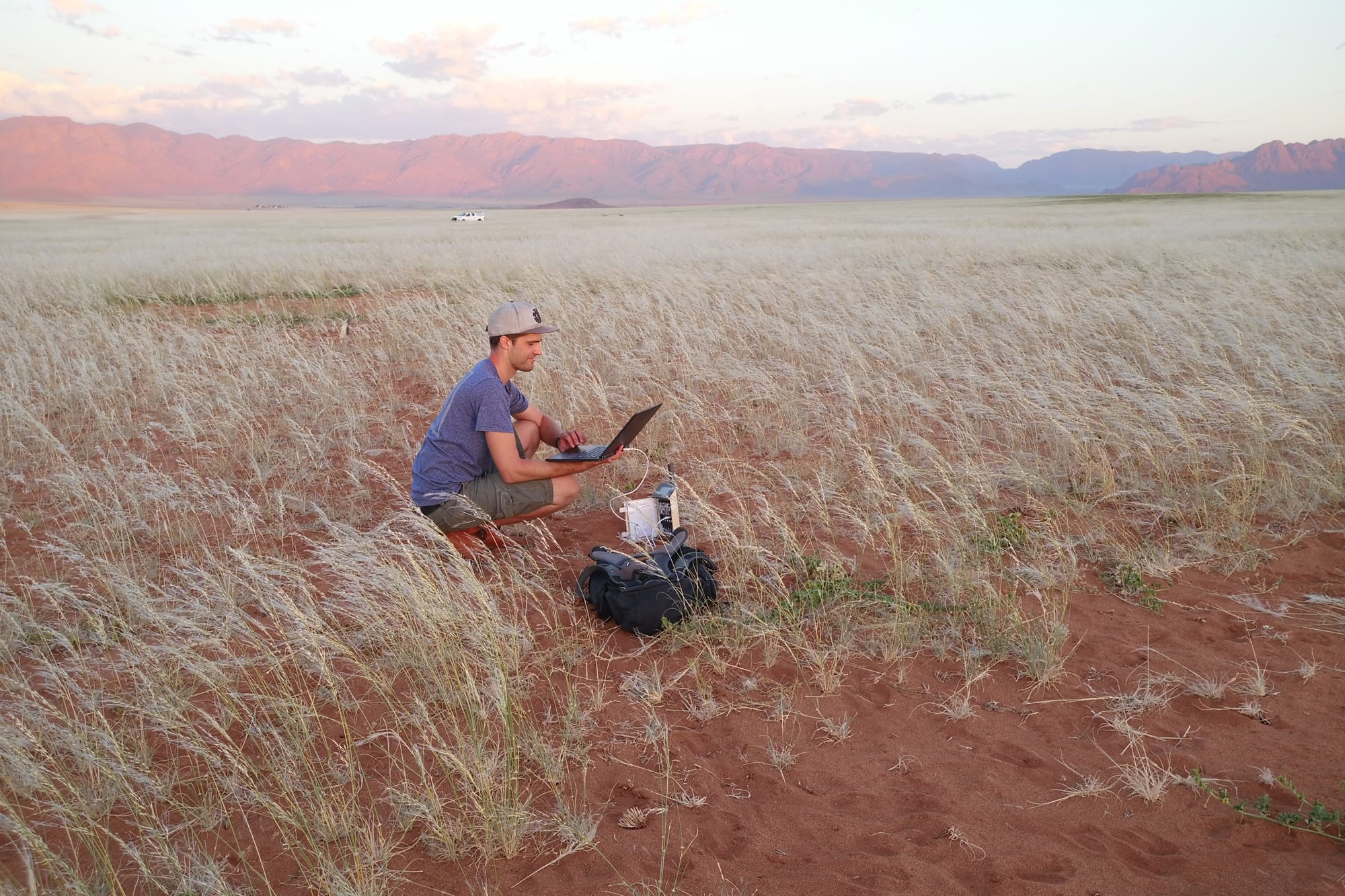
As the name Namib desert suggests, rain is a relatively rare event in the region. However, botanists were able to exploit two good wet seasons to pounce on fairy circles as they happened. They installed soil-moisture sensors in and around the fairy circles to record the soil-water content at 30-minute intervals starting in the dry season of 2020 to the end of the rainy season of 2022.

They found that about ten days after rainfall, the grasses were already starting to die within the circles, while most of the interior area of the circles did not have grass germination at all. Twenty days after rainfall, the struggling grasses within the circles were completely dead and yellowish in colour, while the surrounding grasses were vital and green. When the researchers examined the roots of the grasses from within the circles and compared them to the green grasses on the outside, they found that the roots within the circles were as long as, or even longer than, those outside. This indicated that the grasses were putting effort into the growth of roots in search of water. However, the researchers found no evidence of termites feeding on roots.
When the researchers analyzed the data on soil-moisture fluctuations, they found that the decline in soil water inside and outside the circles was very slow after initial rainfall, when grasses were not yet established. However, when the surrounding grasses were well established, the decline in soil water after rainfall was very fast in all areas, even though there were almost no grasses within the circles to take the water. Getzin explains: "Under the strong heat in the Namib, the grasses are permanently transpiring and losing water. Hence, they create soil-moisture vacuums around their roots and water is drawn towards them. Our results strongly agree with those of researchers who have shown that water in soil diffuses quickly and horizontally in these sands even over distances greater than seven meters."
In their paper, Getzin and colleagues conclude that the vegetation gaps are a necessary feature for survival of the grasses. "By forming periodic vegetation-gap patterns and preventing other grasses to establish within the fairy circles, the matrix grasses benefit from the additional water resource supplied by the FCs. In homogeneous sands of the Namib Desert, the extremely regular, spatially periodic packing of the fairy circles allows for the highest density of vegetation gaps with water supply to the grasses, which is crucial for plant survival in this extremely resource-poor environment."
In a press release, Getzin adds: "By forming strongly patterned landscapes of evenly spaced fairy circles, the grasses act as ecosystem engineers and benefit directly from the water resource provided by the vegetation gaps. In fact, we know related self-organized vegetation structures from various other harsh drylands in the world, and in all those cases the plants have no other chance to survive except by growing exactly in such geometrical formations."
READ THE ARTICLE
Getzin, S., Holch, S., Yizhaq, H. and Wiegand, K. (2022) "Plant water stress, not termite herbivory, causes Namibia's fairy circles," Perspectives in Plant Ecology, Evolution and Systematics, (125698), p. 125698. https://doi.org/10.1016/j.ppees.2022.125698.