
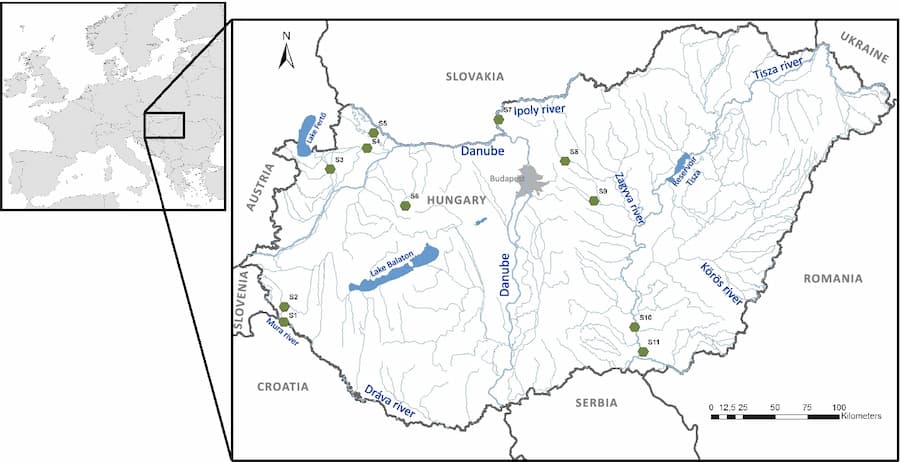
Juhász and colleagues, publishing in Biodiversity and Conservation, have examined the feeding preferences of beavers and the far-reaching implications for our forests. Their study, encompassing over 13,000 woody plant units across 11 Central European watercourses, revealed the surprising preferences of the European Beaver (Castor fiber) when it comes to dinner time.
The ecologists studied rivers and canals in Hungary. Beavers were eradicated from Hungary in the middle of the nineteenth century. They’ve since returned through a mix of natural colonisation and deliberate release. But while the beavers have been away, Hungary has changed. One change is that Robinia pseudoacacia has moved in. Robinia pseudoacacia, or Black Locust, is a popular hardwood tree for plantations, but it has also escaped into the countryside. One of the targets of the study was to see if beavers interacted with native and invasive trees in different ways.
Beavers, it seems, are selective eaters, favouring species like willows and poplars but also occasionally enjoying other tree varieties such as maples and elms. The researchers also found that beavers preferred trees of certain sizes, with 5-9 cm diameter trunks being the most appetising. However, the fussy eaters that they are, the beavers avoided certain trees entirely, such as invasive species like the Black Locust.
The study further showed that beavers’ feeding habits could have far-reaching impacts on forest ecosystems, particularly in the face of climate change. With their love for willows and poplars, the beavers’ selective feeding could inadvertently increase the survival chances of tree species more adapted to drier conditions, leading to an overall change in the composition of forests.
This might sound worrying, but the researchers argue it’s not all doom and gloom. Beaver dams can enhance water levels, creating new habitats for young willows and poplars to thrive. The researchers even suggest that forest management strategies could use these findings to their advantage. By ensuring a good supply of beavers’ favourite tree species near water sources, beavers could be deterred from causing damage to economically valuable tree plantations further away. In their article, Juhász and colleagues state that this would involve conservation management in a narrow strip around the waterways.
The fact that beaver activity is mainly limited to the waterbank also indicates that the band situated 10–20 m from the water should be considered not primarily as an area of forest management objectives, but rather as a green corridor, a means of preserving part of aquatic and riparian biodiversity. The owners of such areas could be granted support in order to motivate them to implement ecological and sustainability measures.
Juhász et al. 2023
READ THE ARTICLE
Juhász, E., Molnár, Z., Bede-Fazekas, Á. and Biró, M. (2023) “General patterns of beavers’ selective foraging: how to evaluate the effects of a re-emerging driver of vegetation change along Central European small watercourses,” Biodiversity and Conservation, 32(7), pp. 2197–2220. Available at: https://doi.org/10.1007/s10531-023-02598-8.