


When you think of a pollinator, you’re probably thinking of something that buzzes. For a lot of the public pollinator means bee, though many invertebrates can be pollinators. Pollinators can even have a backbone. Hummingbirds pollinate flowers in the New World. Even mammals can get involved, as bats pollinate some plants. But, in most cases, you’re thinking of something that flies. That doesn’t have to be what happens.
A couple of years ago, Wester and colleagues reported elephant shrews pollinate a flower. Also, in South Africa, Johnson and Pauw reported on a plant pollinated by a gerbil. Now Kobayashi and colleagues report the First record of non-flying mammalian contributors to pollination in a tropical montane forest in Asia.
The plant is Mucuna thailandica. This, as the name suggests, is a Mucuna found in Thailand. Mucuna are climbing vines in the family Fabaceae, the legume family. The plant is located on Doi Inthanon, the highest mountain in Thailand, a thousand metres above sea level.
There are clues that Mucuna flowers are adapted for mammals to pollinate. The flowers cannot open without some assistance. Kobayashi and colleagues write: ‘Mucuna thailandica has a typical papilionaceous (butterfly-like) flower, consisting of a banner petal, a pair of wing petals, and a pair of keel petals that cover the stamens and pistils. Keel petal-opening is essential for pollination in this genus, but they do not open by themselves… Rather, when an animal pushes the banner petal and presses the wing petals downward, the keel petals are opened and the stamens and pistil are exposed, upon which the pollen grains splash. This essential step is called “explosive opening.” Once a flower explosively opens, the stamens and pistil remain exposed.’
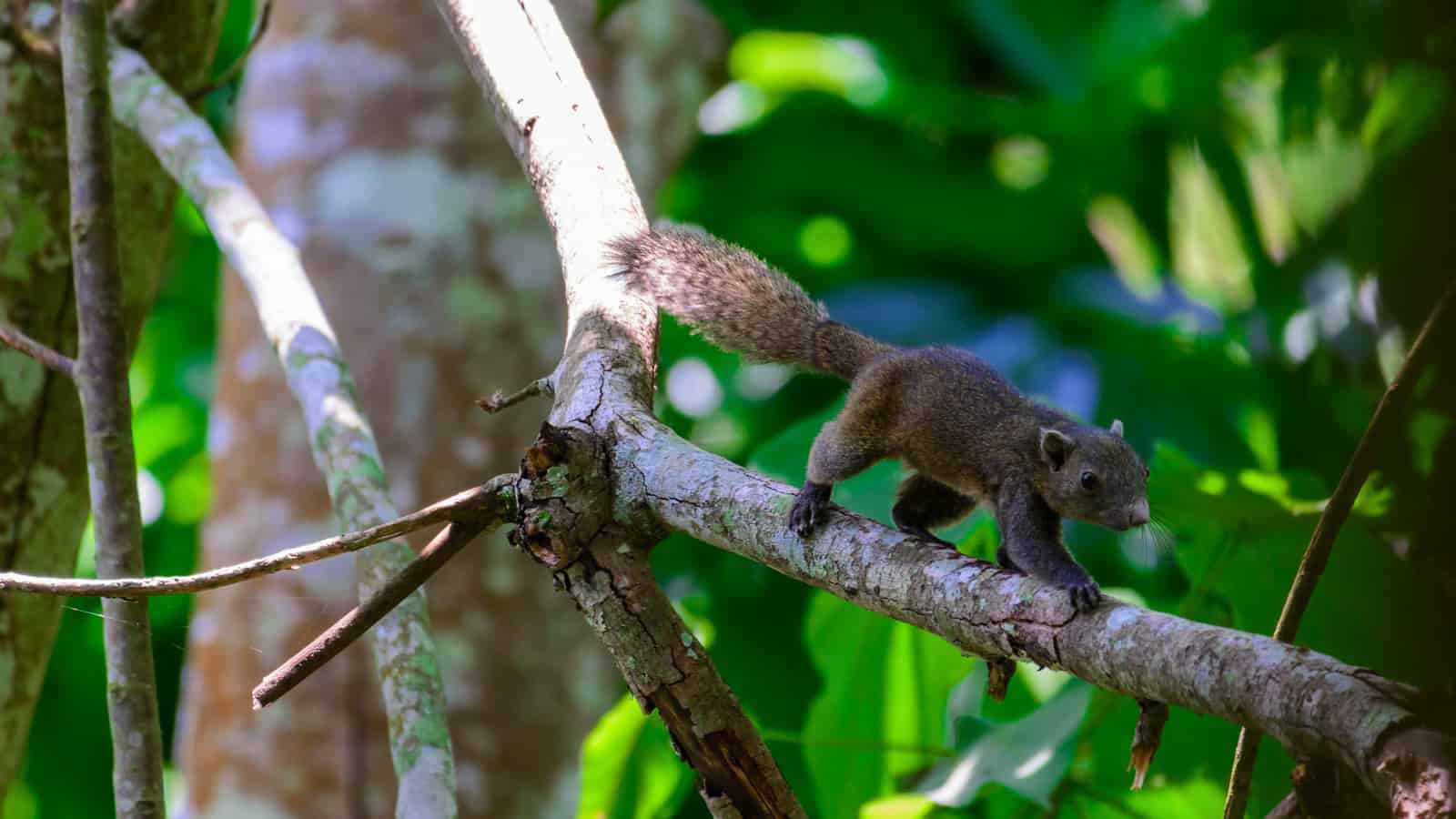
They add that the opening force for M. macrocarpa, which is pollinated by squirrels, flying foxes, and macaques, is in the range of a hundred times greater than would be for bee-pollinated plants. But what pollinates M. thailandica? The obvious way to find out would be to set up a camera trap. Unfortunately, there are very few M. thailandica plants, and the ones that are known are difficult to set up camera traps for.
The is a plant at the Kew Mae Pan Nature Trail in Doi Inthanon National Park, near the office that is accessible. Unfortunately, tourists often walk by the site on tour, so setting up a camera there would be likely to be futile – unless there was some major event that discouraged tourism happening in early 2020.
‘We monitored the plant from the bud stage to the end of the flowering phase. Flower-visiting behaviors were categorized… as: “explosive opening with no damage to the flower”, “visiting and feeding on the nectar of the opened flower”, “destruction of the flower without opening”, “nectar robbing from the unopened flower”, and “other non-specific behaviors and unknown.” Fruit availability on monitored inflorescences was checked when the camera trap was collected on August 29, 2020.’