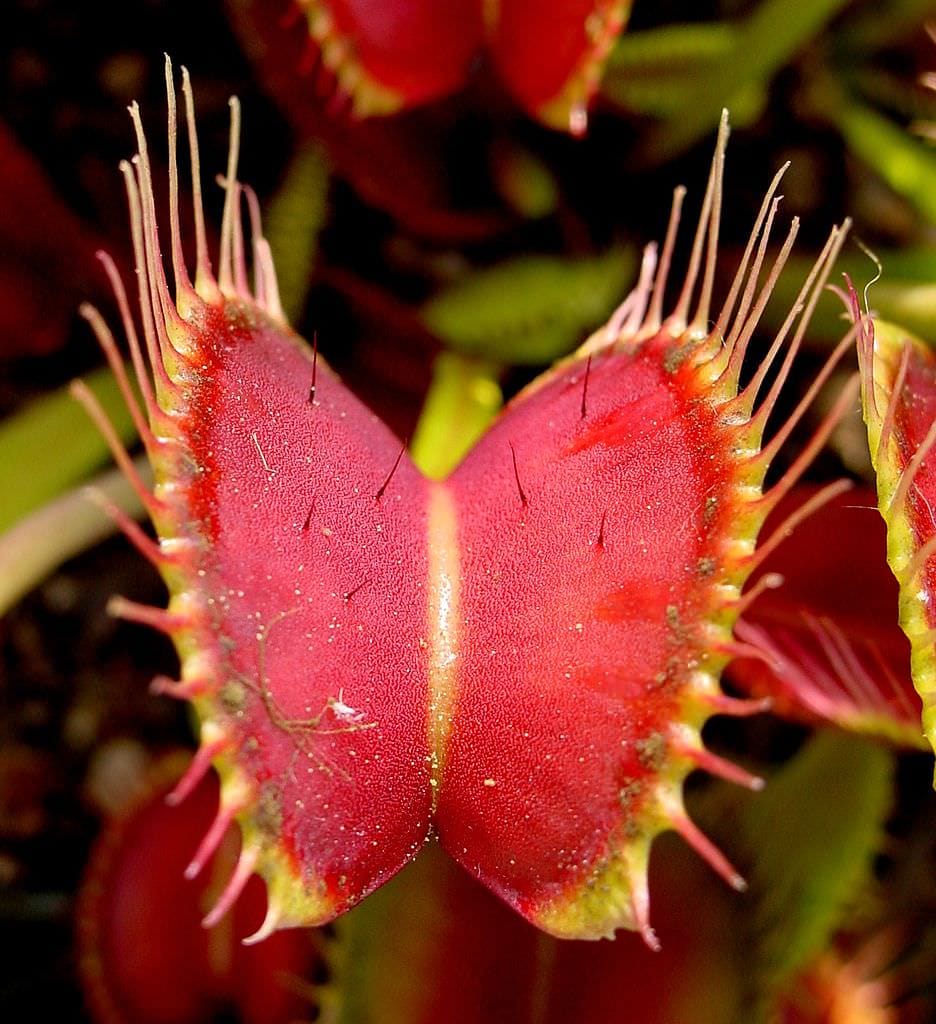



Venus flytraps capture their prey using leaves modified into traps. The traps are triggered by the stimulation of epidermal hairs, which generate an electrical action potential (AP) that closes the trap and, with sufficient further stimulation, sets off a signalling cascade that results in a build-up of jasmonic acid (JA) and the activation of jasmonate-dependent gene expression. This then leads to digestive enzymes being secreted into the trap.
A recent paper by Andrej Pavlovič and colleagues, published in Annals of Botany, asks whether a volatile anaesthetic that inhibits neuronal transmission in animals could act similarly on the electrical signals in a plant. The authors treated Venus flytraps with the anaesthetic diethyl ether contained in a polypropylene bag around the plant, measuring trap responsiveness, electrical signalling, hormonal response, and gene expression as the trigger hairs were stimulated or the plants wounded. They also determined the recovery time of the plants after the removal of the anaesthetic.
A Venus Fly Trap before anaesthetic. Video: Andrej Pavlovič et al. 2020
Tests showed that diethyl ether is an effective anaesthetic on Venus flytraps, inhibiting their ability to close their traps by blocking APs and therefore JA build-up. The plants also lost their wound-response, which shares a signalling pathway with trap closure. This effect was entirely reversible; mechanical stimulation began to produce weak APs as soon as 100 seconds after the gas was removed, with trap closure restored within 10-15 minutes. The authors went on to demonstrate that this effect was due to an interruption of JA signalling – rather than signal reception – by externally applying JA, which caused downstream gene expression to be restored.
The mechanism of anaesthetization in plants has some intriguing parallels with that in animals, with similar proteins related to electrical signalling suspected as targets of diethyl ether in both. “We do not claim that plants feel pain,” the authors write, “but accumulate structurally similar molecules as warning signals. We believe that the suppression of jasmonate accumulation under anaesthesia is mediated by the inhibition of electrical signalling, which is tightly coupled to the JA response in [plants].” The fact that jasmonates are stress hormones that can shift a plant’s resources from growth to defensive reactions suggests that anaesthetics that block those responses may have applications in horticulture.
READ THE ARTICLE
Pavlovič, A., Libiaková, M., Bokor, B., Jakšová, J., Petřík, I., Novák, O., and Baluška, F. (2019) Anaesthesia with diethyl ether impairs jasmonate signalling in the carnivorous plant Venus flytrap (Dionaea muscipula). Annals of Botany, 125(1), pp. 173-183. Available at: https://doi.org/10.1093/aob/mcz177.