Landrein et al. explore the genetic and morphological consequences of natural selection and selective breeding in the genus Abelia (Caprifoliaceae). The genus comprises ornamental shrubs, endemic to China, that have been bred to create attractive and diverse cultivars.
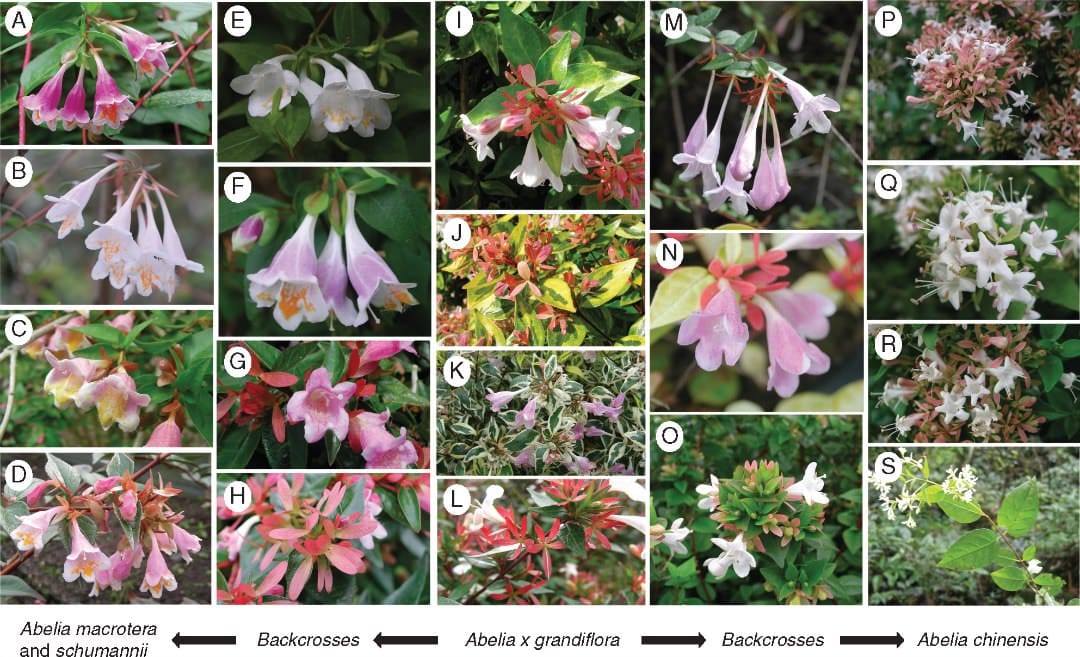
Photographs of Abelia taxa. (A) Abelia macrotera var. macrotera from Sichuan, Bazhong; (B) Abelia macrotera var. mairei from Yunnan, Kunming; (C) Abelia schumaniicultivated, note the large and wide corolla mouth; (D) Abelia macrotera × A. schumanii‘Maurice Foster’ cultivated; (E) Abelia uniflora cultivated in Wuhan B.G., note the white corolla and faint yellow markings; (F) Abelia macrotera var. deutziaefolia from Guizhou, Guiyang, note the short thick tube and exserted style; (G and H) Abelia‘Edward Goucher’, note the two sepals and the notched apex; (I and J) Abelia × grandiflora ‘Francis Mason’; (K) Abelia × grandiflora ‘Conti’, note the variegated leaves; (L) Abelia × grandiflora ‘Sherwood’, note the basal spur on the corolla; (M) Abelia forrestii var. forrestii from Yunnan, Nujiang, note the long tubular, infundibuliform corolla without markings; (N) Abelia ‘Saxon Gold’, note the five sepals and yellow leaves; (O) Abelia ‘Rose Creek’, note the dense terminal inflorescence and campanulate corolla; (P–R) Abelia chinensis var. chinensis cultivated at Kew, note the campanulate corolla and long exserted styles and stamens; (S) Abelia chinensis var. lipoensis note the lax inflorescence.
Fingerprinting (AFLP) and DNA sequence data reveal that several wild taxa experienced hybridization and introgression. Some introgressed taxa are also disjunctly distributed and may be the result of expansion and reduction of distribution ranges. The genetic diversity, that arose as a result of natural gene flow between divergent taxa, is mirrored in the horticultural breeding programmes of Abelia, but within a smaller pool of taxa. Both diversifications result in the transfer of morphological characters between species, such as sepal number and inflorescence structure in Abelia ‘Saxon Gold’ and A. forrestii.