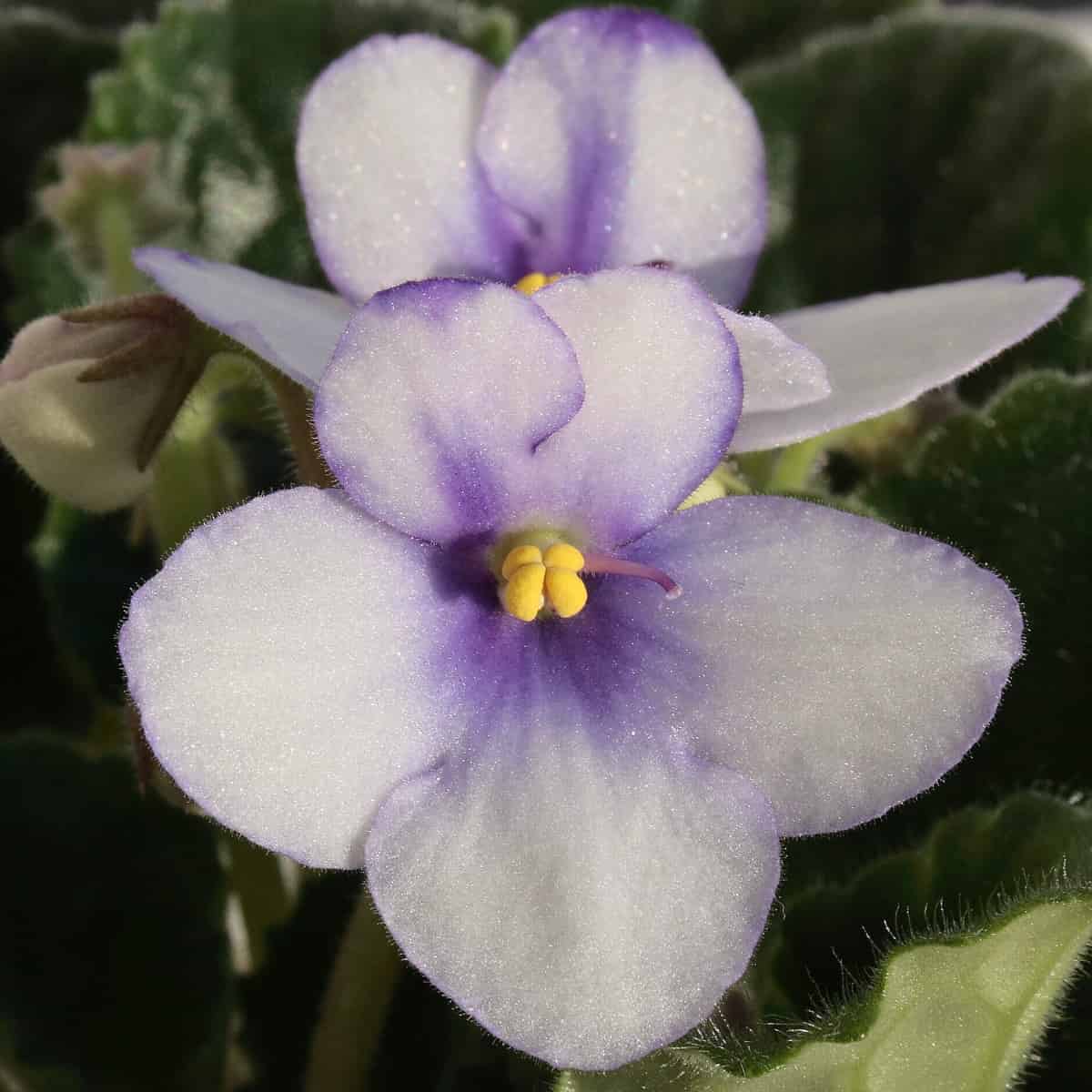



Have you ever noticed how African violets seem to have a mind of their own when it comes to flower colours? One season they’re beautifully striped, the next season their petals are a solid colour. Sometimes the same plant will produce flowers that are completely white. Scientists have long been puzzled by African violets’ tendency to change flower colours, especially when plants are grown from tissue culture in commercial nurseries.
For decades, botanists thought these patterns came from plants having different genetic “layers” (called periclinal chimeras). The problem with a genetic explanation is that when biologists propagate new plants through tissue culture, they typically use a single cell layer, so these new plants should all have the same genetic make-up. Yet these apparently genetically homogenous violets could still produce varying flowers. Daichi Kurata and colleagues examined African violets closely to see how the genes were acting to produce these changes of colour.
The team carefully tracked what happened when they grew African violets from tissue culture, documenting all the colour variations that appeared. They then analysed the different coloured petals to see what pigment molecules were in them, and which colour compounds might be missing. They also looked at what mechanisms were active, or not in the petals when some of these pigments were being made by the plant.
They looked not at the DNA of the plant, but the RNA. RNA is a messenger that travels from the DNA to the ribosomes, the protein making factories of a cell. The RNA only forms when the gene is active, so looking at the RNA told them which genes were in action and which weren’t. The key gene was SiMYB2. It produced two RNAs. In petals with pigments it produced the RNA SiMYB2-Long. This triggered the building of anthocyanins, the pigments that give the violets their purple colour. In white petals, the same gene produced SiMYB2-Short as the RNA. This doesn’t do anything, so the anthocyanins never got made, and the petals stayed white. What decides which version of SiMYB2 gets made?
The botanists looked for methylation in the DNA. This is a modification to the DNA, a -CH₃ group attaches to a cytosine base in the DNA. This makes it harder for the molecular machinery to make an RNA copy of this part of the DNA, and if the copy isn’t made, then the gene is silenced. They found that in white flowers SiMYB2 had a lot of methylation, in the coloured petals, it didn’t. Another interesting feature is that one mutant was unable to make SiMYB2-Short. These mutants produced much more pigment than the usual violets.
Examining the mutant revealed a clue as to why SiMYB2 can be read two ways. It seems that left alone the gene only produces SiMYB2-Long. But what most African violets have is a transposon, a jumping gene, that has inserted itself into the SiMYB2 gene. That break in the code allows the SiMYB2 gene to be interpreted to produce SiMYB2-Long or SiMYB2-Short. But the mutant lacks this transposon, so only SiMYB2-Long can be produced.
Traditional plant breeding has focused on permanent genetic changes, but African Violets demonstrate how reversible molecular switches can cause plants to change their appearance. Similar colour-switching mechanisms have been found in other ornamental flowers like chrysanthemums, suggesting this might be a common way plants create pattern diversity.
This flexibility is a useful tool for plants. It gives them more options to adapt to changing conditions while maintaining their core genetic identity. It’s obviously more of a problem for horticulturalists who spend all the effort propagating a plant through tissue culture to find that they’ve shuffled the methylation and the flower colour. However, if you find your African Violets won’t stay violet, then you can take comfort knowing the plant isn’t complaining about your houseplant care.
READ THE ARTICLE
Kurata, D., Tsuzaki, T., Tatsuzawa, F., Shirasawa, K., Hirakawa, H. & Hosokawa, M. 2025. Unstable anthocyanin pigmentation in Streptocarpus sect. Saintpaulia (African violet) is due to transcriptional selectivity of a single MYB gene. New Phytologist. https://doi.org/10.1111/nph.70286
Cover image: Usambaraveilchen. Photo by Hedwig Storch / Wikimedia Commons