


Beneath the southern Indian Ocean, where the African tectonic plate is ripping apart from its Antarctic neighbour, a deep sea volcano rises. It pierces the ocean’s surface in the roaring forties, a region notorious for its howling winds and tempestuous waves, where it’s known as Marion Island.
Exposed the winds, leave the island cold, with WIkipedia stating that snow or frost could be expected any time of year. It also mentions that it’s among the cloudiest places in the world. You’d expect that if somewhere were to benefit from global warming, this would be the place. It’s also located in somewhere where the greatest warming is expect to occur. A team of South African botanists visited in 2019 and 2020 to conduct experiments what the future has in store for the island.
Marion Island sounds like a great place for botanical fieldwork. It’s isolated, having only risen with its close neighbour Prince Edward Island after the continents dispersed. It’s a great place to get away from it all, unless you want to get away from penguins, seals, and wandering albatrosses. Half the world’s population of wandering albatrosses live on the island. Unfortunately, this population is in trouble because there’s also a lot of mice. Humans only arrived on the island in 1799, bringing with them mice as stowaways. But later arrivals who came to set up a research station in 1947 brought more invasive species with them.
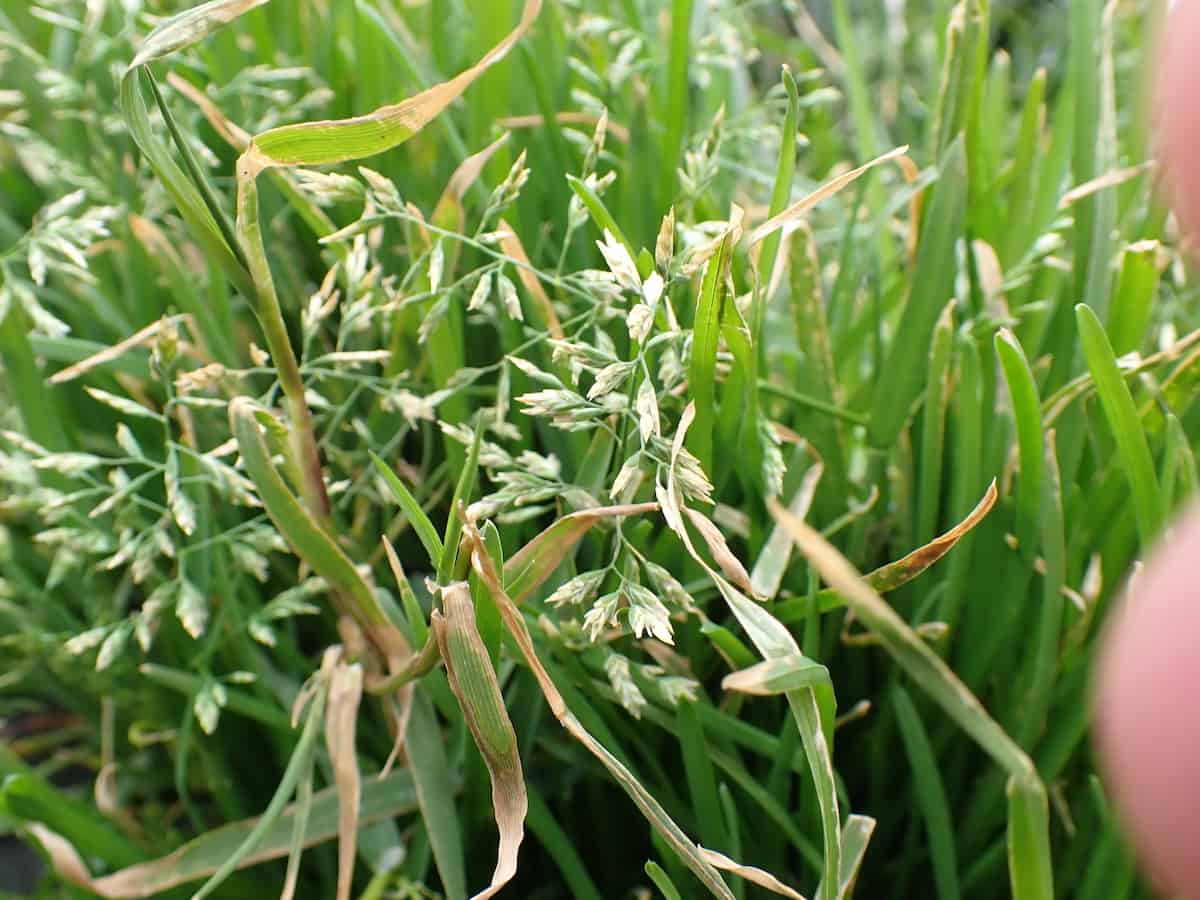
Poa annua, also known as Poa infirma, is a common grass in western Europe and also found around the world as an introduction. Grass seed gets everywhere, and in the middle of the 20th century it got to Marion Island, where it became an invasive species.
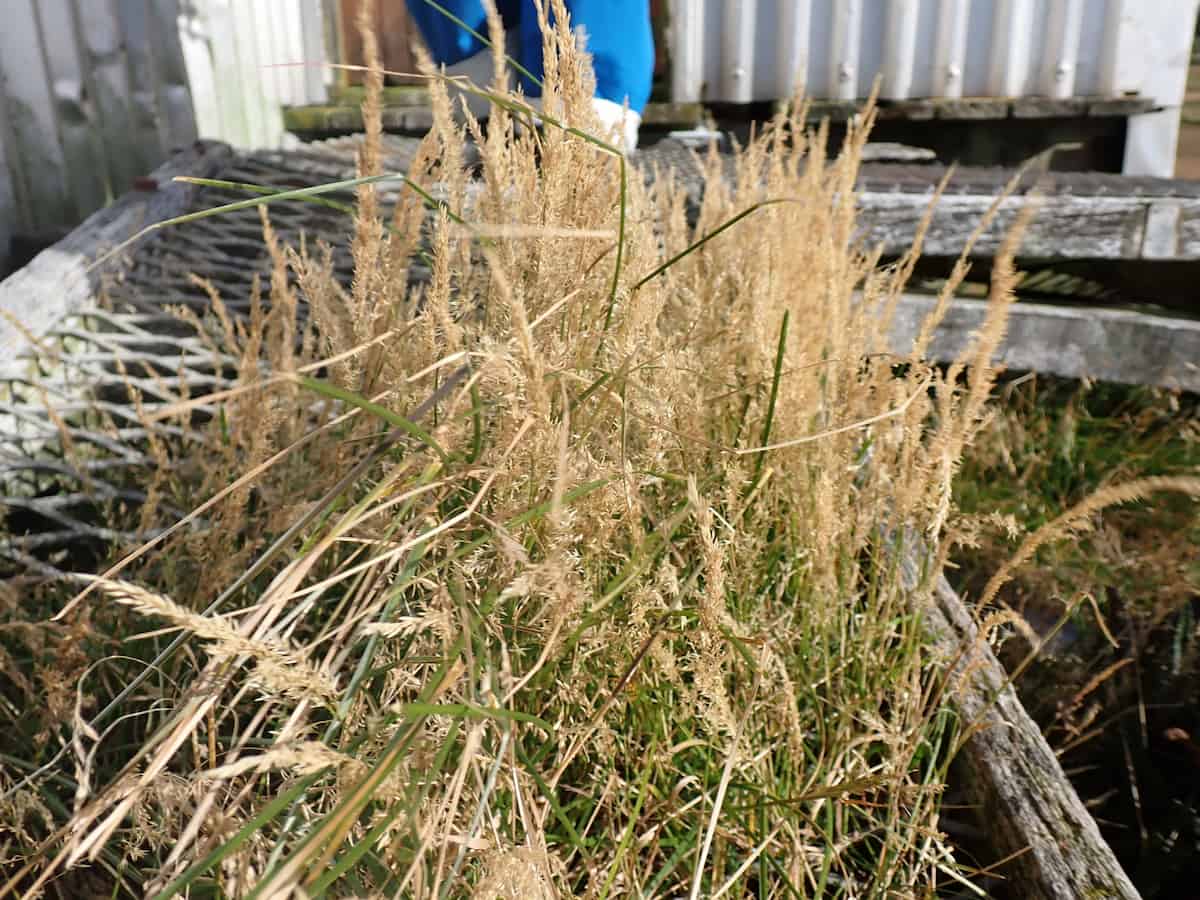
Agrostis stolonifera is another widespread Eurasian grass, that has been taken by humans around the world. It spreads not just by seed, but also by stolons, creeping horizontal stems that can put down new roots. This means that when it finds somewhere it likes it can spread fast.
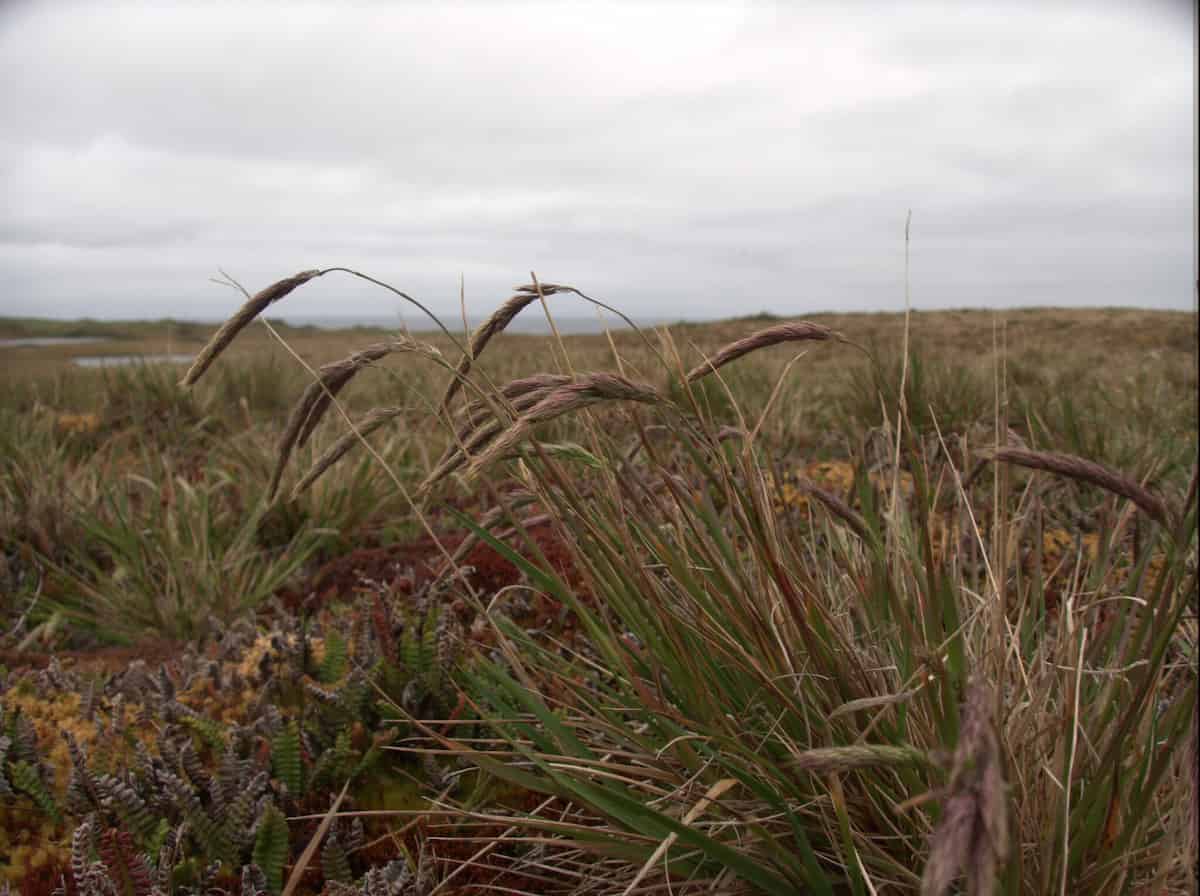
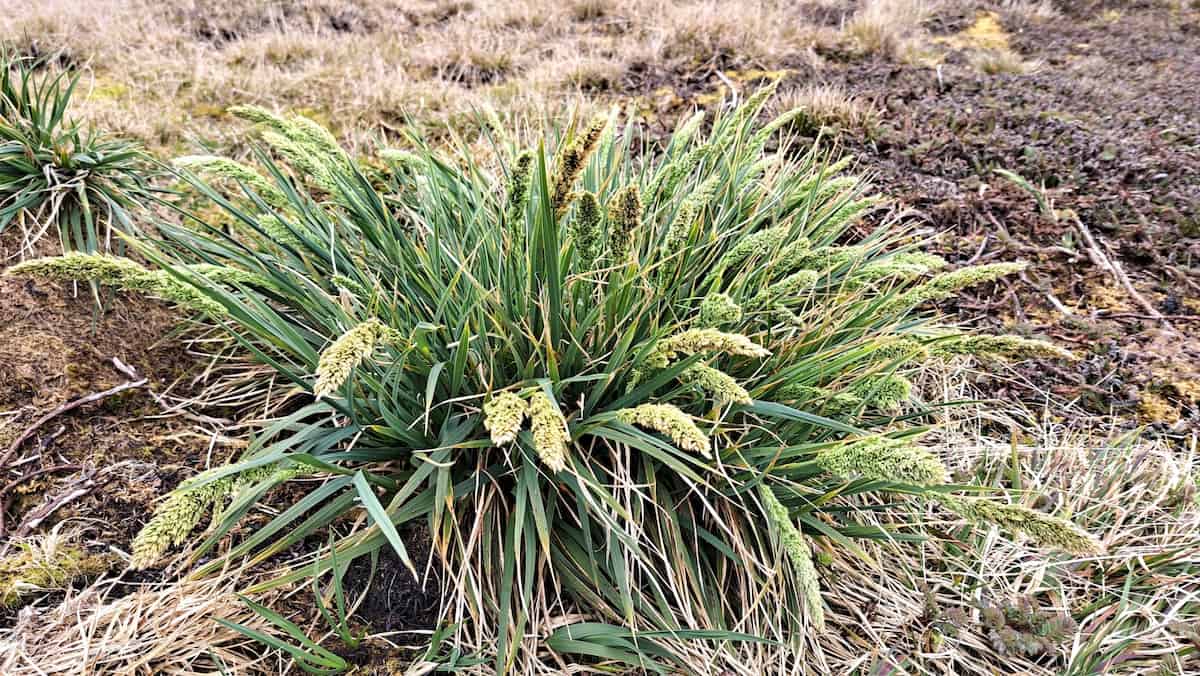
Nita Pallett and colleagues gathered samples of grasses on the island and, placing them in pots, subjected them to soil warming, raising them 3°C above ambient temperature to see how they reacted. They used two native grasses Polypogon magellanicus and Poa cookii for comparison with the invasive plants to see if one side would have an advantage over the other.
One of the reasons subantarctic islands like Marion Island are thought to be so sensitive to global warming is due to the Cold Ecosystem Theory. The idea behind this is that, in cold ecosystems, it’s not the temperature as such that’s the problem. It’s nutrient starvation.
Plants get most of what they need to grow from the atmosphere as carbon dioxide and from the soil as water. But they still need some other elements, in particular nitrogen, phosphorus and potassium. These are provided in the soil by microbes, and when it’s colder microbes are less able to work. The result is plenty of dead matter ready to be decomposed, but not many microbes doing the work. Warmer soil should mean faster decomposition, more nutrient and therefore faster and bigger plant growth.
To check that nutrient limitation was the problem, the team also conducted a second experiment. In this experiment they added nitrogen, phosphorus and potassium as fertiliser to see how the plants reacted. The plants didn’t react the way the theory predicted.
You could expect warming to improve nitrogen availability. The extra warmth kicks microbes into action, recycling dead material and making it available for plants. Yet an increasing number of studies are showing this isn’t always the case. Pallett and colleagues also note other studies have found that the increase in nutrient availability can be temporary. This shows why real-world experiments are necessary.
For the plants of Marion Island, warming consistently increased plant growth for only one species (the invasive Poa annua). The two native grasses showed no significant response to warming, and surprisingly, neither did Agrostis stolonifera, the other invasive species. But the really surprising finding came from the fertiliser experiment.
Adding fertiliser did aid plant growth for all the species. A lot. Growth doubled, for both native and invasive plants. The plants were clearly hungry for food that was theoretically abundant in Marion Island’s organic-rich soil. But if warming was supposed to release these nutrients from the soil, why were the plants still starving?
Testing the soil revealed why the plants remained hungry. Warming did release some nitrogen, but far less than expected. Even worse, it failed to release phosphorus at all, another nutrient essential for plant growth. Marion Island’s rich organic soil, despite months of warming, stubbornly held onto most of its nutritional wealth. The microbial recycling crews that should have been working overtime were barely showing up for work. These findings have significant implications for our understanding of climate change effects. Pallett and colleagues write:
[F]ertiliser application has been used in experiments as a proxy for soil warming, implicitly assuming warming will increase nutrient release (e.g., see Jonasson et al. 1999; Graglia et al. 2001). The use of fertiliser as a proxy for soil warming is inappropriate, because nutrient release with warming may not occur or be comparably small. Furthermore, responses to warming decline with time due to microbial temperature acclimation or substrate limitation (Kirschbaum 2004; Romero-Olivares et al. 2017). Fertiliser application as a warming proxy also assumes simultaneous increases in all nutrients required by plants, which may not be the case.
The results show that the because warming doesn’t automatically lead to more nutrients available in the soil, rising temperatures may aid invasive plants in the Arctic and Antarctic. This is going to create more conservation challenges in regions where access is not simple. The results also emphasise that these are exactly the kind of places biologists will have to be, if they want to test their models against real-world data.
READ THE ARTICLE
Pallett, N.C.M., Ripley, B.S., Greve, M. and Cramer, M.D. (2025) “Warming has limited effects on plant growth through nutrient release: evidence from sub-Antarctic Marion Island,” Annals of Botany. Available at: https://doi.org/10.1093/aob/mcaf154.
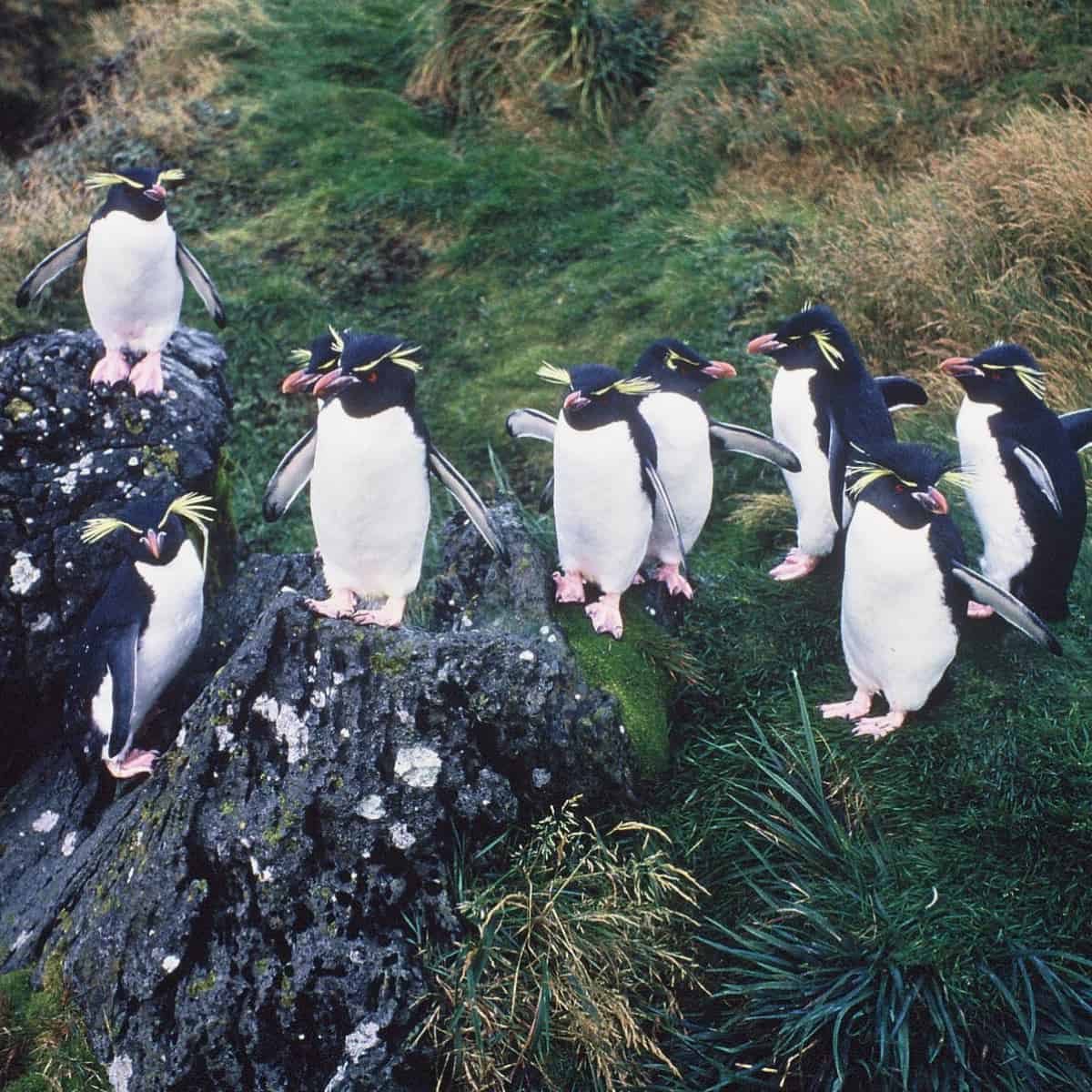
Cover image: Marion Island with some Rockhopper Penguins patiently explaining how they got their name, by lizziepop / iNaturalist CC-BY-NC