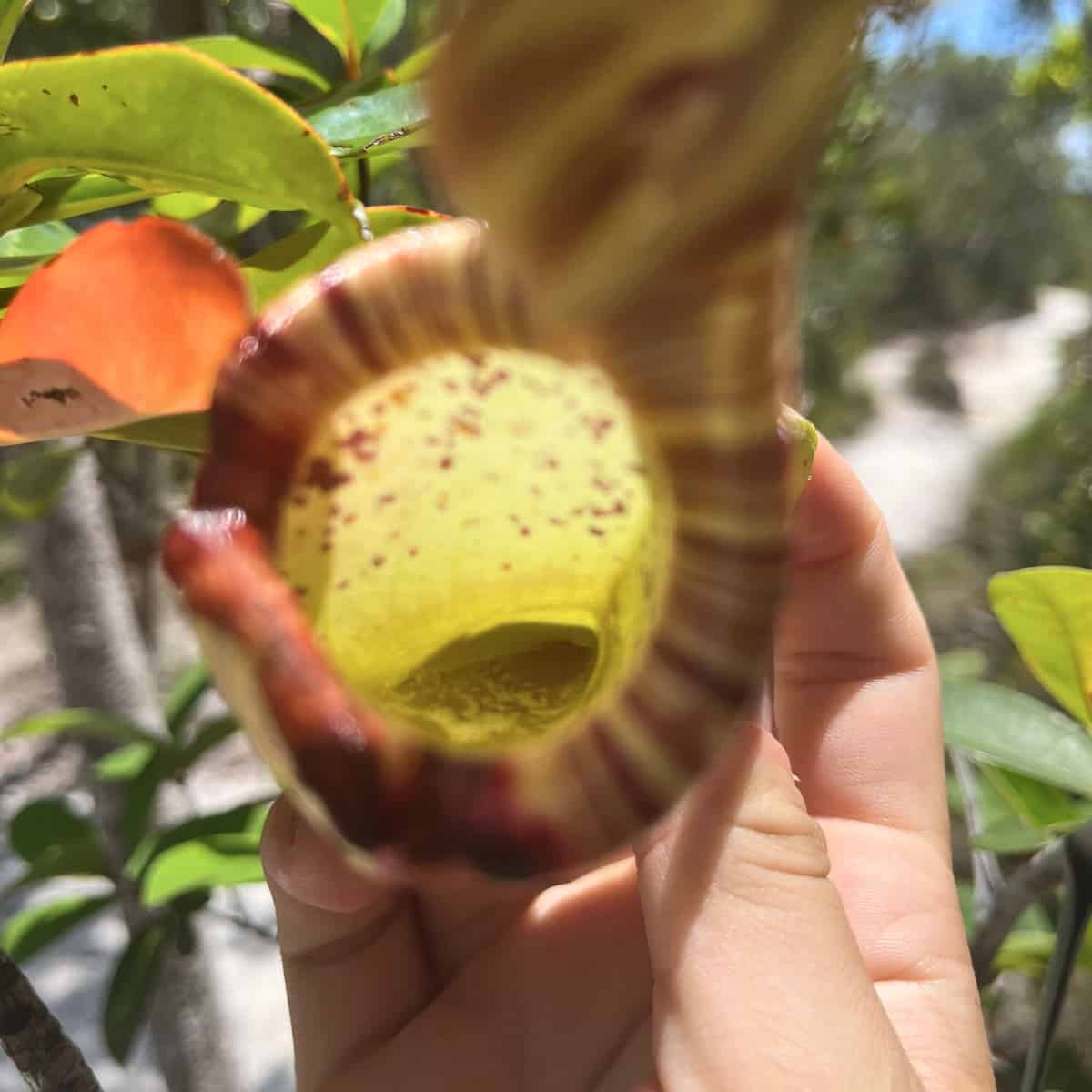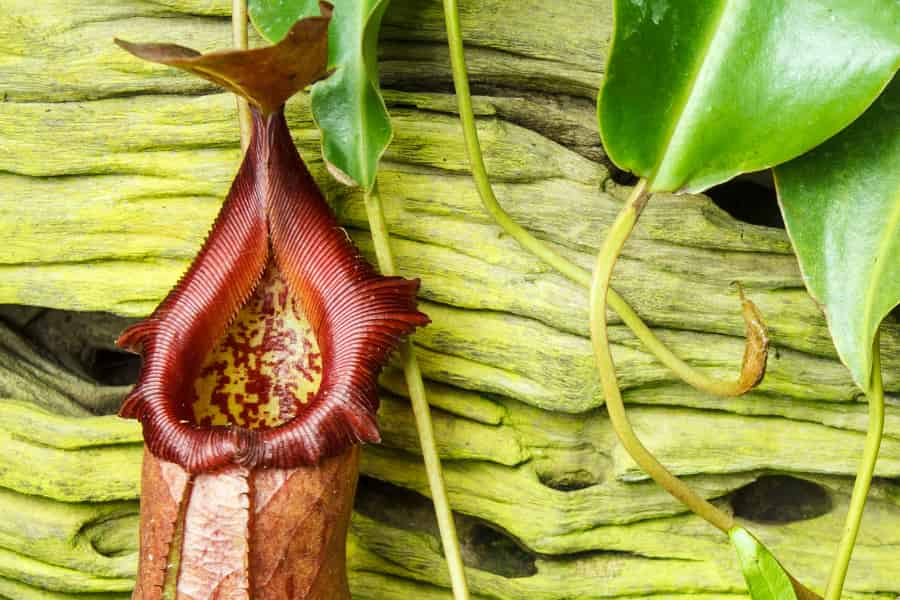


The rim around the opening to a pitcher plant’s trap, the peristome, is distinctive. Often ridges run down into the pitfall trap, but why? Why not have something barbed instead to hinder insects climbing back out? David Labonte and colleagues have examined the topography of these rims. They conclude the entrances fold in an intricate way to increase the wettability and slipperiness of the traps.
Nepenthes is a genus of plants that hunts in the tropics, mainly in southeast Asia. It produces modified leaves that form cups, or pitchers, with a lid over the top. Prey, usually arthropods, comes along to feed at the pitcher and, while venturing on the rim, falls in. Some plants do this by producing wax crystals that can stick to insect pads and prevent grip. But not all Nepenthes plants do this. Some use water to create a wet trap. How the plant can use water reliably, without it running away rapidly, is a puzzle.
The wet trap works by using water to create a low grip surface on the plant. The plant does this by holding a thin film of water in place so, ideally, you’d have a very hydrophilic surface. The problem with that is that the cuticle, the outermost layer of the plant, needs to be a barrier to water to keep moisture in when the weather is warm. These conflicting needs, to be very wet yet remain a waterproof barrier, are why Labonte and colleagues investigated the traps.
The answer lies in the ridges on the peristome, which come in two forms.

The easiest ridges to see are the macroscopic ridges. These form polar channels, running up and down into the trap. Water falls into these ridges and runs down, wetting them. What water doesn’t do very well is run across the ridges. The team experimented to see how difficult it was to for water to travel across from one major channel to the other. The answer is very.
What they found is that water would pile up in a channel. Once the water was deeper than the channel, the water would build up as a bulge instead of overflowing until it reached a critical angle. Then a mass of it would move to fill the next channel. Instead of gently flowing across, it moved in a series of haphazard steps. Combine this with the ease water is guided to run down the channels, and it’s clear that once water enters the peristome, it runs in a very specific direction instead of meandering across.
Water moving across channels in the Nepenthes peristome. Video: Labonte et al 2021.
As well as macroscopic channels, the peristome has microscopic channels. "Each microscopic channel is formed by a single row of overlapping epidermal cells, which form a series of steps," write Labonte and colleagues. These single-cell channels pull water through surface tension and draw water up and down through capillary action. These channels create a stable water film that can cause insects to aquaplane into the trap below. The aquaplaning will only work if there's a stable channel for the water film to form along. This is where the macroscopic channels work, guiding water along the microscopic ridges.
This combination of architecture at the peristome helps make the traps so effective, say the authors in their article. "While the peristome cuticle is only moderately hydrophilic, it remains fully wettable and slippery due to the roughness provided by the microscopic channels, which increase the stability of water films under the adhesive pads, so causing insects to aquaplane. Together, these two mechanisms result in an efficient trapping mechanism that enables pitcher plants to capture some of nature's most proficient climbers."
Understanding how the surface of a pitcher can get so slippery could have applications beyond botany and entomology. Through understanding how these surfaces work, it may be possible to engineer wettable slippery surfaces elsewhere without the need for chemical interaction.
A bioRxiv preprint of this article is freely available at https://doi.org/10.1101/2020.10.09.332916