

Everyone knows that you can age a tree by counting its rings, and the width of those rings is a record of climate. But do you need trees to track the climate?

Climate isn’t the same everywhere. The forthcoming El Niño event threatens parts of the world with droughts and other parts with floods. So in recreating models of past climates it’s helpful to be able to check your work against a wide data set.
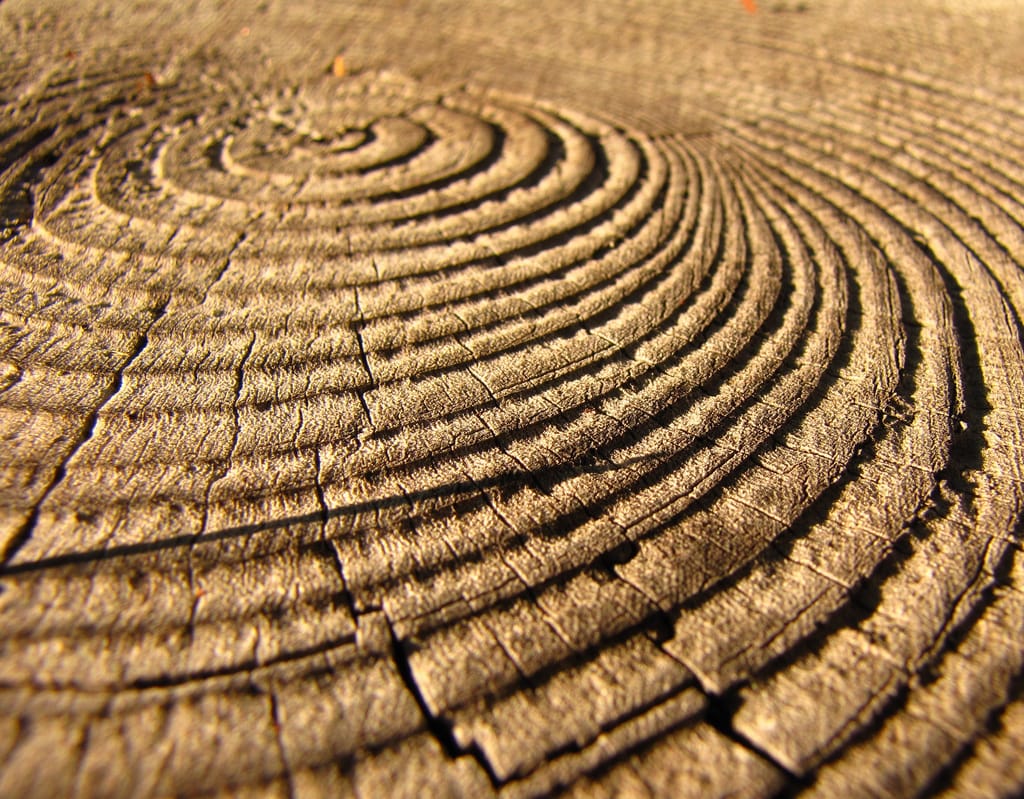
Dendrochronology, the study of tree rings, is a useful tool for doing this. A tree has annual growth and it’s visibly marked in the structure of the tree, making rings as the trunk grows bigger. The width of these rings is a record of the climate for that year. During a wet year a tree may be able to put on more growth than during a drought. So take a sample from a trees and the rings give you a very tight match between the year and its climate.
Of course, that does mean you’re reliant on the area you’re looking at having trees.
Eryuan Liang and Dieter Eckstein have looked at the Tibetan plateau, where there are few trees, and thhey’ve found an alternative. They published a paper in Annals of Botany, Dendrochronological potential of the alpine shrub Rhododendron nivale on the south-eastern Tibetan Plateau, where they showed shrubs could be used instead.
Liang and Eckstein took samples from by the Zuoqiupu Glacier, between 4250 and 4500 metres above sea level. There air pressure at that height is so low that there's a good chance you'd pass out without acclimatisation. They deliberately went this high, as human activity has affected the plants lower down. Rhododendrons are firewood, so the climate record could literally go up in smoke.
[caption id="attachment_15568" align="alignright" width="344"](A) Cross-section of the oldest snowy rhododendron at the study site. The well-defined annual growth rings are shown in (B) and details of the wood anatomy in (C). Scale bar = 5 mm. Photos: Liang and Eckstein (2009).[/caption]
You can see Liang and Eckstein found well-defined annual rings, and also no rotten core to the stem. They found the rings were wide enough to make dendrochronology practical.
They were also able to correlate the ring patterns in the rhododendrons with the rings in Georgei firs, so it looked like the rings were a reliable ecological indicator. The key period for ring width was the mean minimum temperature in July and in the November before. With rhododendrons being widespread in the Tibetan Plateau, they looked like a good source for climate data.
Interesting, but this was all in a paper in 2009, why does it matter now?
Liang and Eckstein got rings as far back as sixty years. It proved the concept, but it was limited in use. Now they've co-authored another paper, and the record goes back a lot further. The paper is Up to 400-year-old Rhododendron shrubs on the southeastern Tibetan Plateau: prospects for shrub-based dendrochronology (subscription required) in the journal Boreas.
This new study uses Rhododendron aganniphum. The plants in the new sample sites had a correlation with the July temperatures, but the relationship to the November temperatures seems a bit more murky. However, the samples they found enabled them to build one sequence from the year 1670 and four more from the eighteenth century. It seems more work could help flesh out the changing climate of the Himalayas.
Liang, E., & Eckstein, D. (2009). Dendrochronological potential of the alpine shrub Rhododendron nivale on the south-eastern Tibetan Plateau. Annals of Botany, 104(4), 665-670. DOI: 10.1093/aob/mcp158
Lu, X., Camarero, J. J., Wang, Y., Liang, E., & Eckstein, D. (2015). Up to 400‐year‐old Rhododendron shrubs on the southeastern Tibetan Plateau: prospects for shrub‐based dendrochronology. Boreas. DOI:10.1111/bor.12122