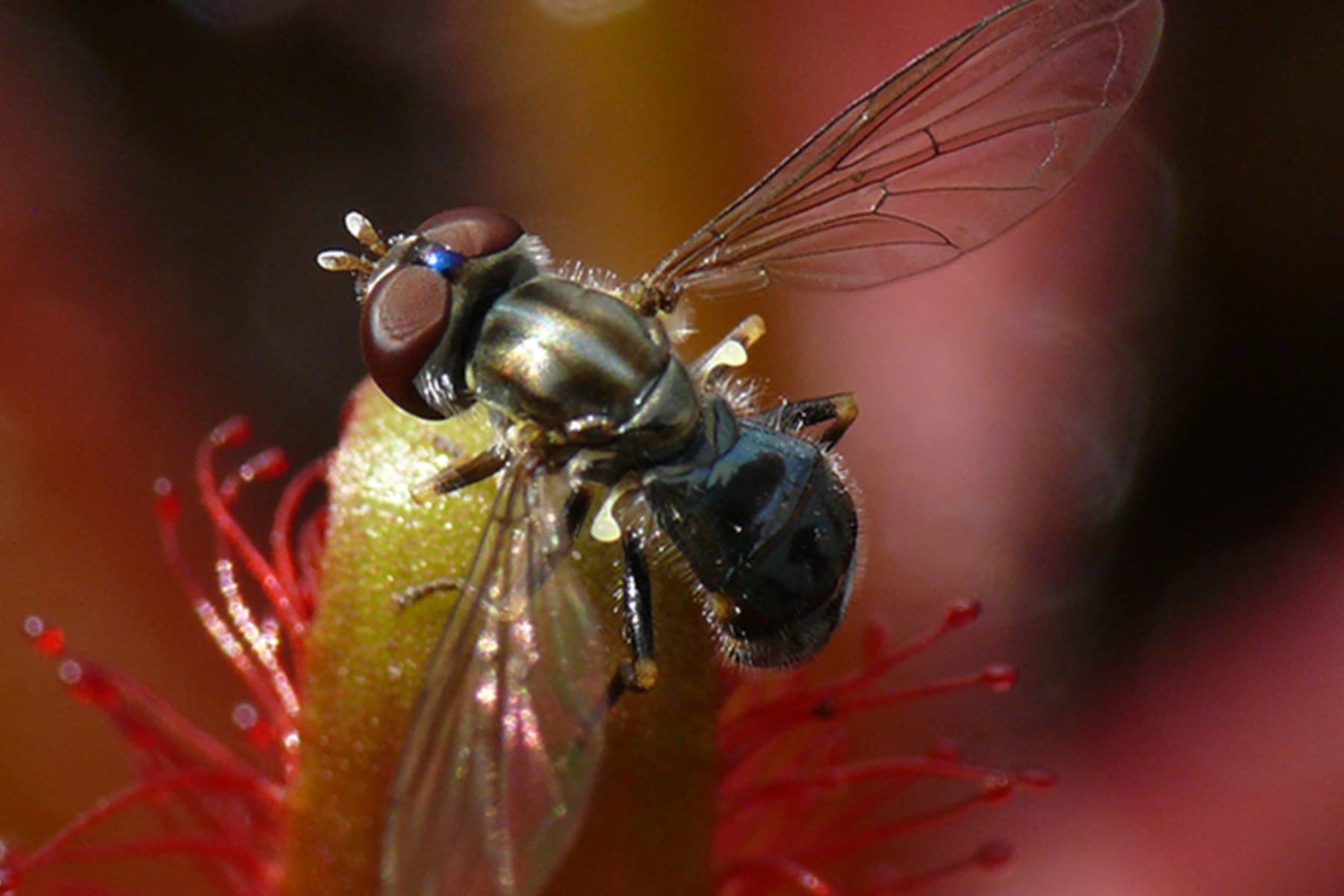


Most of a plant’s food comes from photosynthesis. The plant can make the sugars it needs to fuel it with water and carbon dioxide. But some molecules need more. Plants can pick up other elements, like nitrogen or phosphorus, through their roots. If the soil doesn’t have those elements, some plants can grab them by capturing prey, usually insects and digesting them. The sundew, Drosera spp., is one such plant that captures insects in its leaves. Its leaves are not a healthy place for an insect to be, so a fly like Toxomerus basalis, the Sundew Flower Fly, is a puzzle. A recent study by Andreas Fleischmann and colleagues has found that this fly lays its eggs on or near sundews. Not only that, but the larvae, or maggots, live their lives on sundews, crawling around them until they pupate. Why would a fly leave its children in the care of a plant that would happily eat them?

Sundews get their name from their traps. They have leaves with hairs, and the hairs hold a sticky glue that glistens, like dew, in the sun. They look pretty, but they’re deadly. A fly landing to investigate what might look like a snack gets stuck on the glue and struggles. These struggles activate the leaves. Slowly the leaf curls around, bringing more hairs into contact with the victim, making it harder for them to escape. Eventually, the whole leaf curls around the prey, and the plant releases enzymes to digest the unfortunate creature.
The leaves are very effective, so when a sundew wants to attract a pollinator, it makes sure its flowers are well away from the leaves. That way, it doesn’t load up an insect with pollen before eating it.
The efficiency of a sundew as a killer isn’t just a threat. It’s also an opportunity. Wrapping a leaf around a victim takes time. If a thief were fast enough, the sundew could do the hard work of attracting and trapping a meal, and then someone else could step in and steal the food before it was gone. If you’re enterprising enough, a sundew is less a graveyard and more a meal delivery service. This is the case for the Sundew Flower Fly.
The larvae of the Sundew Flower Fly are hungry and happy to eat most things. Fleischmann and colleagues cite work showing them eating a menu including “aphids, caterpillars, beetle larvae, planthoppers, gall midges, thrips, mealybugs, whiteflies, mites, and insect eggs”. Earlier work by Fleischmann and colleagues showed that if a sundew could catch it, then a Sundew Flower Fly larva was happy to try eating it. The team set out to see if this was a phase in the life cycle or if there was something more. Staking out sundews with cameras, they were able to track the life cycle of the Sundew Flower Fly and found that from egg to pupation, they lived on the plant.
Toxomerus basalis, the Sundew Flower Fly, on a sundew. Video: Fleischmann et al. 2022.
Life for a Sundew Flower Fly starts on the underside of a sundew leaf. The location is due to the female Sundew Flower Fly not being suicidal and landing in the trap to lay her eggs. The flies can escape the traps if they don't hit too many hairs, but it's not a good idea to deliberately hit too many of them. This probably explains why they prefer to lay eggs on the most exposed leaves.
Once they hatch, the larvae sit on the leaves, waiting. If they felt threatened, they would withdraw to the rosette of the plant and hide in the base of the leaves. Once they feel the vibrations of struggling prey, they move out onto the leaves to find and eat it.
The team had thought the larvae would go for dead prey. In fact, they found the larvae like their food fresh and alive. They waited till the prey stopped moving before striking. If starting to eat triggered more movement from the victim, the larvae would back off until they were sure it was safe to eat.
One mystery is 'why are the leaves safe for Sundew Flower Fly larvae?' Surely, if a sundew can trap caterpillars, it could trap the Sundew Flower Fly larvae. How does it not? The answer might be in how sundews trap and sense prey.
Toxomerus basalis, larva on a sundew. Video: Fleischmann et al. 2022.
One major factor in triggering a sundew's trap is a repeated struggle in the same place. The larvae blunder into the hairs, but they're covered in slime of their own, so the glue doesn't attach to anything firm, leaving the larvae free to hit other hairs elsewhere on the leaf. Yet sundews don't just use a sense of touch to detect prey. They also taste.
The hairs of sundews are chemotropic, meaning they move towards certain chemicals. Fleischmann and colleagues argue the chemical composition of the larva's slime might act as a camouflage.
The authors also put forward an alternative explanation. "[I]n his benchmark experiments on carnivorous plants, Darwin found that drops of water do not cause any Drosera tentacle movement. It is possible that the fluid larval exudates acts similarly, provided it does not contain significant quantities of organic or inorganic particles."
After feeding up, the larvae pupate on the underside of the sundew leaves. This takes a few days. Then, as adults, they feed on the pollen of the sundew flowers. In isolation, living with the enemy like this seems like a bizarre adaptation, but some other plants show how a relationship could develop.
Roridula is a genus of protocarnivorous plants. These are plants that, like sundews, can trap insects on sticky leaves. Unlike sundews, Roridula cannot digest the insects it traps, but it doesn't have to. Assassin bugs live on the plant and feed on the insects that Roridula traps. What goes in also comes out, but the waste that the Assassin bugs drop is fresh manure that Roridula can digest.
There are plenty of other plants that have sticky traps for defence and insects that have learned to exploit the victims that get caught. A sundew is a great asset for a fly with the right skills. It's no surprise that Fleischmann and colleagues observed flies of both sexes showing territorial behaviour around the plants. Ironically a plant that seeks to kill insects has ended up being guarded by one that finds it essential for its life history.
READ THE ARTICLE
Fleischmann, A., Gonella, P.M., Rojo, S. and Mengual, X. (2022) "Attracted to feed, not to be fed upon – on the biology of Toxomerus basalis (Walker, 1836), the kleptoparasitic 'sundew flower fly' (Diptera: Syrphidae)," Journal of Tropical Ecology. https://doi.org/10.1017/S0266467422000128