


Carnivorous plants can survive in poor soils by adding insects to their diet and have developed traps to do this. But what happens when prey is difficult to catch? Adam Cross and colleagues examined how some plants employ mammals to hunt and deliver prey to them. Their chemical analysis, published in Annals of Botany, shows that when insects are scarce, this is an effective strategy for survival.
Carnivorous plants are a group of plants that have evolved to capture and digest their prey to supplement their nutrient requirements. Nepenthes is the largest family of these plants, occurring throughout the Palaeotropics. They can be found as vines, possibly on trees, or else as low shrubs. They get their common name, Pitcher Plant, from a characteristic leaf structure in the form of a pitcher, which evolved primarily to attract, capture and digest prey.
The pitchers have an overhanging lid and a cylindrical peristome or specialised lip around the pitcher’s mouth. Inside the pitcher, the walls contain glandular zones and wax crystals, making it difficult for prey to grip, causing them to fall into the pitcher. The pitcher also contains an enzyme cocktail that helps break down and absorb nutrients from the prey.
Not only do Nepenthes species inhabit poor soils, but many live in ultramafic soils, soils with a high concentration of toxic elements like nickel or cobalt. These soils are found around Mount Kinabalu and Mount Tambuyukon, both located in Borneo, and both particularly rich in Nepenthes species. It’s at the high elevations of these mountains where botanists have spotted what appear to be morphological adaptations to capture and consume mammalian waste. Effectively the pitchers act as toilet bowls for small animals.
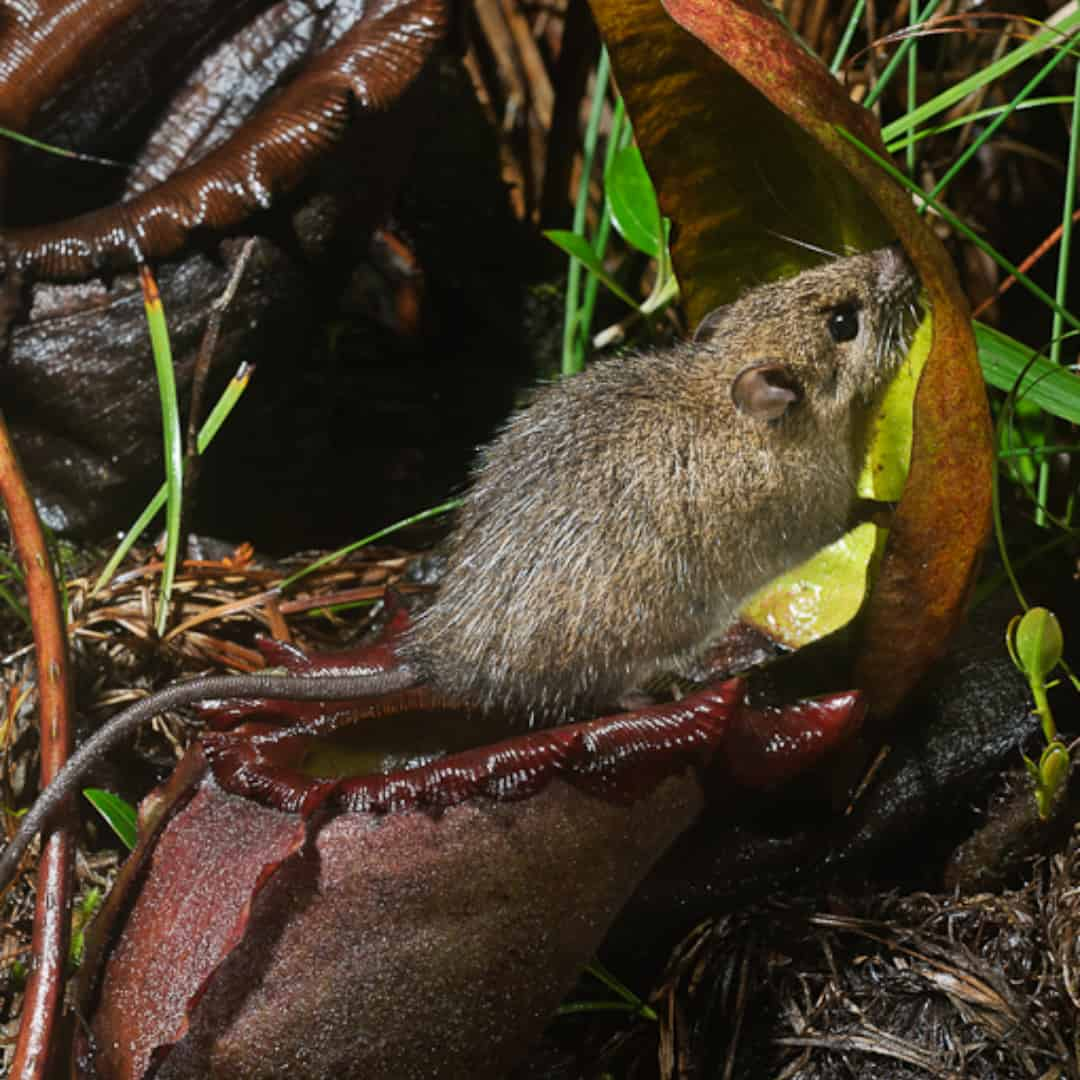
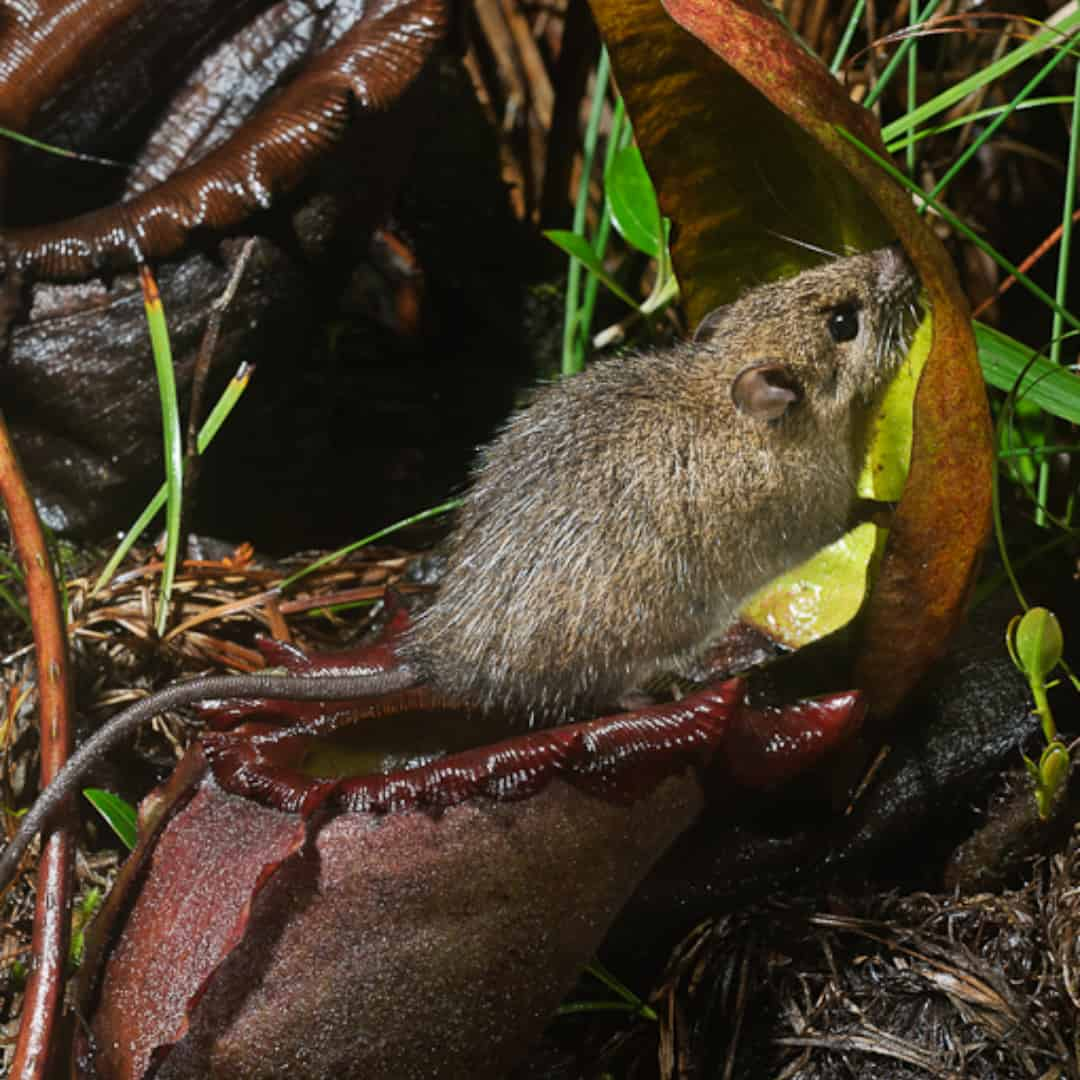
Recent studies have revealed an extraordinary mutualistic association between Nepenthes species found in Borneo and two species of small mammals: mountain tree shrews (Tupaia montana) and summit rats (Rattus baluensis). Clarke and colleagues, and Chin and colleagues, established that these mammals feed on the carbohydrate-rich secretions produced on the pitcher lids of Nepenthes lowii, Nepenthes rajah and Nepenthes macrophylla. The animals then defecate into the pitchers, providing a steady supply of nutrients to the plants. While Tupaia montana visits occur during the day and Rattus baluensis visits occur predominantly at night, it is yet unknown whether other nocturnal small mammals are involved in similar mutualism with Nepenthes.
The pitcher modifications found in some species of Nepenthes seem adapted to work well with Tupaia montana, suggesting that the plant is giving up some of its ability to trap insects directly. However, at this altitude, insects are comparatively rare, so it makes sense for the plant to have the animal chase after the prey and leave the shrew to drop off the concentrated results of its work when it's ready.
It's not just the highland species that host visitors. Nepenthes hemsleyana hosts Hardwicke's Woolly Bats. The bats roost in the pitchers, and they don't get out to visit the bathroom. Likewise, Nepenthes macrophylla attracts a bird known as the Mountain Blackeye, that makes regular deposits into the pitchers. However, Cross and colleagues comment that no other Nepenthes species outside of Borneo have been found to have similar faecal capture mutualisms. So is this a freak occurrence, or is there real value in being someone else's toilet?
Cross and colleagues set out to see where the plants got their nutrients. Were the mammals making a significant contribution, or was it just a little extra for plants that were still trapping their prey? The way they did it was by using natural isotopes as a tag to see where the meals were coming from.
If a plant gets its nitrogen from the soil, then it's relatively low in the heavier 15N isotope. Animals concentrate 15N in their tissues, so if a plant catches insects, it will have a high level of 15N in its tissue. If an animal is defecating into the plant, then it tends to keep more of the heavy nitrogen in its own body, while the waste has some 15N, it's not as rich as meat, so the plants that act as toilets should have a midway level of 15N.
When the scientists examined the tissues of the plants from the mountain tops to see where the nitrogen came from, they found that they were indeed elevated in levels of 15N, but not as much as you'd normally expect from a carnivorous plant. The results match what you'd expect if the plants were looking for other ways to get their nitrogen without directly catching insects.
Cross and colleagues note that not all of the Nepenthes plants attract mammals, so what you may be seeing is niche segregation, where some plants chase one source of nitrogen while other plants avoid competition by getting their nitrogen elsewhere. They also add that even the Nepenthes adapted to attract mammals won't turn away a free lunch if it buzzes into their pitcher. In their article, they write:
We hypothesize that Nepenthes have become specialized for contrasting solutions to nutrient deficiency at high elevation, and that specialization evident in Nepenthes from high elevations arose from the benefit of diverse trapping regimes that facilitate nutritional returns through (1) the attraction, capture and/or retention of specific prey groups; (2) the capture and retention of prey under environmental conditions that would render typical pitcher morphology less effective; or (3) the attraction and retention of nutrient-rich animal by-products (i.e. faeces). None of these are mutually exclusive with respect to incidental prey capture. The many examples of different species with different trapping regimes stably coexisting – often literally side by side – as components of the climax vegetation on various peaks across Malesia may reflect both the directions that this selection pressure may take and its long-term, success-driven stability.Cross et al. 2022
READ THE ARTICLE
Cross, A.T., van der Ent, A., Wickmann, M., Skates, L.M., Sumail, S., Gebauer, G. and Robinson, A. (2022) "Capture of mammal excreta by Nepenthes is an effective heterotrophic nutrition strategy," Annals of Botany, 130(7), pp. 927–938. Available at: https://doi.org/10.1093/aob/mcac134.