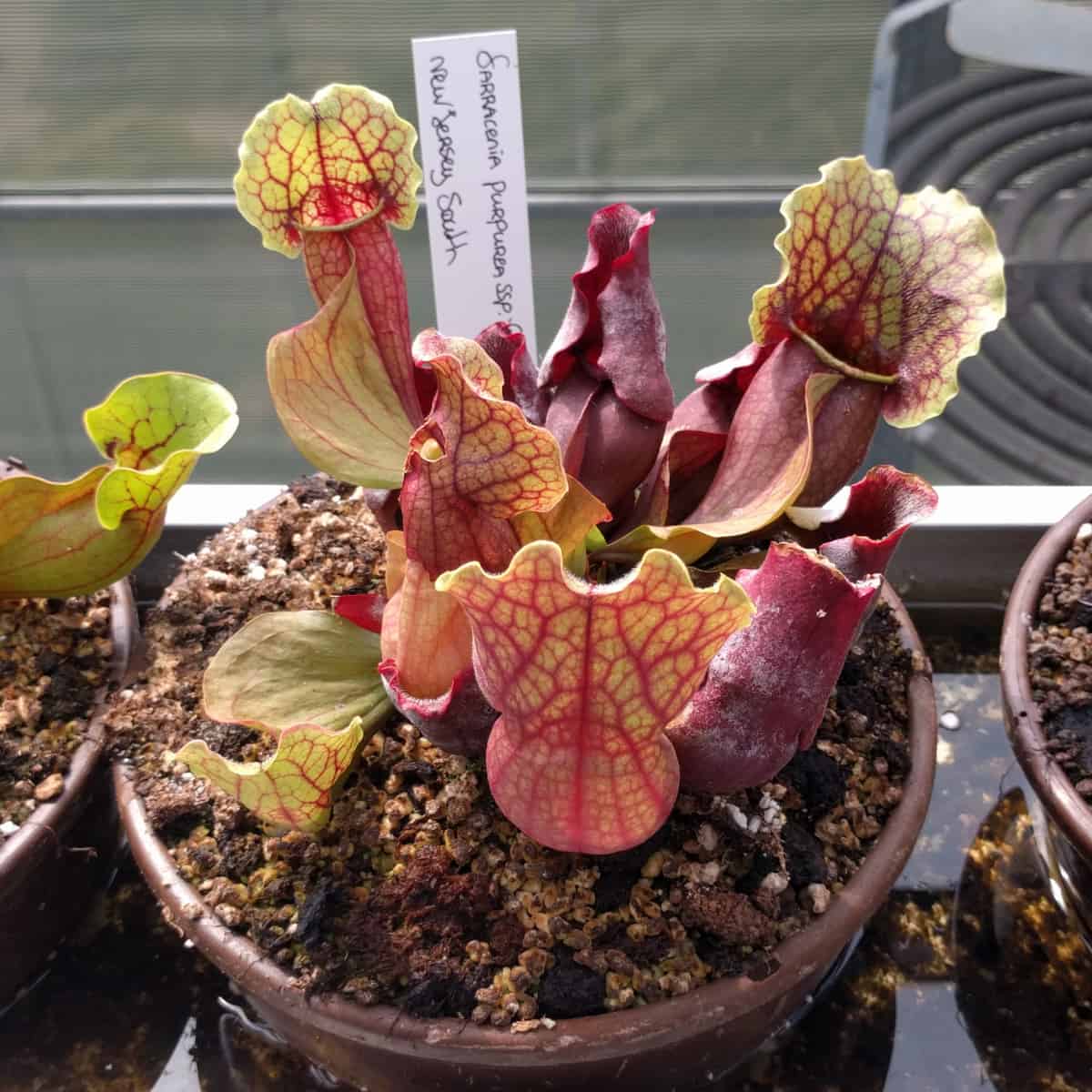



The purpurea in Sarracenia purpurea means purple, and refers to the carnivorous plant’s distinctive reddish-purple venation. But not every Sarracenia purpurea plant is purple. Some are green. This has allowed Martin-Eberhardt and colleagues to ask, why does this species of pitcher plant spend so much effort on making itself purple? Is it to attract prey, or to deter herbivores? Could it even be to attract pollinators? To their surprise, they found that many Sarracenia plants might be trying to deter some visitors.
Sarracenia purpurea lives in nutrient-poor soils, its native range being from the northeastern United States, across the Great Lakes region and into Canada as far west as Alberta. It has relatively short and squat cups, compared to the taller more elegant flutes of many Sarracenia. Most of these cups are in shades of red or purple, but some are green. These cups fill with digestive fluid, and the plant kills prey that fall into them and drown. But it’s either not a very good killer or else very selective. Research has found that it captures less than 1% of its prey.
Martin-Eberhardt and colleagues wanted to know how much these purple cups helped the plant attract prey. They studied 75 pairs of neighbouring red and green pitcher plants growing naturally in Michigan bogs. They tracked new leaves to see how much prey they captured, how much herbivore damage they took and what specialised insects may have colonised their pitchers. This is a new idea I’ve not come across before. Does the red act as a signal to attract insect helpers to colonise these cups?
The results were a bit of a surprise. The red colour did not attract prey, the green plants caught more, over 40% more. Nor did it attract colonisers. It also didn’t help combat herbivory. The red plants were damaged more than the green plants. On every test it seems that red is a worse colour for Sarracenia purpurea than green. Yet the red/green ratio has remained stable for over 60 years. So why hasn’t the plant evolved to be green?
A difference Martin-Eberhardt and colleagues noticed is that not only did the red plants catch fewer prey, they also caught fewer pollinators. Green plants were six times more likely to capture Bombus impatiens bumblebees, a known pollinator of the plant. They argue that the two forms of Sarracenia purpurea continue because there isn’t a clear advantage in a specific colour. There are multiple ecological interactions going on simultaneously. Finding a balance between attracting prey, repelling herbivores and protecting pollinators mean that the red pigments in the plant have many different effects at the same time, that a single interaction approach could miss.
Martin-Eberhardt, S.A., Weber, M.G., & Gilbert, K.J. 2025. Anthocyanin impacts multiple plant-insect interactions in a carnivorous plant. The American Naturalist. https://doi.org/10.1086/735010 ($)
Cross-posted to Bluesky & Mastodon.
Cover. Sarracenia purpurea. Image by Rudolphous CC BY-SA 4.0, via Wikimedia Commons