

The Asian tiger mosquito, Aedes albopictus, is a severe threat to human health, and it is one of the world’s worst invasive animal species and carries many viruses. Scientists have been seeking an effective and environmentally friendly control strategy. Riccardo Casini and colleagues in Italy have been examining bladderworts, aquatic carnivorous plants of the Utricularia genus, as a potential biological control solution.

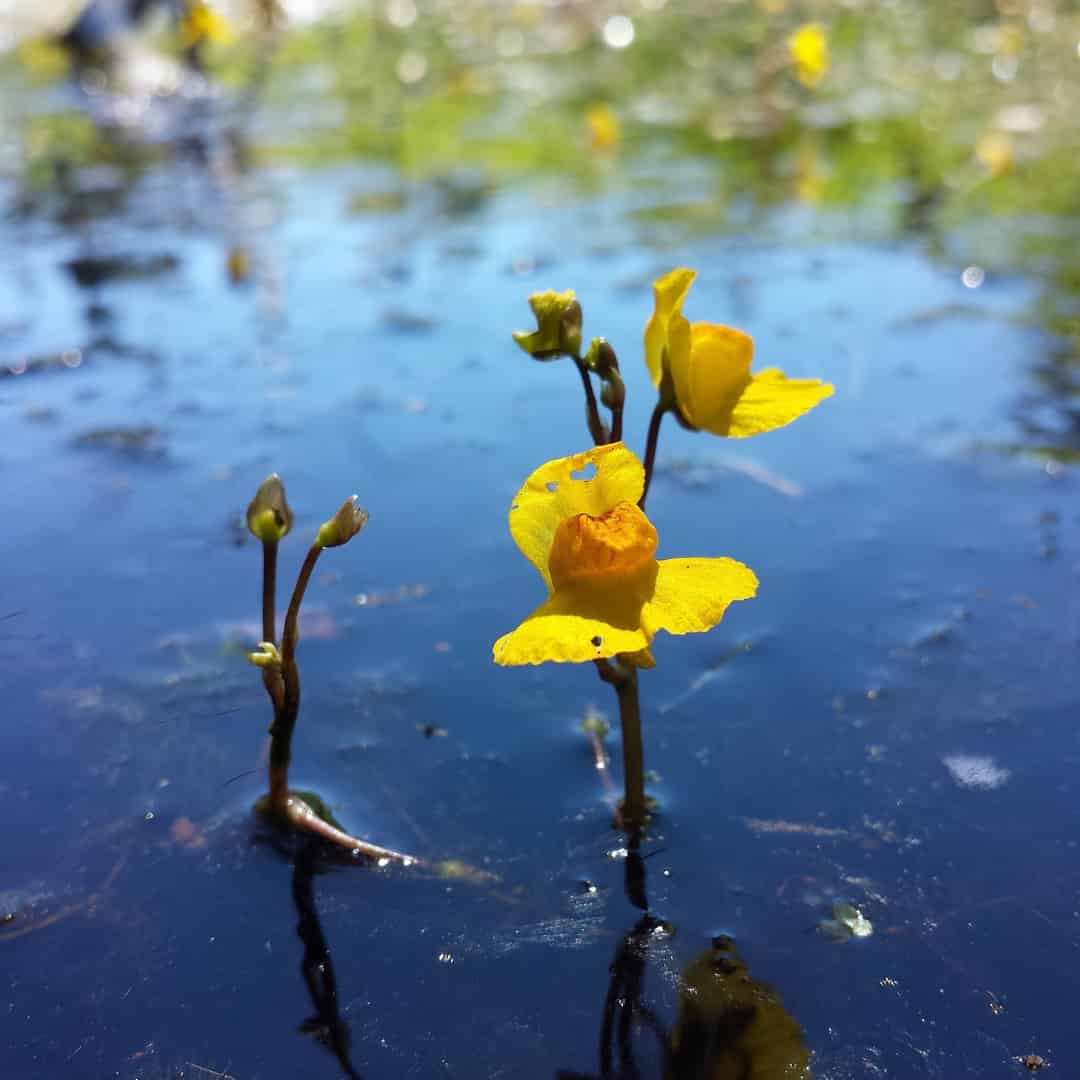
A new study has tested the southern bladderwort, Utricularia australis, as a predator of Aedes albopictus larvae in a no-choice experiment. The team divided the larvae into two size groups: 1st–2nd and 3rd–4th larval instars, an instar being a growth stage for larvae between moults. Twenty Aedes albopictus larvae were placed inside 1-litre plastic cups with a 30-centimetre-long plant segment and left for seven days. The experiments used twelve segments of Utricularia australis, six for each larval size group, counting the number of bladders of each segment at the beginning of the experiment. The 7-day process was repeated five times for each segment/cup over two months, with the number of captured larvae and emerged adults recorded daily.
In total, 84 captured larvae were chosen to measure larval length, percentage of larval body trapped within the bladder, bladder perimeter, and bladder area, to evaluate the ability of the bladders to capture larvae, by complete or partial suction of the body, depending on the relative sizes of larvae and bladders. Results indicated that Utricularia australis is an effective predator of mosquito larvae, with a higher efficiency against the 1st-2nd instar group (72%) compared to the 3rd-4th group (39%). The number of captured larvae depended on the number of bladders on each segment and instar group. The percentage of trapped larval body depended on the relationship between bladder size and larval length.
Source: Casini et al. 2023.
Although the bladders effectively captured small larvae by complete suction of the body, they also killed 3rd-4th instar larvae by trapping a small portion of the body within the trap. The plant segments continuously captured mosquito larvae, with an efficiency that did not decrease during the 2-month period.
One of the exciting factors that Casini and colleagues bring up in their paper is that Utricularia australis might be particularly effective against Aedes albopictus due to how it hunts. They note that the bladderwort is rootless and floats at the surface, and this is where the mosquito larvae breathe, so the two live at the same depth. But they also highlight another habit of bladderworts.
Botanists aren't sure if bladderworts are carnivorous plants. They may be omnivorous, eating meat and other plants. Previous research has suggested they might aid algae's growth so that they can snack on it. Casini and colleagues have another possibility. They say mosquito larvae eat algae, and the bladderworts release chemicals to promote algal growth. Could they be producing bait to catch larvae?
Source: Casini et al. 2023.
Casini and colleagues conclude by saying that bladderworts could be useful as an eco-friendly pesticide (apart from the part of the ecosystem it's brought in to kill). Though they still caution that it is not a cure-all and has limitations. They write:
However, for the practical use of this plant for mosquito control, it is still necessary to understand what types of actual larval breeding sites it could be effectively used in. Aedes albopictus thrives in urban and suburban areas, within several type of man-made breeding sites, both removable (e.g., bucket, cup/bowl, planter dish, tarp and tire) and non-removable, such as ornamental ponds, fountains and containers in gardens and churchyards (commonly water-filled for gardening) (Bartlett-Healy et al., 2012, Becker et al., 2010). The use of U. australis as biocontrol agent should be considered for non-removable breeding sites, taking into account the ecological requirements of the species, e.g., high solar radiation (Rodrigo and Calero, 2019). For instance, as U. australis is traded as an ornamental plant, it might be used within house and urban gardens, where non-removable mosquito breeding sites often occur (e.g., small ponds, fountains) and the human-vector contact is frequent. On the other hand, in urban and suburban areas the removal of smaller larval sites remains the best management action to be implemented by the local community, together with campaigns focused on improving public awareness and cooperation to prevent the creation of stagnant pools of water.Casini et al. 2023.
READ THE ARTICLE
Casini, R., Del Lesto, I., Magliano, A., Ermenegildi, A., Ceschin, S., De Liberato, C. and Romiti, F. (2023) "Predation efficiency of the carnivorous aquatic plant Utricularia australis against Asian tiger mosquito Aedes albopictus larvae: Implications for biological control," Biological control: theory and applications in pest management, (105182), p. 105182. Available at: https://doi.org/10.1016/j.biocontrol.2023.105182.