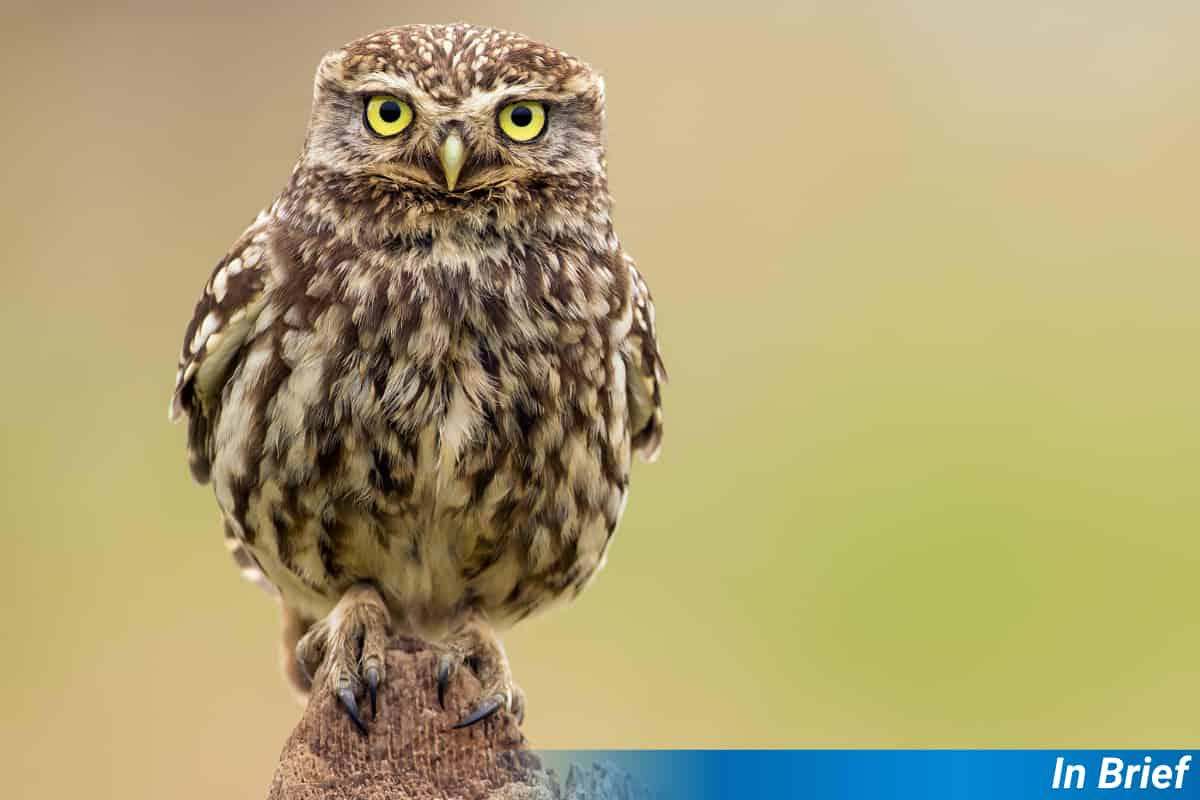



The Little Owl (Athene noctua) is not an obvious candidate for plant assistant. Found from Europe, North Africa in the west, to Korea in the east, it feeds on insects, birds and small furry animals. It is not a gardener. However, research by Saada and colleagues suggest it can help seeds to beat salinity stress, when it vomits.
Like other owls, the Little Owl has trouble digesting fur and bone, so it doesn’t. Instead it digests what it can of a meal and then brings up the remainder in the form of a pellet. The ecologists took Little Owl pellets and created solutions to see if the pellet solution could improve germination of seeds in salty conditions.
They found that seeds treated with owl pellet solution grew better than untreated seeds, with the effect being strongest when salt levels were high. Saada and colleagues think that the pellets, rich in calcium, help protect the seeds from salt damage. They also found soil near owl nests had more organic matter and nitrogen than other areas. Possibly because material can come out of both ends of an owl.
Owls are known to affect plant growth by concentrating nutrients in certain areas. They like to roost in specific places, and so enrich the soil near the centre of their territory. Saada and colleagues believe this is one of the first studies to test how owl pellets aid germination. Their findings could be particularly important in Tunisia, where they did their research, as Tunisian farms can have problems with high levels of salt in the soil.
Saada I, Bessadok K, Hammouda A, Eturki S & Selmi S. 2024. Little owl (Athene noctua) pellets enhance seed germination under salinity stress in two leguminous plant species. Écoscience. https://doi.org/10.1080/11956860.2024.2406160 ($)