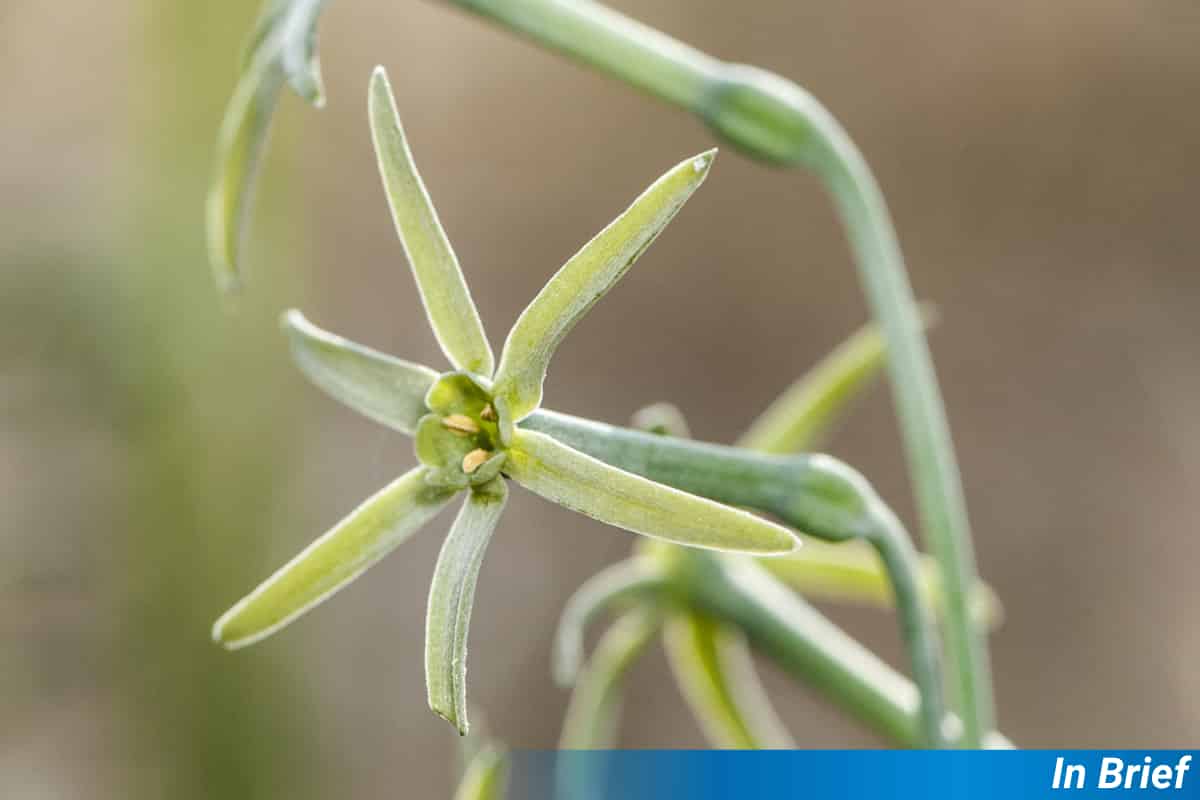



A puzzle is hiding in the scent of Narcissus viridiflorus. Not only does this daffodil have an unusual colour – it’s the only species of daffodil with green flowers – it also has an unusual scent, or rather an unusual sense of timing. Losch & Weigend have found that it releases its scent at night, when its presumed pollinator is sleeping. The result hints that scientists have not identified the correct pollinator for the plant.
Losch & Weigend tracked the scent emissions of three daffodils, using gas chromatography-ion mobility spectrometry to sample the chemistry. They did this for 72 hours, so they could see how scent emissions varied over time. This way they could find if the plants were timing their efforts to catch a specific pollinator.
They found that Narcissus viridiflorus showed strong nighttime scent emissions, peaking around midnight. In contrast, Narcissus papyraceus and Narcissus cantabricus had no clear day-night scent patterns. In particular, the botanists noted that in Narcissus viridiflorus p-cresol and benzyl acetate became a much greater proportion of the scent at night.
This is a puzzle because the plant was thought to be pollinated by Macroglossum stellatarum, the Hummingbird hawk-moth. The problem with that is that Macroglossum stellatarum is active in afternoons and early evenings. If the scent is meant for them, then it’s always too late. Losch & Weigend think the scent points to a moth pollinator – but not this one.
Losch, F., & Weigend, M. 2024. Diurnal patterns of floral volatile emissions in three species of Narcissus. American Journal of Botany 111: e16408. https://doi.org/10.1002/ajb2.16408 (OA)