

Love life can get pretty rough for many animal species. From fierce female phalaropes and jacanas fighting over the most reliable males to raise their chicks, to male snakes and spiders jealously blocking their mates’ reproductive tracts with viscous substances or even their own mutilated penises, to greedy dragonflies and cuttlefish who wipe away any rival’s sperm previously stored by females during sex: the battle to leave offspring seems quite pervasive in the animal kingdom. But zoology is not exactly the main concern of this blog, so what about plants?
A plant’s sex life is very different to ours. First and foremost, the majority of plants are perpetually attached to the ground and incapable of engaging in vigorous fights for a mating partner. Indeed, they usually depend on mobile neighbours—whether wind, water, or any of a diverse array of animal pollinators—to carry their male reproductive cells around, so they can reach an egg cell, fuse with it into an embryo, and eventually give birth to a brand-new plant. But relying on a third-party visitor for reproduction brings along some uncertainties. For instance, pollinators might visit lots of flowers from many different plants in a short time and thus end up carrying some messy pollen mixes in their bodies. How could a plant make sure that its own pollen will be the one to get to the female parts of other flowers to become a father?
One could think that plants must settle for rather passive strategies to increase their chances of parenting, like producing more pollen or more flowers, or making them more attractive to pollinators—all of which demand quite a lot of energy. But far from it, a team of researchers from Brazil and South Africa recently documented an exciting mechanism of competitive pollen replacement for the first time among flowering plants, similar to sperm removal in animals.
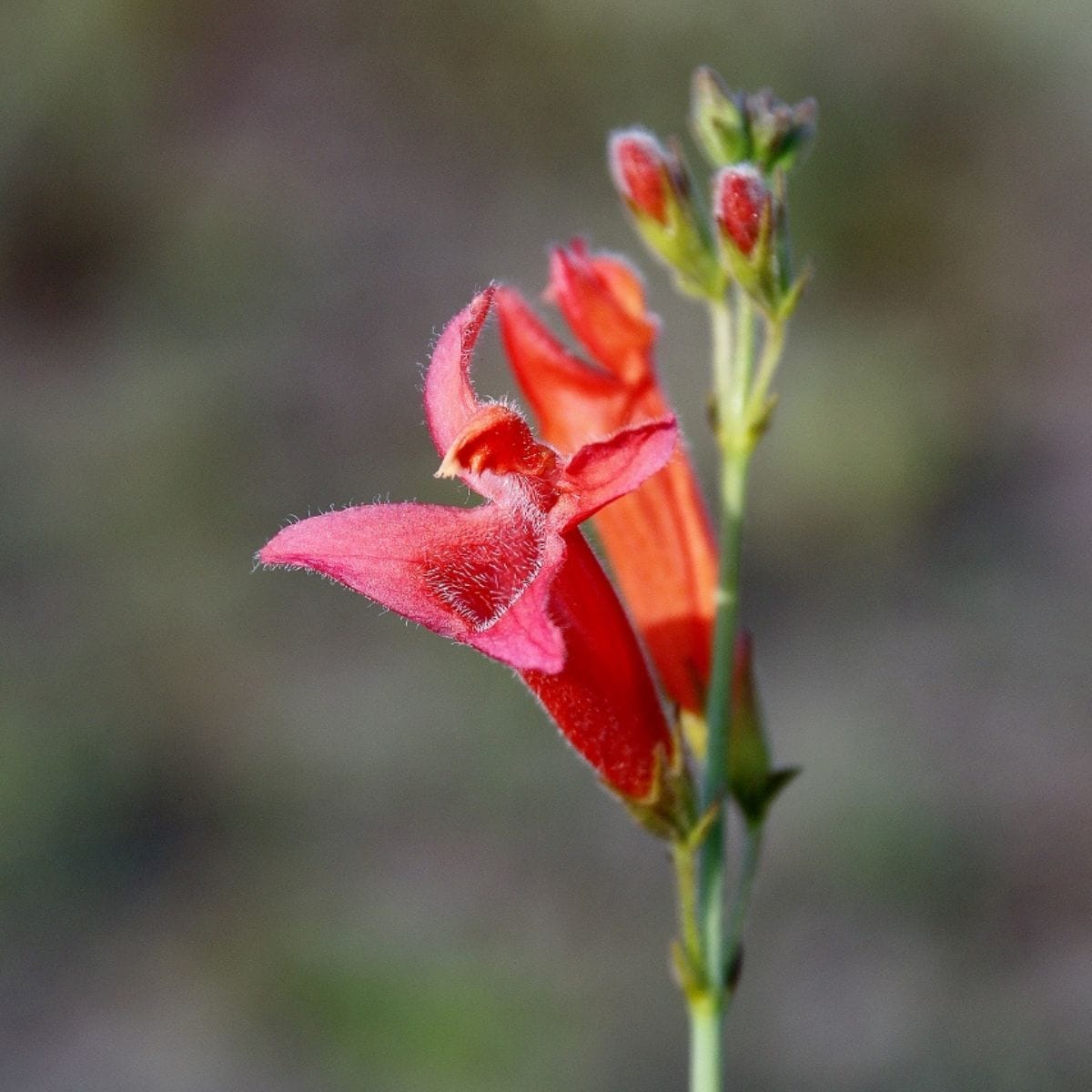
Their study species was Hypenia macrantha, a South American distant cousin of mint, lavender and basil. When it is time to reproduce, this herb flaunts its beautiful tubular red flowers around the Brazilian Cerrado, luring several hummingbird species to aid in their pollination. But this plant’s intimate relations go far beyond the typical bird-pollination story. The elegant design of its apparently delicate flowers holds a secret to ensuring paternity: their anthers, the male pollen-carrying structures, are tightly packed inside a specialized petal lobe that gets triggered like a catapult upon the visit of a hummingbird, blasting the pollen with force onto the bird’s bill.
Video from Eurekalert.
This type of pollen shooting strategy is called ‘explosive pollination’. It had already been documented in several plant lineages pollinated by all kinds of animals, such as orchids and heather relatives. However, Dr Bruce Anderson and his colleagues were the first to experimentally test whether explosive pollination could function to remove rival pollen of previously visited flowers from the bodies of pollinators.
To do so, they took some flowering stems of Hypenia macrantha to the lab and simulated floral visits using a hummingbird skull. Before each trial, they manually applied pollen on the region of the bill where the plant would naturally deposit it—as if the hummingbird was coming to the flower after visiting another plant of the same species, that is, a potential competitor. Such experimental pollen had been previously labelled with UV-fluorescent quantum dots, a promising new technology that allows tracking individual pollen grains. That way, the researchers were able to count and compare the number of labelled pollen grains attached to the bill before and after it was slammed by the flowers’ own loads.
Their findings were remarkable. Explosive flowers removed almost twice as much labelled pollen as previously triggered flowers. Also, greater amounts of pollen accurately shot by the catapult anthers resulted in fewer labelled pollen grains left on the hummingbird bill. This suggests that the force of its pollen projectiles allows Hypenia macrantha to dislodge a great portion of the competing pollen being carried by its pollinators, thus conferring a clear advantage in the quest to reproduce. After all, according to the videos recorded by the authors, the ballistic movement of this species’ anthers turned out to be one of the fastest plant movements recorded so far!
This research leaves the door open to a wealth of exciting questions about plant reproductive competition and evolution. For example, being a hermaphrodite brings some troubles that most animals would never understand. After their touchy male phase, the flowers of Hypenia macrantha enter a quieter female facet, hoping that hummingbirds will bring along someone else’s pollen to fecundate their ovules so they can produce seeds. Could the competitive male flowers of a plant thus interfere with its own equally relevant goal of becoming a mother? In fact, could a plant be discarding its own pollen if a hummingbird visits its flowers in a sequential manner? Do these birds fancy doing that at all after getting slapped by the first flower they visit? And how important are these pollen battles for the evolution of explosive pollination?
The list of questions could go on, but there is one thing we can all be sure about: plants’ sex life is more dramatic than we think, and it will never stop blowing us away.
READ THE ARTICLE
Anderson, B., Sabino-Oliveira, A., Matallana-Puerto, C., Arvelos, C., Novaes, C., de Cario Calaça, D., Schulze-Albuquerque, I., Santos Pereira, J., Borges, J., de Melo, L., Consorte, P., Medina-Benavides, S., de Oliveira Andrade, T., Monteiro, T., Marcelo, V., Silva, V., Oliveira, P., and de Brito, V. (2024) Pollen Wars: Explosive Pollination Removes Pollen Deposited from Previously Visited Flowers. The American Naturalist, 204(6), pp. 616-625. Available at: https://doi.org/10.1086/732797.

Andrés Pereira-Guaqueta
Andrés is a Colombian biologist fascinated by plant-animal interactions and eager to share scientific knowledge outside academia. He is currently finishing his master’s degree at the National Autonomous University of Mexico. His main research interests revolve around the relationships between flowering plants and their animal pollinators, and how they respond to our rapidly changing world.
Spanish translation by Andrés Pereira-Guaqueta.
Cover picture: Hypenia macrantha by Mauricio Mercadante.