

Name: Humans
Scientific name: Homo sapiens
Known for: Appearing on the front cover of National Geographic more consecutive times than any species (cf. Chris Addison)
Record broken: Biggest pollinator.
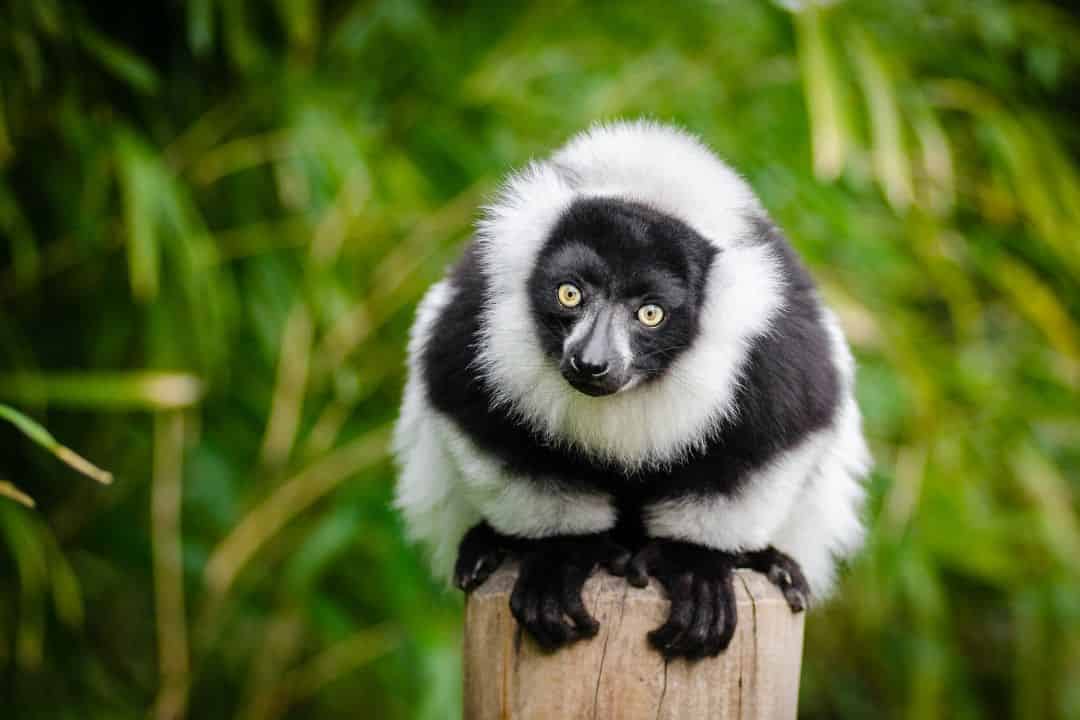
It’s not often you find an error in the Smithsonian and the US Forest Service, but this would appear to be one of them. They list the black-and-white ruffed lemur as the world’s largest pollinator.

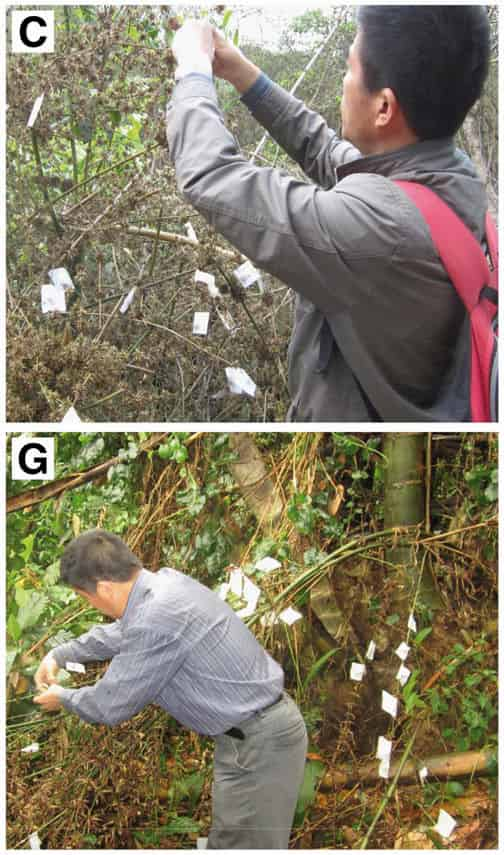
Normally, I would be happy to accept this, but while looking up something else I found that, Ling-Na Chen and colleagues say they carried out hand-pollination experiments in 2012, and have photographic evidence. The black-and-white ruffed lemur, Varecia variegata, never weighs more than 5kg. Chen and colleagues don’t mention their weight in the paper, but I would guess it’s more than 5kg. That makes Homo sapiens the biggest pollinator and Varecia variegata a footnote.
Footnote
Lemurs
The black-and-white ruffed lemur is nevertheless a fascinating creature. John Kress and colleagues proposed that it was part of a coevolutionary system. Their paper on pollination of Ravenala madagascariensis, the Traveller’s Palm, has some beautiful artwork, and some excellent examples of writing, such as the description of how lemurs visit the flowers on the tree.
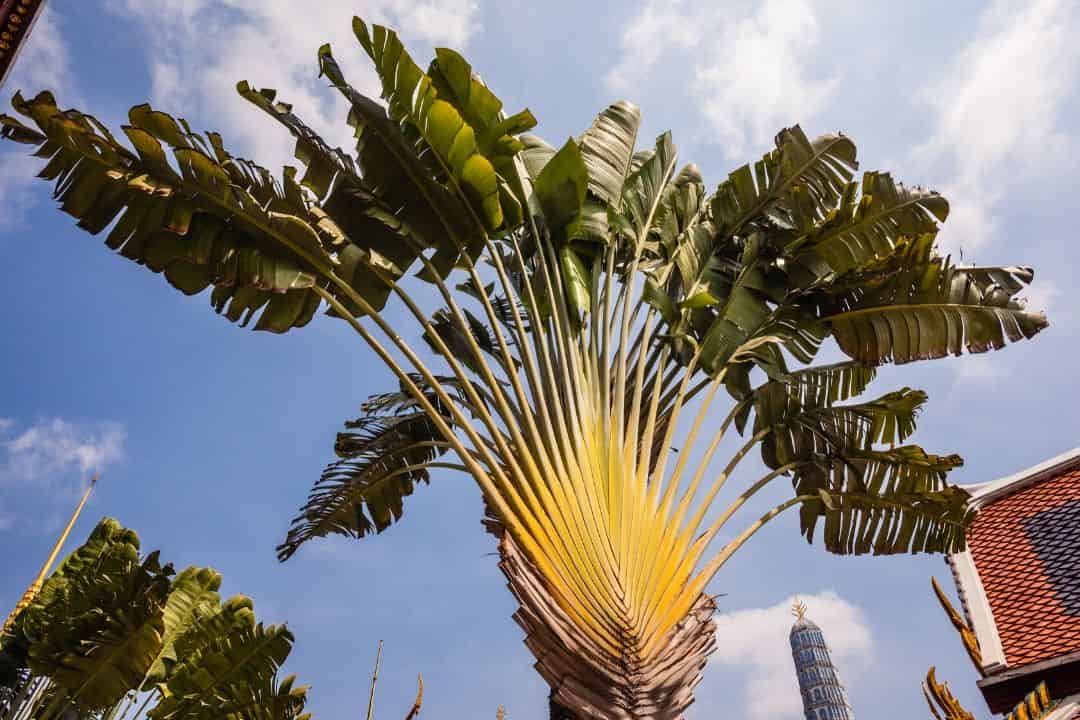
“During foraging, ruffed lemurs, which are totally arboreal animals, approached the inflorescences of Ravenala from the middle and upper branches of neighboring trees. They quickly found unopened or previously opened flowers that were producing nectar. To open a newly emerging flower the lemur grasped the unopened perianth with its teeth and roughly pulled it from the protective inflorescence bract, but did not break it off. This action sprang the perianth open, thus releasing the reflexing anthers that brush pollen onto the muzzle and head of the animal. While holding onto other bracts of the inflorescence with its hindfeet, the lemur pulled the lateral sepals apart with one or both forefeet to allow access to the nectar chamber. The snout was then thrust into the center of the flower and nectar was extracted with the tongue. The lemur contacted both the stamens and stigma while feeding. We also saw the lemurs lick pollen directly from the anthers with their tongues and groom pollen off their fur. We never saw lemurs destroy the flowers they were visiting.”
The fact that the flowers were still viable after lemur visits shows pollination is undoubtedly possible. However, it’s what the lemur did after feeding at a flower that makes it a pollinator and not just a passing visitor.
“The animals invariably visited all open flowers in an inflorescence and frequently moved between inflorescences on the same plant (33 of 37 observed visits = 89%) and between plants (20 of 49 observed visits = 41%) in the observation area. Although it was logistically impossible during this study to actually quantify the amount of pollen carried by the lemurs, the large amount of pollen observed on the fur and the movement of the animals suggest that pollen is transferred over significant distances between plants.”
In their paper, Kress and colleagues acknowledge there are limits to how certain they could be from their observations that pollination was occurring. Still, they list several points about the lemur behaviour during the flowering season that are consistent with pollination. They also add: “Furthermore the flowers themselves possess many obvious specializations for visitation by large, non-flying animals, such as: 1) inflorescences placed below the crown of the plant and hence more easily accessible to arboreal than to flying animals; 2) large flowers enclosed in tough, protective bracts that require manual manipulation by a strong pollinator to be opened; 3) stiff, rodlike styles that withstand the rough handling of the visitors; and 4) copious, sucrose-dominant nectar that provides an energy-rich, renewable reward for a sizable animal for a 2- to 3-mo time period. This evidence coupled with the fact that we never observed significant visitation by animals other than lemurs during our study strongly supports the hypothesis that this plant species endemic to Madagascar has evolved with an endemic group of non-flying animals, the lemurs, as its primary pollinator.”
In the discussion, the authors consider the origin of lemur pollination and come to the conclusion it could be ancient. Usually, vertebrate pollination is considered to be comparatively recent, in evolutionary terms, because flying vertebrates like birds and bats only evolved recently, compared to flowering plants. Kress and colleagues say their observations are consistent with a theory that early angiosperm trees could be pollinated by arboreal mammals and flying vertebrates later replaced them.
Madagascar would be the perfect place to look for this kind of evidence. Douglas Adams has described Madagascar as a kind of ark that sheered off from Africa before the rise of the apes, allowing primate evolution to run along different lines than the rest of the world. The same isolation has allowed plants to survive away from Africa and explains why the island is, or was, such a rich source of endemic species.
Squirrels
But Madagascar is not the only place where non-flying vertebrates are opening flowers. Recent publications by Shun Kobayashi and colleagues have found that squirrels and civets are pollinating Mucuna macrocarpa.
“Mucuna macrocarpa (Fabaceae) is a woody, evergreen, climbing vine that is widely distributed in Southeast Asia, Himalayas, Taiwan, the Ryukyu Archipelago, and Kyushu, Japan,” Kobayashi and colleagues write in Ecology and Evolution. “This species shows a special “explosive opening” step during pollination, which is a common trait in the genus… The stamens and pistil are covered by a pair of carina petals. In M. macrocarpa, the banner petal must be pressed upward strongly while the wing petal must simultaneously be pushed down for the carina petals to open, thus exposing the stamens and pistil. The flower opening triggers the explosive release of a cloud of pollen grains… Once a flower explosively opens, the stamens and pistil are never covered by the carina petals. In at least two sites in Japan, this species needs explosive opening to bear fruit, because unopened flowers do not bear fruit, as experimentally in both bagged and unbagged treatments… Thus, a flower‐opening animal (the “explosive opener”) is necessary to the reproduction of the plant species, making explosive openers effective pollinators.”
Source: Kobayashi et al. 2016.
In a study in Taiwan, Kobayashi and colleagues found the red-bellied squirrel, Callosciurus erythraeus, was the most frequent visitor to the flowers, while in Japan martens opened the flowers. The authors propose using vertebrates as pollinators is an advantage for plants that want to distribute their pollen over long distances. Pollen transport might be why some Protea plants benefit from visits by a carnivore.
Genets
Genetta tigrina is the South African large-spotted genet. This is a small (not very) cat-like animal that is a predator in southern Africa. It generally likes to eat rats or mice, but is also willing to eat snakes, frogs or birds. But Sandy‐Lynn Steenhuisen and colleagues have found that they also visit Protea plants, sometimes called sugarbushes.
The name 'sugarbush' gives away what the genet is after. It visits to drink nectar from the flowers. The team also say the genet is not the only carnivore visiting the flowers. "This is the first study to record mongooses and genets nondestructively visiting and likely pollinating Protea inflorescences. We are confident that these mammals are contributing to pollination as there was pollen visible on their snouts," say Steenhuisen and colleagues in their paper. "[A]lthough they may contribute only a small fraction to total pollination, any pollen they carry would potentially travel much further than via common rodent visitors with small home ranges."
The common feature of the plants pollinated by mammals is that they are getting a service that they otherwise would not get in the wild. So while lemurs, squirrels and genets may not be as large as humans, they are doing a similar job in stirring the the gene pool for the plants they visit. That's why Matt Candeias wrote: "As I have said time and again, plants do not operate in a vacuum. To save a species, one must consider the entirety of its habitat."