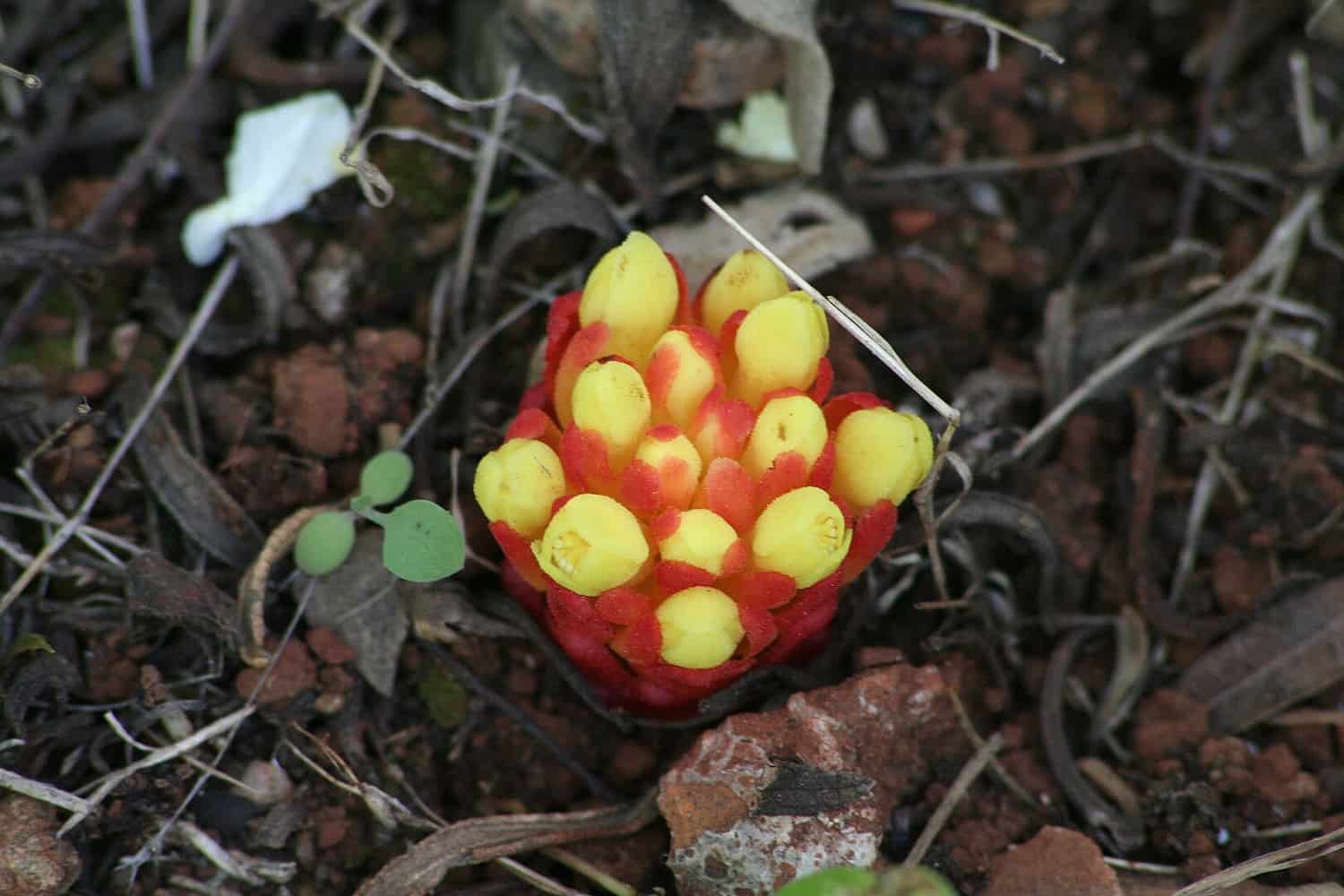



Is it nature or nurture that has the biggest effect on your development? Clara de Vega and colleagues looked at a parasitic plant, and found there was a lot more to Cytinus hypocistis than its genes. C. hypocistis is a plant that that grows inside the roots of plants in the Cistaceae family. de Vega and colleagues examined three different “races” of C. hypocistis, each specialised to a different host species within the Cistaceae family. They found that while the plants looked similar, each had developed in its own unique way.
Cytinus parasites growing on different host plants flowered at different times, with up to a month between the earliest and latest groups. When the plants did flower, parasites on some hosts produced more flowers with higher nectar sugar concentrations. Hand-pollination showed the plants were interfertile, yet the differences in when and how they flowered may be acting as a barrier to this happening naturally.
de Vega studied six populations of Cytinus growing on three different host plant species in southern Spain. It was here they recorded flowering times, measured flower sizes and nectar production, and conducted cross-pollination experiments. The researchers then used statistical tests to analyze differences between the parasite groups.
Most previous research on parasitic plants has focused on them as crop pests, not wild species like Cytinus. This closer look reveals hidden diversity in parasitic plants that appear similar but are genetically and functionally distinct. de Vega and colleagues argue this raises the question of whether we are looking at one species, or a case of cryptic speciation in progress.
de Vega, C., Ortiz, P.L., & Arista, M. 2024. Host-driven phenotypic and phenological differentiation in sympatric races of a parasitic plant. Flora. https://doi.org/10.1016/j.flora.2024.152617 (OA)
Cross-posted to Bluesky, Mastodon & Threads.
Cover image: Cytinus hypocistis by Luis Nunes Alberto – Own work, CC BY-SA 3.0, Link