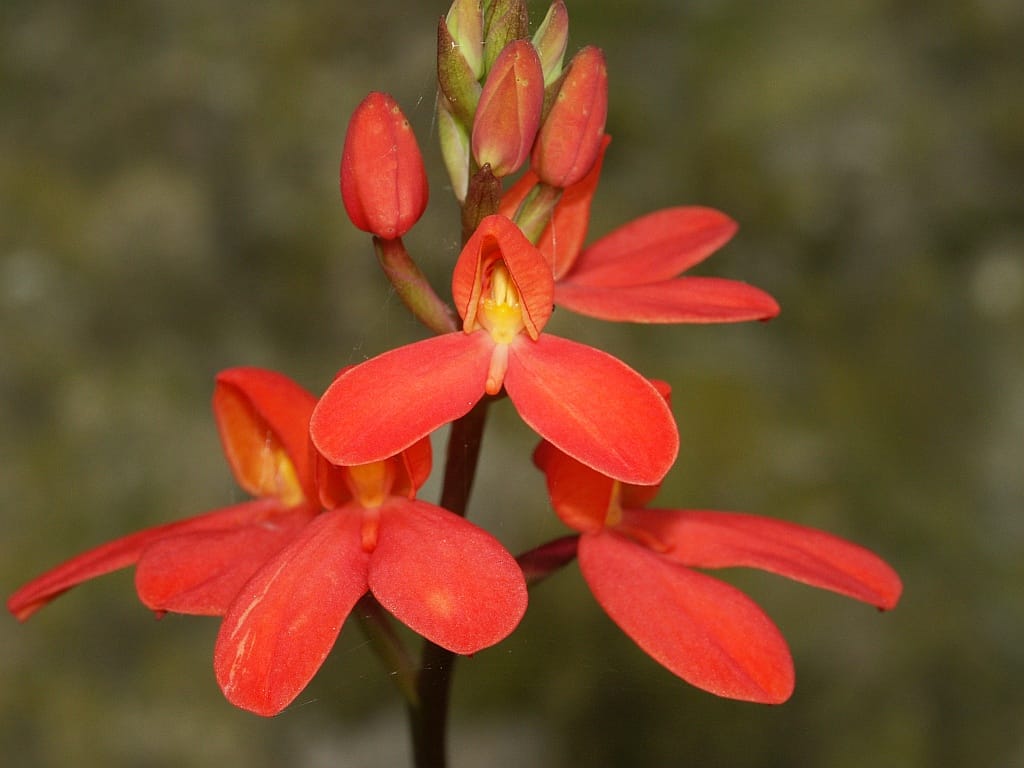



There’s an eye-catching paper in Ecological Monographs recently, “The mating consequences of rewarding vs. deceptive pollination systems: is there a quantity-quality trade-off?” by Hobbhahn et al.. It tackles a puzzle in some orchids: why give a reward to pollinators?
We’re taught from a young age that plants provide nectar to insects for pollinating them, which is why orchids are fascinating. They often don’t, instead getting pollinated through deceit. The usual explanation is that deceit reduces the number of visits by a pollinator to a plant, but it helps target the pollen to another plant of the same species. A pollinator that’s foraging for food will go wherever provides food.
Hobbhahn et al. examine this difference between quality and quantity in Disa. Disa is an African orchid genus where nectar production keeps evolving from rewardless species. They argue that reward pollination probably evolved at times when there was a shortage of suitable pollinators, so quantity became important. If that's the case then when there are enough pollinators around, you could expect the rewardless Disa to have more effective pollination.
To test this, Hobbhahn et al. compared the pollination of four nectar-producing orchids with ten rewardless species using stained pollen. Looking at how the pollen travelled, Hobbhahn et al. could then work out what method was more effective for delivering pollen where it matters.
They found that the rewarding plants were attracting more insects. One possible reason for this is that plants offering a reward reinforce 'good' behaviour, so insects will also visit neighbours. In effect, flowers are not only getting visits through their own nectar supply but also because neighbours have advertised the reward to other insects too.
What about quality instead of quantity. Surprisingly, there was no obvious difference in self-pollination. While the non-rewarding plants might have fewer repeat visits from insects, and less time per visit to be self-pollinated, their flowers got fewer visits anyway. That meant they had more time to self-pollinate than the regularly visited flowers of the rewarding plants. Another issue for quality is how far the pollen travelled.
An insect foraging in a floral display is going to transfer pollen as it flies from one flower to a neighbour. The genes that a plant is swapping is probably shared with a relative. Insects that have been deceived behave differently. They are not happy insects and fly off well away. In fact, they flew well away from the orchids Hobbhahn et al. were studying. That doesn't mean the pollen was lost. They refer back to recent work in Annals of Botany that shows orchid pollen is a survivor, so that it could hang around while the insect searched for another mate insect, even if that took days. It means that a rewardless plant could be mating with another plant that is much more genetically different than a neighbour. It might not be as certain a pollination as the nectar-producing plants get, but when a deceitful plant does successfully reproduce, the reward is more valuable.