
Is it always a good idea for a plant to put on its best display of flowers. If you’re aiming to attract pollinators then it would seem odd to skulk in the shadows. However, a study by Fitch and Vandermeer published in the American Journal of Botany shows that light availability has a complex relationship with reproduction, due to differing relationships with mutualists and antagonists.

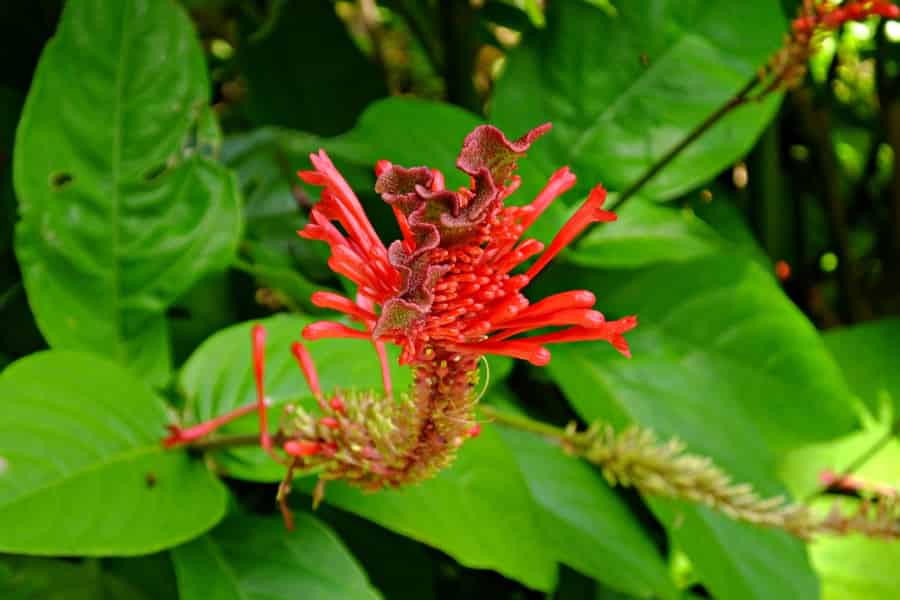
Fitch and Vandermeer based their study on Odontonema cuspidatum (mottled toothedthread or firespike), a plant native to Mexico, but invasive in the southern USA, Central and South America. Its long red tubular flowers are pollinated by hummingbirds. The birds have the narrow beaks necessary to reach deep into the flower to harvest the nectar. Insects do not, yet they’re not willing to leave the nectar to the birds. Two stingless bees, Trigona fulviventris and T. nigerrima, caught Fitch and Vandermeer’s attention.
These bees approach the flowers before they’re fully opened and perforate them at the base. They can then rob the flower of nectar before the hummingbird have a chance to grab it. This is excellent for the bees, but not so good for the flower. The authors report that a robbed flower is 40% less likely to set fruit than an unrobbed flower. While attracting pollinators is good, attracting robbers is a significant cost for a plant.
Fitch and Vandermeer set out to discover how light availability affects nectar robbery. Light can have a lot of effects on plant traits. It can affect flower quantity, morphology, size, and visibility. Also a flower in daylight can be more visible to potential visitors. The flowers they studied grew at Finca Irlanda, a shaded organic coffee farm in southeastern Chiapas, Mexico. In 2017 and 2018, they surveyed plants on the site, and examined the canopy cover above the plant to decide whether the plants had high or low light availability. They then observed flowering and also looked for signs of nectar robbery. The team also cut 12 stems bearing flowers and translocated them between high and low light environments to see how they reacted.
“Light availability influenced multiple floral traits associated with pollinator attraction, in somewhat contrasting ways. Greater light availability was associated with higher flower number and increased nectar volume, but with smaller corolla flare,” write the authors in their article. This, they argue, is largely consistent with greater light availability influencing photosynthesis and so making resources more abundant for producing flowers and nectar. The puzzle is the smaller corolla flare. They note that, in many flowers, a larger flare also attracts pollinators.
When it came to nectar-robbing, the results were striking. More light in the flowering environment led to more nectar robbing. What was interesting in the results was that the flowers moved from a high light to low light environment were significantly less likely to be robbed than plants that grew and remained in a low light environment.
“Since NRI [nectar robbing intensity] was positively correlated with light availability in the FE [flowering environment], pollinators avoiding robbed flowers will, all else being equal, pollinate more flowers on shaded plants. Interestingly, this suggests that light availability... influences nectar robber preference for O. cuspidatum more than pollinator preference,” write Fitch and Vandermeer.
“Our results highlight how complex, interacting effects of light on interactions between plants and mutualist and antagonist partners can complicate the simple assumption that increases in light availability should lead to increased plant reproductive success. Indeed, despite strong positive effects of light availability on plant growth and ovule production in O. cuspidatum, we found no effect of light availability on seed production.”
It’s a striking result because the assumption would be that what’s best for the pollinator is best also for the pollinated. Fitch and Vandermeer argue that reality is more complicated and there needs to be more study of floral antagonists.
READ THE ARTICLE
Fitch, G., and Vandermeer, J. (2020) Light availability influences the intensity of nectar robbery and its effects on reproduction in a tropical shrub via multiple pathways. American Journal of Botany, 107(12), pp. 1635-1644. Available at: https://doi.org/10.1002/ajb2.1559.