


How can gardeners and farmers best keep weeds at bay? For those who don’t want to harm their gardens with chemicals cutting them down may seem the best solution. Unfortunately a study by Alejandro Vasquez and colleagues, published in Scientific Reports, finds that for one weed, silverleaf nightshade, cutting makes it stronger.
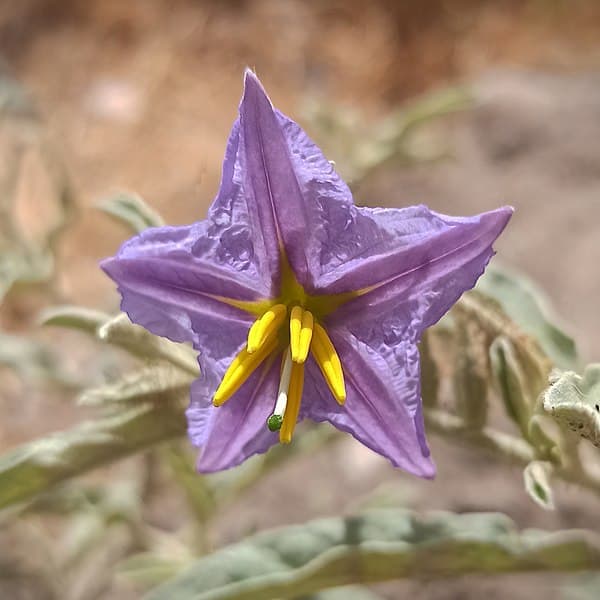
Silverleaf nightshade, Solanum elaeagnifolium, can be found from south Texas to South Africa and Greece. It infests fields and soaks valuable nutrients intended for cash crops. The weed with purple flowers has prickly spines and poisonous berries.
Rupesh Kariyat, an associate professor of entomology and plant pathology with the Arkansas Agricultural Experiment Station, has been studying silverleaf nightshade for more than a decade. Kariyat began the study while at the University of Texas Rio Grande Valley, when he and his graduate student Alejandro Vasquez took on what turned into a five-year, two-part study to observe the effects of frequently mowed silverleaf nightshade.
Although studies have often highlighted weed fitness and defence traits resulting from disturbances like mowing, most were limited to foliar, or leaf, defences, Kariyat said. That changed when Vasquez and fellow master’s biology students monitored fields of mowed, unmowed and frequently mowed silverleaf nightshade.
“Alejandro’s question was, ‘how do these flowers differ between mowed and unmowed plants?’” Kariyat said in a press release. “‘And does that have consequences for the insects that actually feed on them?’”
The Mowing Experiment
The team of scientists examined mowed and unmoved areas in the Rio Grande Valley, around Edinburg, Texas. The plots in southern Texas were all within 16 miles of each other, so would have been subjected to similar climactic and weather conditions.
At each site, the team collected flowers from both mowed and unmowed plants. They carefully measured an array of floral traits, including the size and mass of the flowers. Larger, heavier flowers can be more attractive to pollinators, giving plants a reproductive edge. The researchers also examined the flowers for signs of herbivore damage, such as bite marks or missing petals, to see if mowing influenced how much the plants were being munched on.
But the team didn’t stop there. They wanted to know how the differences between mowed and unmowed plants might affect the herbivores that feed on them. To test this, they conducted feeding experiments using tobacco hornworm caterpillars, a common pest of many Solanaceae plants, including silverleaf nightshade.
The researchers incorporated dried, ground-up flowers into the caterpillars’ artificial diet, simulating the natural feeding process. Some caterpillars were given food containing flowers from mowed plants, while others were fed flowers from unmowed plants. The team then carefully monitored the caterpillars’ growth over time to see how the different diets impacted their development.
The Mowed Plant Paradox
The results of these experiments were striking and somewhat counterintuitive. Rather than weakening the plants, mowing seemed to make silverleaf nightshade more robust and defensible. The flowers from mowed silverleaf nightshade plants were actually larger than those from their unmowed counterparts. However, there was a catch – although larger, the flowers from mowed plants were lighter.
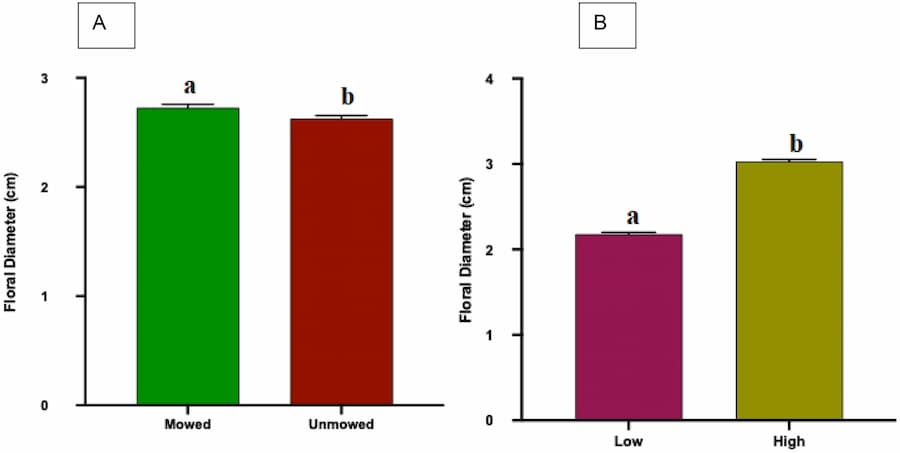
Interestingly, the frequency of mowing also played a role. Plants subjected to more frequent mowing produced even larger and heavier flowers compared to those mowed less often. It seemed that the more intense the disturbance, the stronger the response from the plant.
But the surprises didn’t end there. When the team looked at the plants’ defences, they found that mowed silverleaf nightshade had significantly more spines than unmowed plants. These serve as a mechanical defence against herbivores, deterring them from feeding on the plant’s leaves and stems. Consistent with this, the researchers observed less herbivore damage on flowers from mowed plants.
The caterpillar feeding experiments added another layer to the story. Caterpillars reared on diets containing flowers from mowed plants grew more slowly than those fed unmowed plant material. This effect was particularly pronounced in later stages of development, suggesting that the defensive compounds in mowed flowers become increasingly potent as the caterpillars grow larger and consume more plant tissue.
Taken together, these findings paint a picture of a weed that responds to the stresses of mowing by doubling down on its defences. By investing more in spines and chemical deterrents, mowed silverleaf nightshade seems to be better equipped to fend off herbivores and maintain its reproductive success.
Mowers are a double-edged sword
The team’s findings suggest that mowing is the gardening equivalent of ‘if you scratch it, it’ll only get worse’ when it comes to managing silverleaf nightshade. While it may seem like an effective way to keep the weed in check, mowing actually triggers a suite of defensive responses that make the plant more resilient and harder to control.
Continuous mowing acts as a chronic stressor, inducing silverleaf nightshade to invest more heavily in both physical and chemical defences. The increased density of spines on mowed plants serves as a formidable mechanical barrier against herbivores, while the enhanced potency of defensive compounds in their flowers deters feeding and slows the growth of caterpillars.
These adaptations likely give mowed silverleaf nightshade a competitive edge over other plants in disturbed environments. By deterring herbivores and maintaining its reproductive output, the weed can continue to spread and flourish even in the face of regular mowing.
Moreover, the frequency of mowing appears to be a key factor driving these adaptations. Plants subjected to more frequent mowing showed even greater investments in defensive traits compared to those mowed less often. This suggests that the intensity of disturbance plays a crucial role in shaping the weed’s evolutionary trajectory.
Rethinking Weed Management in Light of Mowing’s Effects
Effectively, by repeatedly mowing silverleaf nightshade, we may be inadvertently selecting for plants that are better equipped to withstand this stressor. Over time, this could lead to the evolution of increasingly resilient and hard-to-control populations, as the most defensive individuals survive and reproduce.
“You are trying to mow these plants so that the plants are getting eliminated,” Kariyat said. “But what you are actually doing here, you are making them much worse, much stronger.”
Tilling areas with silverleaf nightshade also spreads the plant because the rhizomic roots, like many weeds, can propagate asexually over multiple years and growing seasons.
The observations of mowed, unmowed and frequently mowed areas with silverleaf nightshade provide evidence that could prompt further studies by weed scientists on best management practices, Kariyat said.
Since the studies focus solely on silverleaf nightshade, Kariyat said other weeds — even the plant’s family relatives — may or may not react the same way to frequent mowing. In their paper the authors write:
[A]dditional experiments should also examine how mowing affects floral scent with possible consequences for pollination, as most buzz pollinating species, use multi modal host selection (flower size, color, flower density, and scent in Solanum genus.
Vasquez et al. 2024
“This should be something that we consider when we make management plans,” Kariyat said of the plant’s defences. “Management practices need to be better understood using the ecology and biology of the species and the other species which interact with them.”
READ THE ARTICLE
Vasquez, A., Alaniz, A., Dearth, R. and Kariyat, R. (2024) “Continuous mowing differentially affects floral defenses in the noxious and invasive weed Solanum elaeagnifolium in its native range,” Scientific Reports, 14(1). Available at: https://doi.org/10.1038/s41598-024-58672-w.